Tuesday, December 3, 2013

"The American Equivalent of the English Drawing Room Murder Mystery"

THE COLUMBO COLLECTION.
By William Link.
Crippen & Landru.
2010. 274 pages.
Collection: 12 original stories.
The surviving member of television's greatest detective/crime fiction writing team shows he still has the right stuff:
. . . while many of the books written around characters who began their fictional existence on TV are not very good, that's not true of the short stories in 'The Columbo Collection.' It may be the hand of Bill Link - after all, who could know better how to write Columbo stories than the man who created the character? If you enjoy the character on television - or even if you've never seen him - you'll enjoy these stories. — Les Blatt, CLASSIC MYSTERIES (June 28, 2010)
Other views:
Personally, I would probably have much preferred a collection of three or four Columbo novellas which would have provided more time for the format to work. Still, it was a worthy read, particularly for fans that miss that rumpled rain coat. — THE GREAT DETECTIVES OF OLD TIME RADIO (25 June 2011)
Link has a natural ear for dialogue, in particular giving voice to the character of Columbo, fleshing him out as a detective hero who is genuinely gracious, awkwardly modest, and completely unforgettable. — Steven Steinbock, THE STRAND
Although the emphasis is always on the plot—a good thing in its own right—William Link does add the occasional literary flourish that shows he’s not entirely bound to the telegraphic style of TV. No, 'The Columbo Collection' isn’t “Great Art,” but it is an awful lot of fun. — Mike Gray, THE AMERICAN CULTURE (June 8, 2010)
The creators of the series, Richard Levinson and William Link, explained the frumpy detective's origins. What's surprising is how much this modern detective owed to detection's Golden Age:
Each 'Columbo' would make use of the so-called inverted mystery form, a method of storytelling invented by an English writer named R. Austin Freeman in the early part of the century.
According to Ellery Queen in his study of detective fiction, 'Queen's Quorum', Freeman posed himself the following question: "Would it be possible to write a detective story in which, from the outset, the reader was taken entirely into the author's confidence, was made an actual witness of the crime and furnished with every fact that could possibly be used in its detection?" Freeman answered his own question by employing the device in his book 'The Singing Bone', and based on our experience with the two 'Columbo' pilots, we had a hunch that it would work on television. We had no idea that it would become an eventual trap for us and for all of the other writers who would bang their heads against the wall of the inviolate 'Columbo' format. — Levinson & Link, "How We Created Columbo—And How He Nearly Killed Us" (1981), reprinted on THE ULTIMATE LIEUTENANT COLUMBO SITE [Click on "Articles"]
Levinson & Link appreciated how much they owed to their detective fiction predecessors:
We made other decisions those first weeks, the most basic of which was that the series would not be what is known as a "cop show." We had no intention of dealing with the realities of actual police procedures. Instead, we wanted to pay our respects to the classic mystery fiction of our youth, the works of the Carrs, the Queens, and the Christies. We knew that no police officer on earth would be permitted to dress as shabbily as Columbo, or drive a car as desperately in need of burial, but in the interest of flavorful characterization, we deliberately chose not to be realistic. Our show would be a fantasy, and as such it would avoid the harsher aspects of a true policeman's life: the drug busts, the street murders, the prostitutes, and the back-alley shootouts. — Levinson & Link, op. cit.
Columbo would be a detective nothing like Lord Peter but also nothing like Inspector Bucket, either:
We would create a mythical Los Angeles and populate it with affluent men and women living in the stately homes of the British mystery novel; our stories would be much closer in spirit to Dorothy L. Sayers than to Joseph Wambaugh. Besides, our rumpled cop would be much more amusing if he were always out of his element, playing his games of cat and mouse in the mansions and watering holes of the rich. We even decided never to show him at police headquarters or at home; it seemed to us much more effective if he drifted into our stories from limbo. — Levinson & Link, op. cit.
Sometimes dramatic requirements even manage to trump political concerns:
When the series went on the air, many critics found it an ever-so-slightly subversive attack on the American class system in which a proletarian hero triumphed over the effete and moneyed members of the Establishment. But the reason for this was dramatic rather than political. Given the persona of Falk as an actor, it would have been foolish to play him against a similar type, a Jack Klugman, for example, or a Martin Balsam. Much more fun could be had if he were confronted by someone like Noel Coward. — Levinson & Link, op. cit.
This cop would use his wits rather than his fists:
Our final decision was to keep the series nonviolent. There would be a murder, of course, but it would be sanitized and barely seen. Columbo would never carry a gun. He would never be involved in a shooting or a car chase (he'd be lucky, in fact, if his car even started when he turned the key), nor would he ever have a fight. The show would be the American equivalent of the English drawing room murder mystery, dependent almost entirely on dialogue and ingenuity to keep it afloat. — Levinson & Link, op. cit.
William Link, left, with Peter Falk.
Resources: WIKIPEDIA - IMDb.

Category: Detective fiction

Monday, December 2, 2013

Six by Carr

Curt Evans is the undisputed living expert on the Golden Age of Detection; here are snippets from several of his reviews of books by the undisputed expert of the Golden Age impossible crime story. Follow the links to the full articles.
HE WHO WHISPERS (1946):
A grand work. The opening of the book, where the visiting Professor Rigaud tells the tale of the murder on the tower, and the closing section, which tales place in an evocatively portrayed blitzed London, in particular are spectacular set pieces. — MYSTERY*FILE (1 June 2010)
Resources: BOOK - ONTOS.

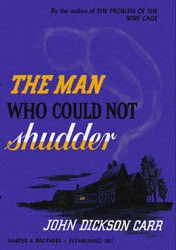
THE MAN WHO COULD NOT SHUDDER (1940):
The murder method in 'Shudder' is, as usual with Carr, cleverly clued; and there’s the bonus as well of a triple twist solution. — MYSTERY*FILE (6 June 2010)
Resources: BOOK - REVIEW.

THE CORPSE IN THE WAXWORKS (1932):
It’s an effective tale, and it offers a nice break in style from many of the Fell and Merrivale stories. — MYSTERY*FILE (9 June 2010)
Resource: BOOK.

THE PROBLEM OF THE GREEN CAPSULE (1939):
Carr often coupled this talent for murder with a Christie-level skill at misdirection, which makes him a truly major figure of the period even if one doesn't like all his stylistic quirks. — MYSTERY*FILE (22 June 2010)
Resources: BOOK - REVIEW.

HE WOULDN'T KILL PATIENCE (1944):
There is some fine slapstick humor at Merrivale’s expense in the beginning of the tale, and he is in good form throughout it. The zoo setting is nicely none, amusing and sinister by turns, and it is merged with the the current London Blitz very effectively. — MYSTERY*FILE (30 June 2010)
Resources: BOOK - REVIEW.

THE READER IS WARNED (1939):
. . . the exuberant narrative is all John Dickson Carr. 'The Reader Is Warned' is one of Carr’s most brilliantly constructed and engagingly told detective novels. — MYSTERY*FILE (20 July 2010)
Resources: BOOK - REVIEW.

Category: Detective fiction

Socialists and Shamuses

To psychoanalyze an individual seems unlikely enough, but to do that to an entire society ... ? This author—a socialist with an existentialist bent—seems undaunted by the task. In his article, which wobbles in all directions, he attempts to contextualize detective fiction into his overarching theme—still popular in academia—of Modern Man being in revolt against himself.

Here we excerpt only some of his thoughts—remarkably puritanical—on the detective story:
If, ironically enough, it is to an intellectual that we owe the first full presentation of the absurd, this is not so with violence.
The increasing emphasis on pure violence forms an integral part of the development of what we might call popular literature: the comics, the pulps, the detective stories, etc. The heavy-handed display of sexuality and violence in the comics today are a far cry from the innocent anti-social activities of the ‘ThimbleTheatre’, ‘The Captain and the Kids’, or ‘Krazy Kat’.
Similarly remarkable is the shift from the cerebral exercise of Sherlock Holmes to the perverted brutality of the modern murder mystery.
There are two essential elements in the modern detective story which relate it to the literature of extreme situations.
In the first place, the hero operates outside of the conventions of society. He is frequently a private detective, who, although formally dedicated to upholding law and order, can accomplish this only by violating certain of the laws of the society he is theoretically defending.
His capabilities and achievements are sharply contrasted with the unimaginative and unproductive blunderings of the orthodox guardians of the peace.
His activity is revolutionary in the sense that it ignores the legal framework of society. Like the political revolutionary, who justifies his destructive work by an appeal to the fundamental laws of society, he must violate the existing laws in the name of a higher good.
And both figures, who stand alone, thrown back entirely on their own individual resources, must expiate their anti-social acts by the periodic submission to violence.
The other essential element of the modern detective story is, precisely, this presentation of violence.
Violence is an integral part of the actions of those who, standing alone, violate custom in the name of some higher good.
Literary tradition utilizes violence primarily as a means: it is the inevitable companion of those who deal regularly with the naked forces of power; it is also the expiatory mechanism by which the hero recognizes the superiority of society.
But in the modern detective story a significant shift has occurred: violence becomes an end in itself.
The description of gratuitous violence, frequently accompanied by marked sexual over-tones, has become more and more important. Especially in films or in the comics has the visual display of this gratuitous violence become primary.
Aside from the subtle, perverted sexual gratification such scenes afford, the exercise of violence is a method by which the modern hero can purge himself of his guilty feelings of hatred against the stifling and hostile stupidity of the mediocrities who represent society, the crowd, the human race—all those ugly absurdities against which he is in revolt.
Our time is, however, not a revolutionary time; thus the heroes of popular literature must always ultimately submit to the recognized authorities—moral or legal. It is only in the works of those writers who are in conscious revolt against society that this violence is permitted to remain in its unregenerate purity. — Albert Votaw, "The Literature of Extreme Situations," HORIZON (September 1949)
Speaking of socialism and detective fiction, there is Dan Billany's THE OPERA HOUSE MURDERS (1940; U.S. title: IT TAKES A THIEF), published in the Golden Age but written by a man in conscious revolt against the society it represented:
Billany had been born into a strongly socialist working-class family in Hull, Yorkshire, in 1913, the very year that E. C. Bentley’s 'Trent’s Last Case' appeared, a work regarded as ushering in a ‘Golden Age’ of detective fiction that was to last until the Second World War.
Despite this coincidence, Billany, like others of his generation reaching adulthood in the ‘Pink’ decade of the 1930s, came to resent the typical Golden Age detective story’s ‘snobbery, nostalgia, and lack of social concern’. 
The outbreak of war did little to diminish the fervour of his politics, and particularly, as his later writings show, his strong sense of class consciousness. Vague hopes for a new world order may have informed the writings of certain poets, novelists and essayists, but for Billany the old class system was proving itself considerably resistant to the pressures of a so-called People’s War.
[In another novel, Billany] turns on the very genre which, to that point, represented his sole claim to literary fame. He singles out for attack Dorothy L. Sayers and her detective hero Lord Peter Wimsey as survivors of a literature where ‘Real Human Beings’ are ‘the gentle Writer and the gentle Reader’ for whom,
     ". . . from the windows of Rugby Chapel or Eton, from Oxford or from Park Lane, . . . the working-class, those droll, non-literary, non-ablutionary, non-intelligent, non-creative masses, made a pleasant background of racy, smelly, ludicrous movements for the activities of the normal non-working world."
In such a literature, says Billany, the working classes are a ‘sub-human species’ drawn with a ‘Few Bold Strokes’ into either ‘comic relief’ caricatures or ‘as examples of Humble Worth’. In the figure of Wimsey, Sayers perpetuates this attitude, and neither is spared Billany’s sarcasm and disgust:
     "How her Lord compromises within himself the delicate wit, the erudition, the calm, the intelligence and all the rest of the virtues natural to the non-working world! How skilfully and with how few words, he corrects the Common Persons he meets in the ’bus, train or street! How the vulgar, ‘flashy’, ‘horsey’, persons of the Lower Orders, the bobbies, the sergeants, the plumbers, the butchers and the bellringers become the hilarious laughing stocks of Lord Peter’s and Dorothy’s wit – that wit so subtle and so sensitive, so delicate and so adroit." — Paul Skrebels, "The Socialist and the Detective Story: The Case of Dan Billany’s THE OPERA HOUSE MURDERS" [PDF]

Category: Detective fiction

"The Red Badge of Carnage"

A dedicated, rationalistic, and antitheistic Englishman satirically scores some points against the status quo—especially 19th century imperialism—using the new field of detective fiction as a convenient starting point. Excerpts:
MR. JOHN M. ROBERTSON writes disapprovingly of "the sanguinary school of fiction" which he thinks is being much too sedulously cultivated by British writers. Now, instead of the "problem novel," it is the "murder novel" which appears as a menace to society.
And this literature of homicide, we are to understand, is a peculiarly British product. Even America stands exonerated, as Mr. [Henry] James and Mr. [William Dean] Howells obstinately pursue the presentment of mere character and its reactions.
But in England the psychological novel "feels the competition of the sarcological, and is moved to adopt modern methods," while the short story "wears the red badge of carnage in two cases out of three."
Mr. Robertson is gently ironical throughout the article. He observes that the taste appealed to by the sanguinary school is eminently virtuous . . . .
Robertson also strikes a note of mild condescension towards women mystery authors:
"To be sure, a difficulty might be raised about the possible effects of the murder novel upon the statistics of crime.
"If it be true that the penny dreadful, with its highwaymen heroes, propels untutored youth to burglary, it seems arguable that the constant reading of tales of honorable murder, written by gentlemen for gentlemen and ladies, might tend to encourage the practise in real life, where it must often seem so convenient, and where its propriety must often be perfectly clear, as tried by the generous standards of the sanguinary school, so notoriously scrupulous about morals.
"But thousands of estimable people will be ready to testify that such apprehensions are 'morbid' and 'sentimental'; so that we seem entitled to be of good cheer over our literary condition.
"At the close of the nineteenth century, unemasculated by peace and the Peace Society, unsophisticated by Socialism, untainted by utilitarian ethics and French models, our great reading public draws a Spartan moral stimulus from the healthy novel of homicide; and the weaker sex, too long a prey to mere psychology and the lore of the affections, has learned to share the masculine interest in the effective use of the knife and pistol, whether in public or in private quarrel." — Unsigned, "Homicide in Fiction," THE LITERARY DIGEST (April 1, 1899)
John M. Robertson, the political radical's political radical, has an entire Wikipedia article devoted to his career in politics and his anti-religious opinions.

As an example of women sharing "the masculine interest in the effective use of the knife and pistol," see, for instance, Allan Griffith's VINTAGE POP FICTIONS (July 7, 2012) review of TWELVE WOMEN DETECTIVE STORIES.

Category: Detective fiction

Sunday, December 1, 2013

A "Vaguely Incompetent" Hardboiled Eye

CELLINI SMITH: DETECTIVE.
By Robert Reeves.
Houghton Mifflin Co.
1943. $2.00

"Robert Reeves," Mike Grost tells us, "was a 'Black Mask' writer of the late 1930's and early 1940's era. He seems to have been a member of the Frank Gruber - Norbert Davis school of humorous private eye writers."
Furthermore:
'Cellini Smith: Detective' is a formal, puzzle plot detective novel, as the term would be understood by Ellery Queen or John Dickson Carr. Like many Golden Age detective writers, Reeves builds up his story out of a number of different mystery subplots. — Mike Grost, "Robert Reeves," A GUIDE TO CLASSIC MYSTERY AND DETECTION
Not only is it a detective story, it's also slightly off kilter:
[In 'No Love Lost' and 'Cellini Smith: Detective' Reeves's] humor predominates. Some evidence can be found to support Anthony Boucher’s comment that Cellini “is unique among hardboiled private eyes in being admittedly an intellectual—and tough enough to get away with it.” Cellini does read books on anthropology and does occasionally make a witty quip, but his methods of detection rarely exhibit any real thought or ingenuity. I tend to agree with Ron Goulart, who says that Cellini Smith is “vaguely incompetent” and that the Reeves novels are "fine examples of the screwball side of the hardboiled school." — John L. Apostolou, "The Short Career of Robert Reeves," BLACK MASK MAGAZINE
. . . by his third full-length adventure, 1943's 'Cellini Smith, Detective,' he's considering shucking his struggling P.I. biz altogether and just enlisting, until a gang of hoboes hire him for $26.94 to find out who murdered one of their colleagues. — Kevin Burton Smith, "Cellini Smith," THE THRILLING DETECTIVE
A contemporary review of CELLINI SMITH:
Several murders in and near California hobo camp give detective Smith personal injury and other tough moments. - Good tough hobo dialog. Plenty of excitement, a brash and likeable detective, and thrills by the gallon. - Verdict: Very good. — THE SATURDAY REVIEW (April 24, 1943)
Other Reeves P.I. novels:
DEAD AND DONE FOR (1939): "Tough stuff."
NO LOVE LOST (1941): "Lurid and lively yarn . . ."

Category: Detective fiction

Nize Kitty

THE LEOPARD MAN.
RKO.
1943. 66 minutes.
"You don't get the idea, mister. These cops banging those pans, flashing those lights, they're gonna scare that poor cat of mine. Cats are funny, mister. They don't want to hurt you, but if you scare them they go crazy. These cops, they don't know what they're doing."
Despite what everybody says about THE LEOPARD MAN, it's not really a horror film. Of course it looks and even sounds like one most of the time, and it's true producer Val Lewton specialized in horror films (e.g., 'Cat People', 'I Walked with a Zombie', etc.). Nevertheless, when you eliminate all the terror trappings, what's left isn't just a crime movie but an actual mystery film.
It's clear the intention was to ratchet up the suspense as much as possible—and then go beyond that. So it's surprising to realize that just about every moment of violence is off screen; lighting and sound effects do the job of suggesting the horrors we don't see.
"Mamacita, let me in! Let me in! Let me in! If you love me, let me in!"
When someone is attacked and murdered on one side of a door, we and another person on this side of it HEAR the violent scuffle but only SEE the victim's blood oozing under the door.

In a darkened cemetery dimly lit by a hazy moon, another victim is stalked by something unseen up in the trees. The camera focuses on the tree limbs as they creak downward and then spring up, with the attacker just out of visual range. All we hear is a muffled scream.
THE LEOPARD MAN has many moments like that. The source material was BLACK ALIBI, a 1942 novel by Cornell Woolrich.
Numerous books and stories by Cornell Woolrich have been adapted for other media, such as these films: 'Convicted' (1938), 'Street of Chance' (1942), 'Phantom Lady' (1944), 'The Mark of the Whistler' (1944), 'Deadline at Dawn' (1946), 'Black Angel' (1946), 'The Chase' (1946), 'Fall Guy' (1947), 'The Guilty' (1947), 'Fear in the Night' (1947), 'The Return of the Whistler' (1948), 'I Wouldn't Be in Your Shoes' (1948), 'Night Has a Thousand Eyes' (1948), 'The Window (1949), 'No Man of Her Own' (1950), 6 episodes of the 'Suspense' TV series (1949-50), 3 segments of 'Robert Montgomery Presents' (1950-51), 'Rear Window' (1954), 'Obsession' (1954), 'Nightmare' (1956); 3 installments each of 'Lux Video Theatre' (1954-57), 'The Ford Television Theatre' (1955-57), 'Alfred Hitchcock Presents' (1956-58), and 'Thriller' (1961); 'The Bride Wore Black' (1968), 'You'll Never See Me Again' (1973, TVM), even 'Mrs. Winterbourne' (1996)—and this list of media adaptations is hardly exhaustive.

Category: Detective fiction

There is Nothing Like a Dame

. . . especially this Dame. A short piece about honors bestowed on a fairly well-known mystery author. Excerpts:
As writers of whodunits go, none has broken more rules than has stout, aging (and tricky) Agatha Christie. In her more than fifty mysteries . . . Mrs. Christie has baffled her readers in some startling ways. In at least one of her novels her policeman himself turns out to be the murderer. So, in other novels, does one or another of her comic characters (though purist whodunit writers bring in such characters only for comic relief). And, at the end of one history-making whodunit, Mrs. Christie's fictional first-person narrator reveals that he himself is the culprit.
Such slick tricks have brought lustre to the name of Agatha Christie, and last week, as two of her mysteries were running simultaneously as plays in London (and one other was running on Broadway and in Paris), new lustre was added to her name. — John Haverstick, "Author of the Week," THE SATURDAY REVIEW (February 4, 1956).

Category: Detective fiction