From Jasper Fforde's THE BIG OVER EASY, a detective story using nursery rhyme characters:
"The entire crime-fighting fraternity yesterday bade a tearful farewell to the last 'locked room' mystery at a large banquet held in its honor. The much-loved conceptual chestnut of mystery fiction for over a century had been unwell for many years and was finally discovered dead at 3:15 A.M. last Tuesday."
Then it turns out that the locked room mystery was murdered . . . in a locked room. — Source: TV TROPES ("Locked Room Mystery"). [Watch out for SPOILERS on this site.]
Category: Detective fiction
Needles in haystacks are easier to locate than these four novels (MURDER AT MONK'S BARN, THE FIGURE OF EIGHT, THE END OF THE CHASE, and THE PRIME MINISTER'S PENCIL):
John Street – former intelligence officer, practitioner of politico-military propaganda and well known to readers of crime and detective stories as ‘John Rhode’ and ‘Miles Burton’ – was “not an easy man to know – his reticences were such that all who met him could not fail to respect them, but to those who were privileged to enjoy his friendship he leaves memories of kindnesses and sensitive understanding that might surprise many of his readers.”
Something that came as a surprise for almost all of Street’s many readers when this article first appeared is that he also wrote mysteries under another, previously unsuspected pseudonym. A pseudonym that, like ‘John Rhode,’ plays on his real name. John Street was also ‘Cecil Waye’, author of a series of four novels published in the early 1930s.
. . . Why did John Street decide that [these books] should appear under a further pseudonym, distancing them from the bulk of his detective fiction? The four books are broadly similar in style to the mysteries of ‘John Rhode’ and ‘Miles Burton’, and, with one significant exception, their plots do not contain any excessively implausible elements. It is of course impossible to know Street’s reasons but some points do seem worth noting . . . . — Tony Medawar, "A 'Rhode' by Any Other Name," MYSTERY*FILE
Only two Waye titles managed to jump The Pond to America, receiving lukewarm receptions upon their arrival:
THE FIGURE OF EIGHT (1931):
Murderous Central-American conspirators in London run afoul of "Yard" and clever private investigator. - Mysterious aboriginal poisons with pat antidotes give your judge pain in neck. Outside that a swift and engaging yarn. - Verdict: Fair. — THE SATURDAY REVIEW (April 22, 1933)
THE PRIME MINISTER'S PENCIL (1933):
Secretary of a prominent public figure in England found dead. This is eclipsed by violent death of the Prime Minister in his room at the House of Commons. Christopher Perrin, private investigator, follows his own hunch. - Good local color; Perrin and his friend Philpott of Scotland Yard well characterized. Mystery suffers because title of story gives too direct a clue. But excellently written. - Verdict: Readable. — THE SATURDAY REVIEW (September 2, 1933)
If you happen to come across any novels by "Cecil Waye," don't let them get away. As Medawar explains, "[They] were published in the early 1930s and, like other books of that period, are extremely elusive" — which is something of an understatement.
For more information about Cecil John Charles Street, see the Wikipedia article.
Category: Detective fiction
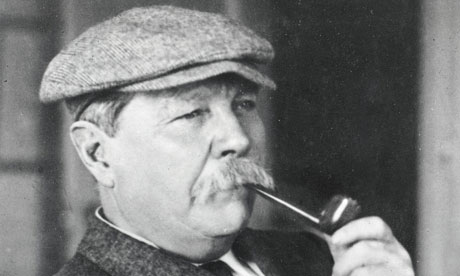
Conan Doyle was the master of the short mystery story—until Agatha Christie came along:
PARTNERS IN CRIME (1929) [BOOK - DVD]:
By no means as good Agatha Christie's detective story as we have a right to expect from Mrs. Christie, although it ['Partners in Crime'] is amusing and contains much good burlesque of modern sleuth yarns. A young couple, Tommy and Tuppence, take over a detective agency, and the record of their cases, in which they attempt imitations of various detectives of fiction, is funny, but only occasionally—very occasionally—grips you with the weird, mysterious grip which is the sine qua non of such a tale. — Walter R. Brooks, "The Week's Reading," THE OUTLOOK (September 11, 1929; Jump To page 70)
All of the stories in 'Partners in Crime' are explicitly comic and are crosses between the humorous tale and the mystery story. Actually, most of Christie’s works have large elements of comedy in them. Her books are extremely funny, and often gentle spoofs of their characters and their social milieu. — Michael Grost, MYSTERY*FILE
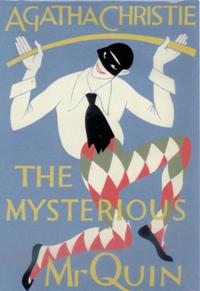
THE MYSTERIOUS MR. QUIN (1930) [BOOK]:
The short stories that make up the collection entitled "The Mysterious Mr. Quin," by Agatha Christie (Dodd, Mead) are not detective stories in the usual accepted sense. While they do contain mystery and crime, they are primarily studies in deduction.
Mrs. Christie possesses the rare faculty of making something interesting out of almost nothing. Many of these stories of crime, love, and adventure are slight in regard to plot, but the deductions are so cleverly handled that the actual events do not matter very much.
Two characters, Mr. Satterwaite [sic], an amusing old bachelor, and Mr. Harley Quin appear in each of the stories—Mr. Harley Quin playing Sherlock Holmes to Mr. Satterwaite's [sic] Watson.
Who Mr. Quin really is—a human being or symbolical character—remains a mystery to the end of the book. You can draw your own conclusions and you probably will be right. The hook will give you many problems to solve and a chuckle over Mrs. Christie's entertaining and subtle humor. — Robert Innes Center, THE SATURDAY REVIEW (May 24, 1930)
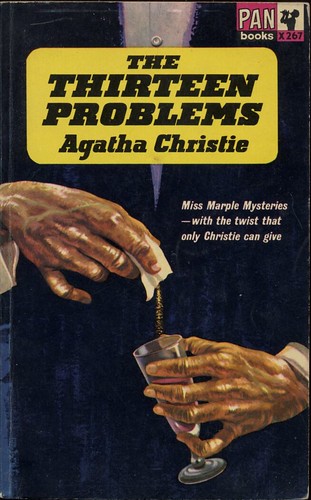
THE THIRTEEN PROBLEMS (1932) [a.k.a. THE TUESDAY CLUB MURDERS] [BOOK]:
Various and sundry—mostly murders; all parts of England; Miss Marple. - Feminine rival to Father Brown placidly knits and cleverly untangles stiff crime-twisters put to her by house-party guests. (Short stories.) - Verdict: Fine. — THE SATURDAY REVIEW (April 8, 1933)
MR. PARKER PYNE, DETECTIVE (1933) [a.k.a. PARKER PYNE INVESTIGATES] [BOOK]:
After the first burst of stories though, the tales become more familiar. Jewels are stolen, children are kidnapped, people are murdered. It was almost as if Christie had run out of fresh idea for the character before she ran out of required words for the collection. . . . So we’re left with almost two collections, the first light-hearted and adventurous and the second more traditional class mystery tales. That’s not to say that any of the stories are weak, but they are not her best either. — Jeffrey Marks, THE CORPSE STEPS OUT (April 6, 2012)
Mr. Parker Pyne, happiness-consultant, straightens out marital upsets in London, solves a few murders on trip to Near East. - Unusual character of central figure pulls together loose collection of stories designed to keep Christie pot simmering. - Verdict: Readable. — THE SATURDAY REVIEW (June 23, 1934)
Parker Pyne's two appearances on film: HERE and HERE, DVD HERE.
Category: Detective fiction
ENGLISH FICTION FROM THE FIFTH TO THE TWENTIETH CENTURY.
By Carl Holliday.
The Century Co.
1912.
Chapter VIII: Pages 388-389.
Conan Doyle was very much alive while others were already commending him to posterity:
In inventive power and ingenuity few men of the nineteenth or twentieth century have excelled Sir Arthur Conan Doyle, author of the famous Sherlock Holmes stories. It is reported that Doyle is sometimes chagrined that he should be more noted for these detective tales than for his more deep and serious productions, such as 'A Study in Scarlet', 'The Sign of the Four', 'The White Company', and 'The Great Shadow'; but it is nevertheless probable that his most lasting fame will be based on those tales of intrigue and shrewd scheming, 'The Adventures of Sherlock Holmes', 'The Memoirs of Sherlock Holmes', and 'The Return of Sherlock Holmes'. In spite of the doctor-novelist's efforts to kill off the astute detective, the people will not let the hero die, but call again and again for his return.
Doyle, like Dumas, owes much to Poe in this business of making and solving riddles. There may not be any great amount of the philosophy of life in such efforts; the author may not have opportunities to show a varied delineation of characters; but that supreme skill and great technical art may be displayed in such work has been proved by both Poe and Doyle. And it should be remembered that this continued study of one hero may result in a character of permanent literary value. Sherlock Holmes is to-day as living a personality to hundreds of thousands of readers as Pickwick or Becky Sharp. Moreover, this vivid relating of but one episode at a time in the character's life makes the narrative a perfect specimen of the short story, a type that differentiates itself rather strictly from the novel, not by its shortness, but by the fact that it reviews only one of the critical moments in a life. Conan Doyle in his conciseness, his vividness, his logical, closely woven plots, his use of the mysterious, his ingenious solutions, and his knowledge of what to leave out, will probably long be considered a master of the short-story form.

Category: Detective fiction
"I wondered if that infernal ear, with its electric-charged wires leading to some man in another part of the building, could hear my heart beat."
It might make you feel better to know that electronic eavesdropping isn't a new concern; our ancestors from a hundred years ago were a bit excited about it, too. Excerpts from a magazine article:
THE PRACTICAL POSSIBILITIES of the dictograph have become pretty well known since William J. Burns used it in his detective work. It is positively unsafe for anybody to say anything anywhere now unless he is perfectly willing to have a stenographer take it down.
No dictograph evidence has yet appeared in suits for damages for broken hearts, but it may be well for proposing swains to first have a look around to see if the little tell-tale machine is under the sofa.
Your conversation with your banker or your lawyer, your dicker for a horse or a cow with your neighbor—all must be couched in diplomatic language, for an unseen interviewer may be taking down your every word. — "Scientific Eavesdropping," THE LITERARY DIGEST (June 15, 1912)
Thanks to "the ear," there was a small revolution in detective work:
"In walls, under sofa and chair, in chandelier, behind a desk, beside a window, it has hidden—the unseen listener to secret conversations.
"The secrets of prison cells have been tapped, hotel rooms and offices have given up incriminating conversation.
"To representatives of the law it has proclaimed loudly the whispered words of cunning malefactors. It has figured sensationally in the undoing of dynamiters, legislative bribetakers, grafters high and crooks low, across the continent." — "Scientific Eavesdropping", op. cit.
William Burns was a well-known real-life detective in his day:
"Let us dwell momentarily now upon the 'detective dictograph.' Last year, William J. Burns was regarded as the flesh-and-blood unification of Sherlock Holmes and M. Lecoq, with an Arsene Lupin daredeviltry. That was before it became known that he used the dictograph.
"This with all respect to Burns's acumen as a detective, for he knew enough to make use of the latest that science had devised for catching criminals. Burns was the first American to see the immense possibilties of the instrument in detective work.
"He is so enamored with it that he always carries one in his pocket. Fictional detectives carry automatics and handcuffs. Burns carries a dictograph." — "Scientific Eavesdropping", op. cit.
Even crooked politicians couldn't hide from "the ear":
"Last summer the ear overheard the legislative grafters at Columbus, Ohio. The incident disgusted these higher crooks exceedingly. Not so the honest population of the city. They held a dictograph celebration. To-day, you can buy dictograph cocktails at Columbus. What better proof of its popularity could be given?" — "Scientific Eavesdropping", op. cit.
Technology is morally neutral; it's how it is used—or abused—that should matter.
Category: Detective fiction
THE BANDBOX.
By Louis Joseph Vance (1879-1933).
Little, Brown & Co.
1912. $1.25
Vance is most famous for his Lone Wolf series.
Three critics of the day seemed to like this one. Complete reviews follow:
Double-dyed mysteries, one after another, one mystery dovetailing into the other like a Chinese puzzle until the reader is tempted to skip whole pages, knowing that by doing so he may get a clue, even though he is sure to miss a few extra mysteries, for there is one on every page—that is the sort of impression 'The Bandbox', by Mr. Louis Joseph Vance, may leave upon the conscientious reader.
For those who love mystery Mr. Vance's book will be a delight from first to last.
A bandbox may seem a commonplace thing, but when there are two of them and one contains a diamond necklace, and when the box with the necklace is always getting mixed up with the box without one, when they are shipped over seas with detectives and thieves by the dozen trailing after them, and when murder and sudden death occur wherever one or both those bandboxes turn up, it will be seen that they are more interesting than the most wonderful Paris bonnet could make them.
Naturally there is a love theme involved, and the beautiful Alison Landis, who owned one of the bandboxes, had some sentiment in her. But what the reader gets is not romance, it is mystery. There is no time for much else. — Philip G. Hubert, Jr., "A Budget of Novels," THE BOOKMAN (May 1912; scroll to page 319)
True to his traditional habit, Mr. Vance has given us another alliterative title. All the same the tale bristles with breathless adventure, mistaken identities, detective investigations, and startling situations.
The scenes are laid in London, New York, and the ocean liner plying between those two ports.
It is a rousing story, told with a stimulating style and culminating in love rewarded, but, before that happy end is reached, there are many thrilling revelations.
Twin bandboxes, twin heroes—one of them a villain of the deepest dye—a designing actress, and a sweet and lovable young lady—all act at cross-purposes and involve themselves in a network of suspicious circumstances, entertaining if not edifying. — Unsigned, THE LITERARY DIGEST (May 4, 1912; Jump To page 951)
Ordinarily a band-box is not an inspiring object; but when it is French and florid, and contains a hat which in turn conceals an unsuspected pearl necklace belonging to a beautiful smuggler-actress, our interest quickens. That is the kind of box Louis Joseph Vance tells about in "The Band-Box".
From Paris to London, thence to New York, goes the band-box, accompanied and pursued by a heterogeneous and hasty group of people—a playwright who is engaged to the smuggler-actress, another actress, a thief and his double (who fortunately is honest), maids, chauffeurs, and ordinary society women.
The band-box leads them a merry chase, and there isn't a moment to spare anywhere in the book. It's the sort of book one saves for a trip from Boston to New York—to shorten the journey by about two hours. — Unsigned, McCLURE'S MAGAZINE (June 1912; scroll to page 240)
THE BANDBOX is available in several places on the Internet, including HERE and HERE.
Category: Detective fiction