Sunday, December 8, 2013

Mark Twain's Anti-detective Fiction

Twain's generalized dissatisfaction with society leaked through his detective stories:
In all of his writing, Mark Twain uses various techniques and genres to expose social corruption. One of the genres he uses is the detective story. Twain burlesques the classical detective character and the classical detective story elements to show that detectives are not really heroes; they are members of a corrupt society who create chaos instead of order. Twain believed that the ideal detective who symbolized truth, solved crimes, and established justice, was good.
But through his observations and experiences Twain came to believe that this ideal character did not exist. Instead, he saw corrupt, inept detectives, like Allan Pinkerton and his agency men whose attempts to solve crimes were mere dramatic escapades. Twain blatantly ridicules Pinkerton-type detectives in his burlesques, "Cap'n Simon Wheeler, Amateur Detective, A Light Tragedy," 'Simon Wheeler, Detective', and "The Stolen White Elephant."
Though these burlesques seem to be exaggerated, they are based on fact. According to Twain, the tragedy about such detectives is that they are heroes in the public eye, and corrupt heroes represent a corrupt society.
One of the reasons why Twain believed the society to be corrupt was because of the abuse of science in the nineteenth century. Though Twain initially admired scientific reason and common sense, he saw men becoming more like machines than human beings. In his novel, 'Pudd'nhead Wilson', Twain shows how inept scientific detectives are at salvaging humanity. Pudd'nhead Wilson uses the scientific method of fingerprinting to uncover a murder, but his victory does not touch the underlying corruption of the town.
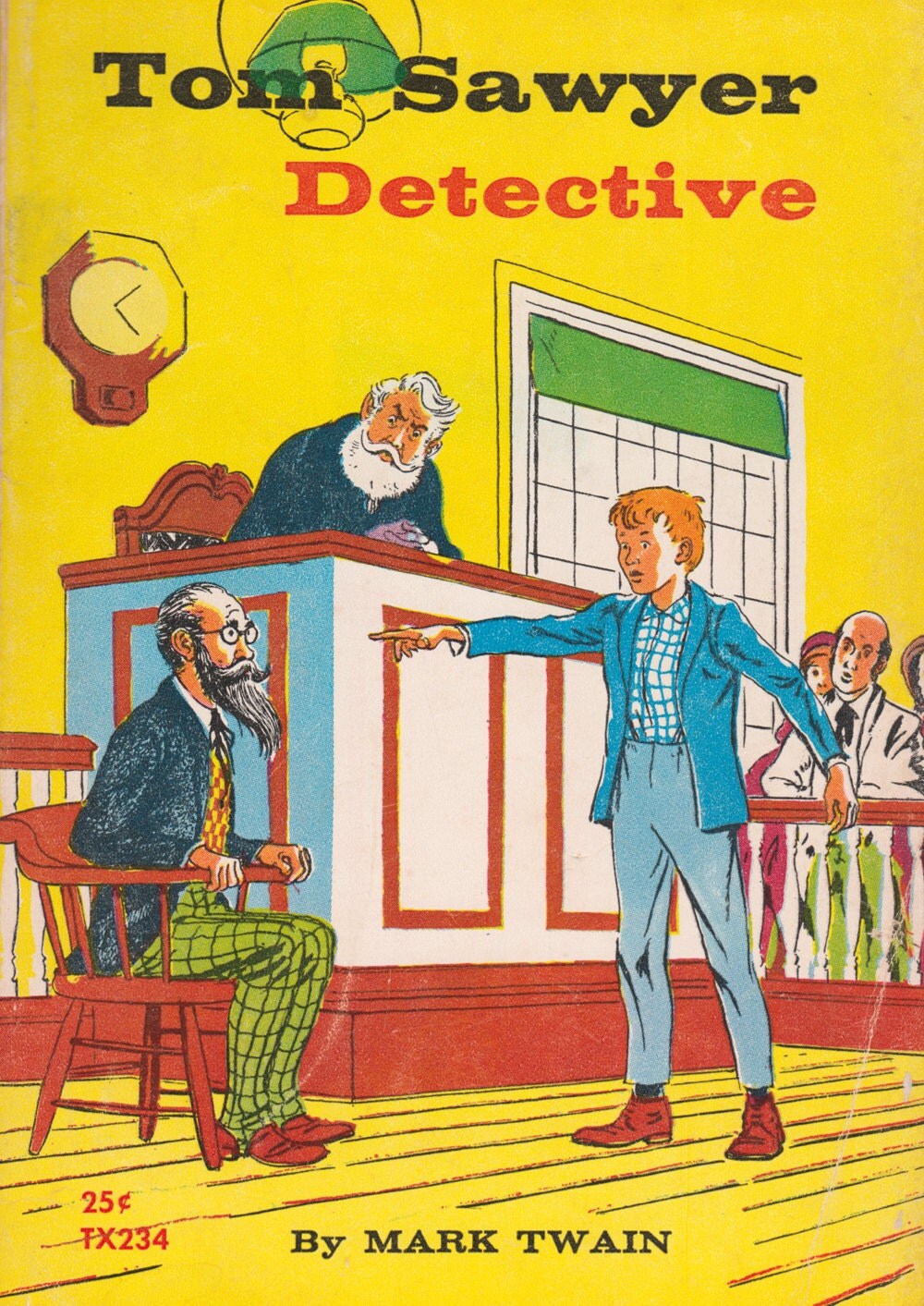
Twain thought that the ideal detective could only exist in fiction. In 'Tom Sawyer, Detective' Twain creates a boy detective hero in Tom Sawyer whose success depends mainly on coincidence and luck. This undermines the principle on which detective stories are based: that the crime must be solved by the analytical deductive reasoning powers of the detective.
In his burlesque of the fictional Sherlock Holmes in "A Double Barreled Detective Story," Twain shows the unreality of detective fiction amidst society's moral corruption.
Throughout these works Twain shows that the perfect four part form of the detective story is as unreal as the detective character. Conventionally, all detective stories begin with a crime, then the detective or Watson-figure presents the evidence, then the detective solves the crime, and finally the detective gives a conclusion or synopsis of his analytical reasoning. Twain generally follows the first three parts but in the process the works often become confused and ridiculous.
In all of his detective stories, Twain gives the conclusion rather than having his fictional detective character do so. In the conclusions Twain exposes a social system so corrupt that more than detectives are needed to uncover the problems and restore justice and order to the society. By presenting the problems, Twain acts as a social reformer who makes the public aware of the necessity of change. — Donna Mary Andrews, "Mark Twain, Detective Story Writer," Master's Thesis (1981)
For Twain, the detective is simply the useless appendage of a clueless society:
Much of Twain's detective fiction consists of conscious, and perhaps overwrought, parody or burlesque of the genre.
"What a curious thing a 'detective' story is," Twain confessed in 1896. "And was there ever one that the author needn't be ashamed of, except [Poe's] 'Murders in the Rue Morgue'?"
Twain's spoof of English detective fiction in particular mirrors his more general dismissal of European manners, artifacts, and culture.
[All of Twain's detective stories] parody the formula writing characteristic of the genre and in doing so satirize the sentimentality and romantic expectations of readers of detective fiction generally. Burlesque is the prevalent mode of these farcical pieces that expose the absurdity of detectives and their methods . . . . — LeMaster, et al., THE MARK TWAIN ENCYCLOPEDIA (pages 213-214).
Resources:
- TOM SAWYER, DETECTIVE [Text here]
- THE TRAGEDY OF PUDD'NHEAD WILSON [Text here]
- A DOUBLE-BARRELLED DETECTIVE STORY [Text here]
- THE STOLEN WHITE ELEPHANT [Text here]
- THE FACTS CONCERNING THE RECENT CARNIVAL OF CRIME IN CONNECTICUT [Text here]
SIMON WHEELER, DETECTIVE [Text here].
Skeptical of detectives, real life and otherwise.

Category: Detective fiction

Love and Murder

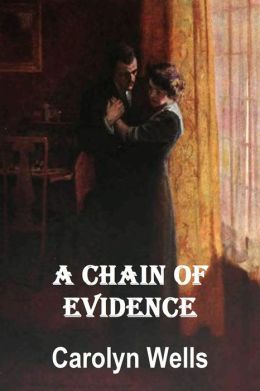
A CHAIN OF EVIDENCE.
By Carolyn Wells.
J. B. Lippincott.
1912. 324 pages. $1.25

Early reviewers were inclined to cut Carolyn some slack:
A detective story mixt with romance of the "love-at-first-sight" variety makes this story peculiarly interesting to those who enjoy the solution of mysteries, and the pursuit of murderers.
When old Robert Pembroke was found dead in bed, the physician soon found that there were suspicious circumstances which must be investigated and the young lawyer across the hall—already attracted by the beauty of old Pembroke's niece—volunteers his services when he realizes that circumstances involve her in suspicion.
The door being securely fastened, and windows locked, make the problem a very serious one, but Otis Landon, our lover-lawyer, finally calls in Fleming Stone of Sherlockian perspicacity, and he tracks the villain and exonerates the fair heroine. — THE LITERARY DIGEST (July 20, 1912) [Text is online HERE and HERE.]
Another opinion:
'A Chain of Evidence' (1907, 1912) seems to be Wells' first impossible crime. It depends on a simple gimmick, and is a poor novel. Its mystery involves an outsider penetrating a locked apartment. It also has a simple alibi puzzle. There is perhaps some historical interest, in reading about what a New York City apartment was like at this early date. — Mike Grost, "Carolyn Wells," A GUIDE TO CLASSIC MYSTERY AND DETECTION
. . . but she did occasionally do better.

Category: Detective fiction
AC and the Short Form — Part 2

Detective fiction as we know and love it began in short stories, and Agatha Christie continued the tradition.

THE REGATTA MYSTERY (1939):
Brief cases presented to Hercule Poirot and Parker Pyne range from murder mysteries and jewel thefts to smoothing course of young love. - Alternation of detectives gives variety to pleasant but not too ingenious or carefully written Christie by-products. - Verdict: Pretty good. — THE SATURDAY REVIEW (June 24, 1939)
TRIPLE THREAT (1943):
Short story collection featuring Poirot, Harley Quin and "Tuppence." - Excellent omnibus, recommended to those who like their detective fiction short and eventful. The Quin stories are especially worth re-reading. - Verdict: Bedside book de luxe. — THE SATURDAY REVIEW (July 17, 1943)
THE LABO[U]RS OF HERCULES (1947):
H. Poirot solves dozen distinctive cases named for exploits of mythological homonym. Crimes are set against English and Continental backgrounds. - Characteristic Poirot puzzlers. Classical tie-ins sometimes far-fetched—and collection notable for dullest single Poirot tale ever published anywhere, anytime. - Verdict: Satisfactory shorts. — THE SATURDAY REVIEW (July 19, 1947) [See also the GAD Wiki here.]
THE WITNESS FOR THE PROSECUTION (1948):
Eleven short stories, some recent, some rather elderly, most of them dealing with psychic side of murder and other crimes. - Needful addition to library shelf of "Agatha Christie's published volumes." Magazine and anthology readers may find several familiar faces. - Verdict: Standard collection. — THE SATURDAY REVIEW (September 18, 1948) [The full text of the play WITNESS FOR THE PROSECUTION (1954) is online here.]

THREE BLIND MICE (1950):
Eight short stories and one long one about Christiean fixed stars Poirot and Marple and too infrequently recurring comet Harley Quin. - Long story (only one introducing "new" sleuth) least effective of well-up-to-standard lot, all clever and lustrously polished. - Verdict: Standard brand. — THE SATURDAY REVIEW (April 8, 1950)

Part 1 is here.

Category: Detective fiction

Saturday, December 7, 2013

Anthony Wynne — "One of the Lesser Golden Age Writers"

Lesser he may have been, but more than half of Wynne's stories involved impossible crimes.

MURDER OF A LADY (1931) [a.k.a. THE SILVER SCALE MYSTERY]:
Anthony Wynne's detective novels have been out  of print for sixty years, but some retain interest today. Along with John Dickson Carr, Wynne was one of the most prominent Golden Age practitioners of the locked room mystery. Unfortunately, his novels often tend to be overly melodramatic, thinly characterized and humorless, no doubt in part explaining their obscurity today. — Curt Evans, MYSTERY*FILE (22 September 2010) [Go here for another review.]
THE CASE OF THE GOLD COINS (1933):
In this case Hailey's assistance is solicited by Captain Jack Ainger of the CID to investigate the strange death of Lord Wallace in a remote section of Northumberland. Wallace's body was found in the middle of a wide expanse of beach near his home, badly battered and bruised, with a knife driven into his back. The location of the wound and bloodstains found under the corpse prove that he died on the spot. Yet there are no footprints in the sand for many yards in any direction and no way either the murderer or the sea could have erased any. — Bill Pronzini, MYSTERY*FILE (22 September 2010)
Two murders and a treasure hoard on Barren Island keep Dr. Hailey busy by land and sea. - For action, detection, plot, and background this equals Dr. Hailey's best exploits. - Verdict: Top-hole. — THE SATURDAY REVIEW (January 20, 1934)
And don't miss Wynne's "interview" with his character:
This is Dr. Hailey's philosophy of crime. He never blames the criminal so whole-heartedly as to be unable to see and feel his tragedy. But neither does he give support to those sentimentalists who demand the relaxation of all social laws, in order that temptation to crime may nowhere exist. — Anthony Wynne, "Meet Dr. Eustace Hailey," CLASSIC CRIME FICTION
Category: Detective fiction

"Rather Dangerous in Their Suggestion"

Should the villain ever be allowed to escape justice? Several years ago James Lincoln Warren gave it some thought:
Don’t stories that feature criminals as heroes romanticize the worst in human behavior? Disregarding the “gentlemanly” part, much of contemporary crime fiction regularly features ruthless assassins and psychotic serial killers as protagonists. Is that really want we want?
 . . . In every other story I’ve written that I can think of, Justice Is (Completely) Served. I like it better that way. After all, if one is going to bother to write a story about morality (and what else is crime fiction?), then there ought to be some sort of moral in it.
Some of today's crime writers, says Warren, have grown lazy in plotting their stories:
. . . it’s easier to plan and execute a crime than it is to solve one. Accordingly, it’s easier to write about committing a crime than about solving one. Committing a crime may require resolve, but bringing one to justice requires wit or character or both. That’s what makes ratiocinative fair-play mysteries so much fun to read. — James Lincoln Warren, "And the Crooked Shall Be Made Straight," CRIMINAL BRIEF (September 20, 2010)

Category: Detective fiction

First We Kill All the Lawyers

SKIN O' MY TOOTH: HIS MEMOIRS, BY HIS CONFIDENTIAL CLERK. 
By Baroness Orczy.
Doubleday, Doran.
1928. $2.00
Collection: 12 stories.
It looks as if unscrupulous lawyers were irresistibly attractive to Golden Age writers.

Here is a contemporary assessment (THE SATURDAY REVIEW, December 22, 1928):
In a dozen short stories, Alexander Stanislaus Mullins, confidential clerk to Patrick Mulligan, the lawyer-detective whose nickname gives the book its title, tells how his master saved a dozen clients who were unjustly accused of a couple of dozen crimes.
There is not much that is either novel or exciting in the walls of apparently irrefragable evidence reared around these suspects, nor in the manner in which Skin o' my Tooth topples them over.
From Wikipedia ("Skin o' My Tooth"):
[The central character] Mulligan is an ugly, portly, but particularly sharp Irish lawyer who goes to great lengths (even unscrupulous ones) to get his clients off. Usually this involves him solving the crimes himself. The nickname comes from one client who described Mulligan freeing him "by the skin o' my tooth."
Contents:

"The Murder in Saltashe Woods"
"The Case of the Sicilian Prince"
"The Duffield Peerage Case"
"The Kazan Pearls"
"The Case of Major Gibson"
"The Inverted Five"
"The Turquoise Stud"
"Overwhelming Evidence"
"The Case of Mrs. Norris"
"The Murton-Braby Murder"
"A Shot in the Night"
"The Hungarian Landowner"

The text is available at PROJECT GUTENBERG, AUSTRALIA.

The creator of the Scarlet Pimpernel originated other characters as well:
Orczy was an early pioneer of the detective story, with no fewer than three series characters: The Old Man in the Corner, an armchair detective who unravels mysteries, along with knotted pieces of string, in the Lyons corner tea-shop for a young woman journalist, and who reappears in 'Unravelled Knots'; Skin O' My Tooth, the nickname given to an elderly and unconventional lawyer; and Lady Molly of Scotland Yard. — The GAD Wiki ("Orczy, Baroness Emmuska")
A few other reviews of Orczy's non-Pimpernels:
THE CASE OF MISS ELLIOTT (1905): "The stories contained in a volume by Baroness Orczy, entitled 'The Case of Miss Eliot' (6 s.), will certainly appeal to all lovers of mysteries, though for ordinary readers they may prove rather too gruesome. Some of the 'cases' are cleverly presented and well worked out." — THE BOOKMAN (U.K.) (November 1905; scroll to page 94) [See also WIKIPEDIA]
LADY MOLLY OF SCOTLAND YARD (1910): "The female Sherlock Holmes was bound to arrive in fiction, and it was as inevitable that she should have her subordinate, Mary Granard, who plays the role of Watson. Lady Molly, however, works in connection with Scotland Yard, and she has neither chemistry nor the violin as recreations. The twelve stories in which her feminine wit is described are of the ordinary detective class, put together with the authoress's well-known skill. In the last of them, Lady Molly succeeds in clearing her husband of suspicion on a charge of murder, and this enables her to retire from detective work. It also enables Miss Granard to explain how her dear lady managed to keep her position in society and at the same time to practise her profession. People who like the brandy of criminology can have twelve sips in this book. The authoress knows how to blend and serve up her stuff, and probably her large public will be curious to see how she contrives to excite them in this new role. Probably, also, they will persuade her that Lady Molly's marriage need not interrupt finally her career as a feminine detective." — THE BOOKMAN (U.K.) (October 1910)
All of these and more are covered by Mike Grost ("Baroness Orczy") on his mega-site. Did you know, for example, that she helped pioneer the "armchair detective" story? With that in mind, enjoy this Old Man in the Corner story, "The Regent's Park Murder."

Category: Detective fiction

A Shout-Out

A big thank you is due to everyone who has visited the ONTOS site. Your presence is most welcome.

Notes for the curious: Our audience for the month of November 7 to December 6, 2013 ran as follows:

- United States: 789
- Malaysia: 318
- United Kingdom: 114
- Australia: 63
- Spain: 56
- Canada: 40
- Germany: 32
- Netherlands: 27
- Italy: 22
- Taiwan: 19

That Malaysian figure came as an unexpected yet pleasant surprise. We hope all of you, regardless of where you live, will continue to visit ONTOS often.