HE ARRIVED AT DUSK.
By R. C. Ashby.
Macmillan.
1933. $2.00
Available on Kindle.
R. C. Ashby was really Rubie Constance Ashby:
Murderous ghost of Roman legionary terrorizes Northumberland village and baffles Scotland Yard skeptics. - Well nigh perfect admixture of eerie horror, romance, and good detecting. The writing is excellent and the scenery grand. - Verdict: A 1. — THE SATURDAY REVIEW (July 1, 1933)
Truly a little masterpiece of a book. Reminiscent of Christie at the height of her powers in its brilliant use of misdirection . . . . Really a classic of its kind. One of the best blending of supernatural and detective novel genres written in the 1930s. — J. F. Norris, MYSTERY*FILE (27 November 2010)
A minor masterpiece in the subgenre of the supernatural detective novel it tells the story of an ancient Roman soldier who haunts a Welsh manor and a wicked murderer who exploits the legend for his own personal gain. Ashby's use of multiple narrators and a brilliant use of misdirection and misinterpre-tation is something to be admired for such an early work. — J. F. Norris, The GAD Wiki
Ashby also wrote OUT WENT THE TAPER (1934):
Not as good as 'He Arrived at Dusk', because, although it’s another ghost story (haunted house in Wales, with a splendidly nightmarish journey through underground passages festooned with cobwebs), it’s basically an adventure story, with gangsters. — Nick Fuller, The GAD Wiki
Triple murder, haunted ruin, ditto house, believable ghost, and inquiring young Rhodes scholar in eerie Welsh hills. - Warranted to freeze most torrid vertebrae on hottest night (by author of "It Walks by Night," q.v.) - Verdict: Br-r-r! — THE SATURDAY REVIEW (July 21, 1934)
A tremendously good ghost story, with a background of eerie Welsh hills, a ruined monastery with a sinister history, a young American hero, a wholesome English heroine, three satisfactorily vicious villains, some shuddery "psychic" passages and no end of spine-tickling situations. And all done in literate, smoothly flowing prose. Not to be missed. — SCRIBNER'S (August 1934)
Category: Detective fiction
THE SECOND SHOT.
By Anthony Berkeley.
Crime Club.
1930. $1.00
Available on Kindle.
From THE SATURDAY REVIEW ("Murder Will Out" by William C. Weber, July 18, 1931):
What at this writing is the latest of the dollar Crime Club books is also one of the best. It is "The Second Shot," by Anthony Berkeley. The officiating detective is Roger Sheringham, who likes his beer and an unusual method of discovering criminals.
The story is told by Cyril Pinkerton, also known as "Tapers," a very nice young man who, for his timidity, was chosen to be the murderer of Eric Scott-Davies in a faked crime. But something goes wrong. Instead of a fake corpse there is a very dead one.
Sheringham comes on the scene, consumes copious libations, and finally solves the crime. And then in the last chapter you get the surprise of your life.
From Martin Edwards's DO YOU WRITE UNDER YOUR OWN NAME? (12 November 2010):
True, it is really a tricksy whodunit, and the psychological forays are relatively shallow. And the setting, in an English country house (there is a map of the scene on the endpapers) is very much in the classic tradition.
Yet it is a clever piece of work, with Roger Sheringham proving even more fallible than ever in his role of interfering amateur sleuth.
From "Anthony Berkeley" (Martin Edwards):
. . . in 'The Second Shot' (1930), when Sheringham demonstrates, through apparently irrefutable logic, that one particular suspect must have committed the crime and those concerned then agree to shield her. There follows, however, a typically cunning Berkeley twist, with an epilogue in which the real villain of the piece, whom Sheringham has failed to identify, explains why he committed the crime.
Category: Detective fiction
A THREE-PIPE PROBLEM.
By Julian Symons.
Collins Crime Club.
1975.
Now available on Kindle.
Before Cumberbatch and even before Brett, there was Sheridan Haynes:
[TV actor Sheridan] Haynes, in his role of Holmes, becomes gradually more involved in a case known as the Karate Killings, to the consternation of all. He states that Sherlock Holmes could have solved the case, then sets out to do it with the help of a Watson, and some Baker Street Irregulars (actually Traffic Wardens).
Sher Haynes is a sympathetic character and the book, if improbable, is a lot of fun and very well done. Sherlockians should enjoy it. — Jeff Myerson, MYSTERY*FILE (9 November 2010)
However:
This isn't very successful. Symons didn't believe in Great Detectives, and so, although he solves the mystery, it's more by inept bumbling than by reason, and there's none of the grandeur or vitality of Conan Doyle's splendid melodramas. Instead, 1970s London is drab and sordid, full of gangsters, actors, and motor-cars. — Nick Fuller, The GAD Wiki [Note: SPOILERS.]
Category: Detective fiction
As we've seen previously, critics seldom had strong objections to Bailey's novels, but what about his short stories? Click on the links for more info:
MR. FORTUNE WONDERS (1933):
-"Very good." — THE SATURDAY REVIEW (December 9, 1933)
MR. FORTUNE OBJECTS (1935):
- "Read it." — THE SATURDAY REVIEW (April 20, 1935)
A CLUE FOR MR. FORTUNE (1936):
- "Gratifyin'." — THE SATURDAY REVIEW (October 3, 1936)
THIS IS MR. FORTUNE (1938):
- ". . . demonstrates neatly the superiority of a series of short stories . . ." — SCRIBNER'S (September 1938; scroll to page 53)
MR. FORTUNE HERE (1940):
- "Satisfyin'." — THE SATURDAY REVIEW (July 27, 1940)
MEET MR. FORTUNE (1942):
- "Rewardin'." — THE SATURDAY REVIEW (June 20, 1942)
Category: Detective fiction
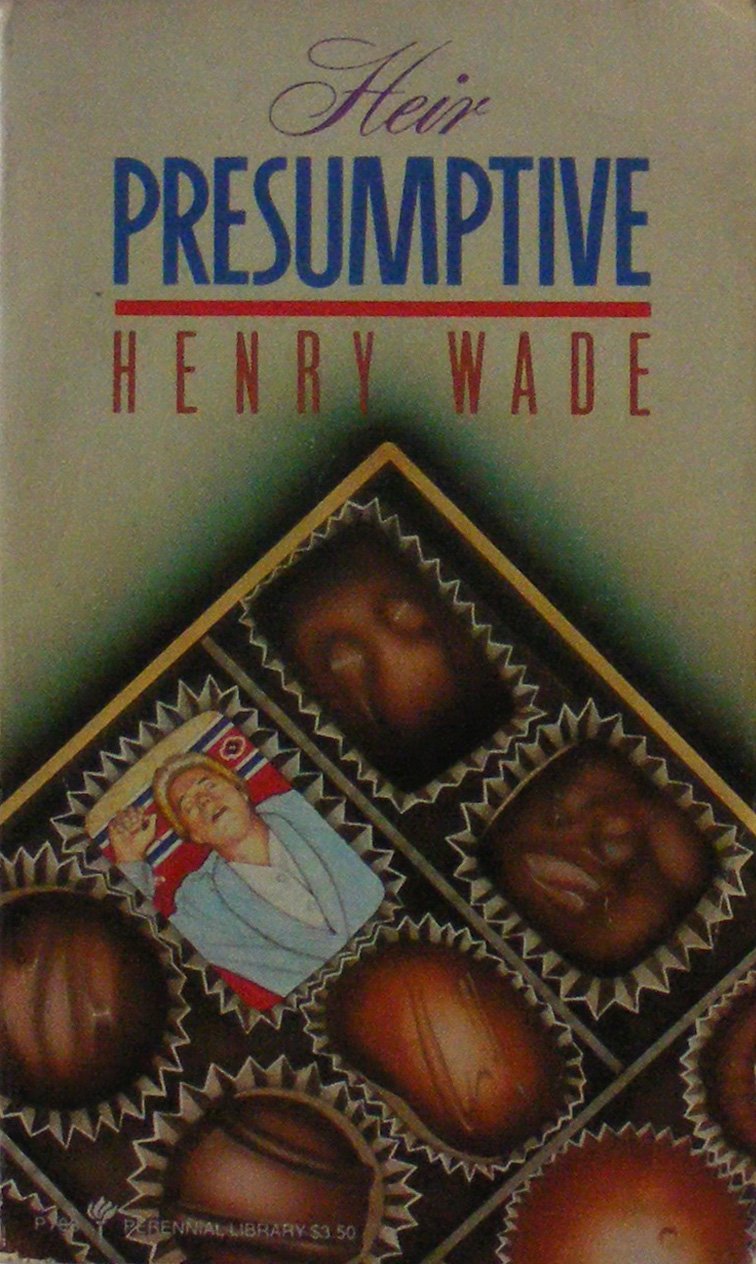
HEIR PRESUMPTIVE.
By Henry Wade.
Macmillan.
1935. Reissued: 1953. 209 pages. $2.50
Henry Wade's novel . . .
. . . neatly combines the attractions of the inverted story with those of the detective story proper; and the book finishes with a brilliant and powerful twist ending. — Nick Fuller, The GAD Wiki
Some people will stop at nothing:
Eustace Hendel is alerted by a newspaper item to the fact that he just might be line for an inheritance that will solve all his financial problems. And those problems are pressing; he is running out of cash, and risks losing his lovely but greedy girlfriend as a result. However, he sees a possible route to becoming the next Lord Barradys. Unfortunately, some family members stand in his way—you can guess what rascally Eustace starts to contemplate . . . . — Martin Edwards, DO YOU WRITE UNDER YOUR OWN NAME? (5 November 2010)
From THE SATURDAY REVIEW (October 17, 1953):
British wastrel, at end of rope (and family line), plots own enrichment. - Violent terminal switcheroo mars otherwise skilfully-told story. - Verdict: Plus mark, on balance.
From AT THE SCENE OF THE CRIME (August 5, 2011):
. . . 'Heir Presumptive' has got to be one of the greatest mysteries ever written. It’s a successful inverted murder story and told brilliantly through the main character. The characters are complex and you really feel you get to know them. . . . There are suspenseful scenes, and the plot twists and turns so much you feel you’ve been taken on an emotional roller-coaster ride. There is real horror here—the ordeal of the investigations feels exhausting. The finale is just brilliant.
Here is a previous ONTOS article about another Wade novel.
Category: Detective fiction
THE CRIMSON BLIND.
By Fred M. White.
R. F. Fenno & Company.
1905. 378 pages.
Text available HERE and HERE.
According to Wikipedia, Frederick Merrick White (1859-1935) was a prolific author who sometimes produced science fiction, mysteries, and the occasional spy story:
[White] wrote a number of novels and short stories under the name "Fred M. White" including the six 'Doom of London' science-fiction stories, in which various catastrophes beset London. These include "The Four Days' Night" (1903), in which London is beset by a massive killer smog; "The Dust of Death" (1903), in which diphtheria infects the city, spreading from refuse tips and sewers; and "The Four White Days" (1903), in which a sudden and deep winter paralyses the city under snow and ice. These six stories all first appeared in 'Pearson's Magazine', and were illustrated by Warwick Goble.
He was also a pioneer of the spy story, and in 2003, his series 'The Romance of the Secret Service Fund' (written in 1899) was edited by Douglas G. Greene and published by Battered Silicon Dispatch Box.
As for THE CRIMSON BLIND:
Over a century after its first publication, 'The Crimson Blind' remains a rattling good story, as well as an interesting example of a transitional phase in mystery writing.
On the one hand, the backstory is unrepentantly mid-Victorian, with dreadful secrets, an aristocratic family estranged from each other, sundered lovers, savage dogs, a decayed country seat, forgeries, royal jewellery and a smiling hypocritical villain who aspires to become—gasp!—a Member of Parliament.
On the other hand, much of the story is set in that most prosaic of places, Brighton on the English south coast; the juvenile lead is a writer of detective stories rather than a missing heir, and—most surprising of all—the three female leads are all enterprising young ladies who take sensible and effective action to solve their predicament, rather than sitting around bemoaning their lot. — Jon, The GAD Wiki
A few other White texts that are available online:
- THE SLAVE OF SILENCE (1904)
- THE CARDINAL MOTH (1905)
- THE WEIGHT OF THE CROWN (1906)
- THE MIDNIGHT GUEST: A DETECTIVE STORY (1907)
- THE MYSTERY OF THE FOUR FINGERS (1908).
Resources:
- White's science fiction is at Project Gutenberg, Australia: The "Doom of London" Series.
- Project Gutenberg's online list - Project Gutenberg, Australia's much more extensive online list.
Categories: Detective fiction, Science fiction
Evidently in the 1930s and '40s, when Bailey ventured into long mysteries, the critics of the day hardly ever found anything to object to. Follow the links to somewhat fuller descriptions:
SHADOW ON THE WALL (1934):
- "Essential." — THE SATURDAY REVIEW (June 9, 1934)
THE SULLEN SKY MYSTERY (1935):
- "Superb." — THE SATURDAY REVIEW (October 19, 1935)
BLACK LAND, WHITE LAND (1937):
- "Expert." — THE SATURDAY REVIEW (February 6, 1937)
THE TWITTERING BIRD MYSTERY (1937) [a.k.a. CLUNK'S CLAIMANT]:
- "Unexcelled." — THE SATURDAY REVIEW (October 30, 1937)
THE GREAT GAME (1939):
- "Enthralling." — THE SATURDAY REVIEW (February 4, 1939)
- ". . . a brilliant denouement . . ." — SCRIBNER'S (April 1939)
MR. CLUNK'S TEXT (1939) [a.k.a. THE VERON MYSTERY]:
- "Top grade." — THE SATURDAY REVIEW (December 2, 1939)
THE BISHOP'S CRIME (1940):
- "Elegant." — THE SATURDAY REVIEW (January 25, 1941)
ORPHAN ANN (1941) [a.k.a. THE LITTLE CAPTAIN]:
- "Hard to beat." — THE SATURDAY REVIEW (August 23, 1941)
THE APPREHENSIVE DOG (1942) [a.k.a. DEAD MAN'S SHOES(?)]:
- "A- ." — THE SATURDAY REVIEW (March 7, 1942)
NOBODY'S VINEYARD (1942) [a.k.a. NO MURDER(?)]:
- "First rate." — THE SATURDAY REVIEW (September 19, 1942)
MR. FORTUNE FINDS A PIG (1943):
- "Top-notch." — THE SATURDAY REVIEW (April 17, 1943)
THE CAT'S WHISKER (1944):
- "Good Fortune." — THE SATURDAY REVIEW (November 18, 1944)
THE QUEEN OF SPADES (1944) [a.k.a. SLIPPERY ANNE(?)]:
- "Not the best Bailey." — THE SATURDAY REVIEW (February 5, 1944)
THE WRONG MAN (1945):
- "Standard brand." — THE SATURDAY REVIEW (September 22, 1945)
THE LIFE SENTENCE (1946):
- "Good Fortune." — THE SATURDAY REVIEW (November 16, 1946)
HONOUR AMONG THIEVES (1947):
- "B- Grade Bailey." — THE SATURDAY REVIEW (September 20, 1947)
SAVE A ROPE (1948) [a.k.a. SAVING A ROPE]:
- "High class Bailey." — THE SATURDAY REVIEW (August 14, 1948)
Resources:
- GAD Wiki ("H. C. Bailey").
- THE NEW CRIME CLUB GOLDEN BOOK OF BEST DETECTIVE STORIES (1934) has Bailey's Joshua Clunk novel THE RED CASTLE MYSTERY (1932), reviews of which are HERE, HERE (scroll to page 747, left middle), and HERE.
Category: Detective fiction