Monday, December 23, 2013

Poirot's Yuletide Locked Room Problem

HERCULE POIROT'S CHRISTMAS.
By Agatha Christie.
Collins Crime Club/Dodd, Mead.
1938/1939. 256 pages. $2.00
[a.k.a. MURDER FOR CHRISTMAS and A HOLIDAY FOR MURDER]
Available on Kindle.

The consensus of opinion is that it's a good, but not great, Christie number:
I'm also no expert on locked room mysteries though I've vowed to read more of them. What I would say about the ones I've read is the word "farfetched" often seems to apply. There's the tiniest bit of that quality to this one but overall I think Christie handles this aspect of the book quite nicely. — William I. Lengeman III, TRADITIONAL MYSTERIES (October 12, 2011)
Uncomfortable English family reunion punctuated by stabbing of partriarch with lurid past. H. Poirot on hand. - Slow start, interesting middle, rather incredible conclusion add up to entertaining but grade B Christie. - Verdict: For Poirot fans. — THE SATURDAY REVIEW (February 11, 1939)
In the new Hercule Poirot tale, Murder for Christmas, competent writing, well-ordered action, and deftly limned characters may or may not compensate the reader for a somewhat confused climax and a solution which, among exacting fans, has been taboo since Zangwill's The Big Bow Mystery. — "Books" by S. S. Van Dine, SCRIBNER'S (April 1939)
Yet another highly successful intellectual parody of the detective story . . . The solution is brilliant, blame falling upon a character the reader never suspected. — Nick Fuller, GAD Wiki
Resources:
- Filmed in 1994 (IMDb).
- COLLIER'S WEEKLY serialized MURDER FOR CHRISTMAS in ten installments, November 1938 - January 1939:
- Part 1
- Part 2
- Part 3
- Part 4
- Part 5
- Part 6
- Part 7
- Part 8
- Part 9
- Part 10

Category: Detective fiction

"Too Clever by Half"

THE LOST GALLOWS.
By John Dickson Carr.
Harper & Brothers.
1931. 344 pages.
In Mike's opinion, JDC had a few faults:
Carr overdoes it plotting and on atmospherics, even as he leaves the story itself somewhat underdone . . . A tendency to mistake antic confusion for dramatic mystification was a besetting flaw . . . . — ONLY DETECT (July 26, 2010)
However, Nick Fuller doesn't think they were fatal:
Even though lurid in parts, the prose is generally excellent, and gives the impression of moving through a nightmare, at once theatrical and melodramatic, but thoroughly entertaining. — GAD Wiki
Resource:
- A GUIDE TO CLASSIC MYSTERY AND DETECTION ("John Dickson Carr").

Category: Detective fiction

Future Murders

Robert Bloch (1917-94) will be forever identified with Alfred Hitchcock's film PSYCHO (1960), but he also crossed over into science fiction, as here with a STAR TREK episode. Brief excerpt:
. . . when he [Bloch] returned to his tried and true theme of Jack the Ripper preying on contemporary society (“Yours Truly, Jack the Ripper,” Weird Tales, 1943) and projected the character four centuries into the future, he succeeded very well. The Trek production team gave Bloch’s story the proper treatment, with nearly every scene largely drenched in shadows and fog accompanied by an intense, fittingly nerve-jangling musical score—and for the first time viewer, the attempts at misdirection succeed at diverting suspicion away from the real killer. — Mike Gray, "Jack the Ripper in the Twenty-Third and a Halfth Century," THE AMERICAN CULTURE (October 14, 2010)

Categories: Science fiction, Detective fiction

Hoch and Tinseltown

Edward D. Hoch (1930-2008) produced volumes of cinematic stories which Hollywood has almost entirely ignored:
As prolific as Edward D. Hoch was—with over 900 short stories to his credit—the movie and TV media have made virtually no use of his output. The Internet Movie Database (IMDb) lists just 9 films derived from his works (9/900 = 1 percent). No more eloquent testimony against the obtuseness of Hollywood can be adduced. — Mike Tooney, MYSTERY*FILE (4 December 2011)
Another Ellery Queen like feature of Hoch's tales: his ability to make the criminal be someone the reader has never suspected. Hoch has repeatedly surprised me with ingenious choices of murderer, someone in the tale that did not fall under suspicion. Yet these choices are always fair, someone present in the tale, and with clues pointing towards the criminal's identity. This is especially hard to do in the space of a short story. One can bury a murderer far more easily in a 200 page novel than in a 20 page short story. Hoch has also come up with some surprising motives. They too are often far removed from the conspicuous motives discussed in the body of the story; yet also fairly present and clued. — Mike Grost, GAD Wiki
Hoch was a master of the classic detective story, emphasizing mystery and deduction rather than suspense and fast action; EQMM has called him "The King of the Classical Whodunit." His stories are very well written and are usually tightly plotted puzzles, with carefully and fairly presented clues, both physical and psychological. He was particularly partial to "impossible crime" tales, where to all appearances the crime (usually a murder) could not have been committed at all; he invented numerous variants on the locked room mystery popularized by John Dickson Carr and others. — Wikipedia ("Edward D. Hoch")
Resources:
- "Cop of the Year" (1972), IMDb.
- "Freefall to Terror" (1973), IMDb.
- Cult TV Lounge (2019).
- "The Man without a Face" (1974), IMDb.

Category: Detective fiction

Sunday, December 22, 2013

The Case of the Falling (Pop) Star

BLACK AURA.
By John Sladek (1937-2000).
Jonathan Cape/Walker.
1974/1979.
Retro-detective Thackeray Phin investigates a levitation that didn't . . . levitate.

Mike at ONLY DETECT (November 26, 2010) reviews this fairly obscure latter-day impossible crime novel. Excerpt:
Like Carr, he [author Sladek] seems to look upon Ye Olde England as a timeless realm of romance and fantasy—the kind of place where two impossible crimes can easily occur, if not before breakfast, then certainly within a 24-hour period. The plot here doesn’t reach the heights of Carrian cleverness or complexity, but it’s one that Carr or any other impossible-crime chronicler of the 1930s might have been proud to fashion. And Sladek, having witnessed the modern spectacle of Portobello Road, writes with a satiric worldliness that departs from the relatively ingenuous tone that earlier mystery writers brought to writing about the everyday miracle that is London.
Jeff Meyerson at MYSTERY*FILE (8 June 2010) reviews BLACK AURA and the only other Thackeray Phin novel, INVISIBLE GREEN:
. . . Sladek handles both problems with a nice bit of misdirection worthy of Carr. The characters are eccentric and well-defined, the atmosphere is suitably Carrian.
Sladek wrote mostly science fiction. He explained why in a 1982 interview:
I think these days an SF connection would be a boost to other books; I'm sure more people have read my two little detective puzzles because of the SF connection. Those two novels suffered mainly from being written about 50 years after the fashion for puzzles of detection. I enjoyed writing them, planning the absurd crimes and clues, but I found I was turning out a product the supermarket didn't need any more—stove polish or yellow cakes of laundry soap. One could starve very quickly writing locked-room mysteries like those. SF has much more glamour and glitter attached to it, in these high-tech days.
Resource:
- A Wikipedia article ("John Thomas Sladek").

Category: Detective fiction

What Was the Question?

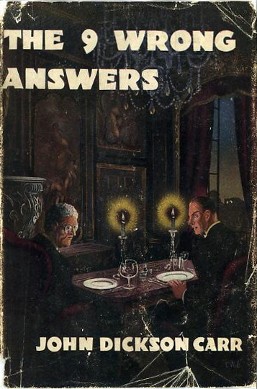
THE NINE WRONG ANSWERS.
By John Dickson Carr.
1952.
Harper's. $3.00
In this one, Carr is into mind games—with you, the reader, being his guinea pig.

A contemporary review (THE SATURDAY REVIEW, December 6, 1952):
Penniless Briton, footloose in N.Y., accepts London impersonation job for big dough, almost turns toes up. - Trick yarn, with footnotes to deflect reader from phony solutions; tale much too long. - Verdict: On the fantastic side.
Excerpts from other reviews:
As ever, Carr’s characters are complex and well developed and the plot is sufficiently convoluted to test the wits of the most sophisticated reader. — Richard & Karen LaPorte, MYSTERY*FILE (27 October 2011)
One of the most consistently entertaining late Carrs, reminiscent of classic Hitchcock. — Nick Fuller, GAD Wiki
Where the book comes into its own is in the Wrong Answers. At various points throughout the book, a footnote disabuses the reader of a supposition that they may have made about the events in the story up to that point. On the face of it, they are intended to help the reader move in the right direction in their deductions. In fact, they are a very cunning piece of misdirection. — Puzzle Doctor, IN SEARCH OF THE CLASSIC MYSTERY NOVEL (April 12, 2011)

Category: Detective fiction

Time Off for Good Behavior

ONTOS will not be posting from December 24th (East Coast, USA) until sometime after Christmas Day—when isn't exactly clear.

Thanks again to all of you who have visited ONTOS; we hope you have benefitted from it. Meanwhile, here are your attendance figures; once again, Malaysia tops the list:

PAGEVIEWS BY COUNTRIES (November 22nd - December 21st):
- Malaysia: 1080
- United States: 828
- United Kingdom: 128
- Russia: 96
- Germany: 53
- Spain: 51
- Canada: 49
- Serbia: 44
- Netherlands: 38
- Ireland: 21

Finally we want to wish a "Happy Christmas to all, and to all a good-night."