Friday, March 14, 2014

"Nothing Higher or Nobler Than the Typical Dime Novel"

TINMAN.
By Tom Gallon (1866-1914).
Ward Lock & Company Limited.
1907. 315 pages.
Online HERE and HERE.
Tom Gallon's ambition must have been to be the next Charles Dickens:
Whenever a novel appears which does not deal too exclusively with the aristocracy, its admirers hasten to assure the public that Dickens has again come among us, improved and brought up to date! Many people professed to find this flavor in Mr. De Morgan's delightful "Joseph Vance"! The unbiased criticism on the cover of "Tinman" claims that "In plot, style, and treatment, it compares favorably with Dickens"! It is well that this has been pointed out, since unaided no sane person would have discovered it. "The House on the Marsh" at a stretch—but Dickens!
Tom Gallon is gifted with the lurid manner. The clouds hanging over "The House of Usher" are as a dawn in June compared to the blackness permanently settled about Hammerstone Market. Even at twenty a young man might have experience enough to call in the police when his guardian went on so that "in all my life I never remember to have seen a man so suddenly become a wild beast as Jerry Fanshawe did then."
Jerry ran about banging doors and blaspheming, "pulling at his lips with his long fingers. . . ." But he was not having things all his own way, since ". . . I had never seen on any face such a look of mingled fear and hopelessness and longing and misery as I saw in his face then." Although Jerry "clinched and unclinched his hands and moistened his lips and strove to speak," and also had that habit of examining his nails which is the primary impulse of every villain, Charlie had no suspicion of him (otherwise Jerry would have been immediately consigned to Bedlam or Reading Gaol, ending the story promptly at page forty-nine).
As it is, notwithstanding an important manner, "Tinman" has only been strung out to store size by the ingenious device of repeating the heroine's adventures in the person of her daughter, merely giving a happier outcome to the fortunes of Barbara number two. — THE NATION (August 15, 1907)
Tom Gallon's book is of less virile calibre, although the theme possesses greater novelty. Here we have a man of weak will and "Tinman" chivalrous instincts, upon whose credulity the villain of the story works, until he convinces him that the honour of the woman he loves is at the mercy of a third man, whom it is his duty as a sort of modern knight-errant to kill. He commits the murder, is of course discovered, refuses to reveal his real motive, which might have won him a recommendation for mercy, and is sentenced to be hanged; but the sentence is afterward commuted, and eventually he is released after serving twenty odd years at hard labour.
The first portion of the book, though somewhat lurid in method, would have made a strong and unusual short story; but the further development of events, after the murderer's release, and the way in which history is forced to repeat itself, so that a second murder may add a cumulative thrill to an already overburdened plot, conveys an unmistakable flavour of nothing higher or nobler than the typical dime novel. — Frederic Taber Cooper, "The Factor of Style and Some Recent Novels," THE BOOKMAN (October 1907; scroll to page 165)

Category: Detective fiction

A Fox-Davies Quintet

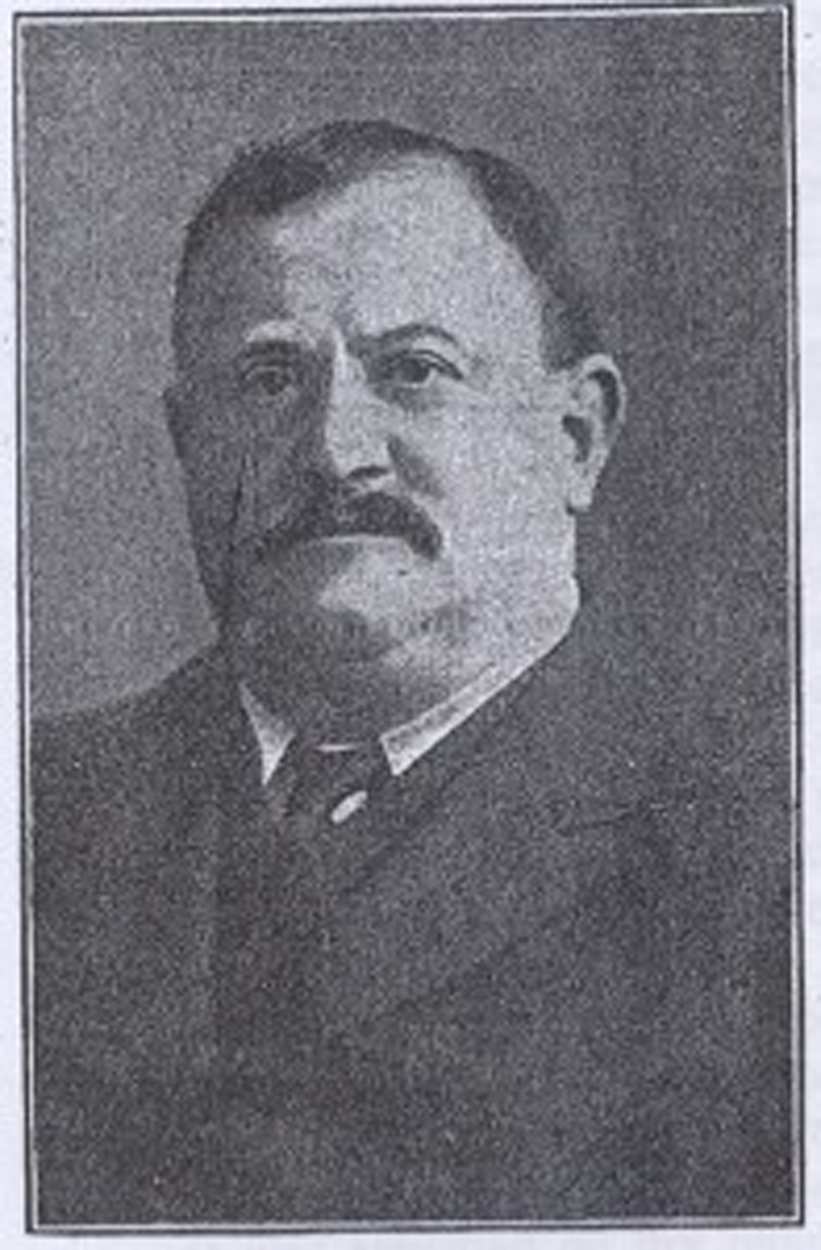
Long before Perry Mason, detective-lawyers were solving cases on their own, sometimes saving the taxpayers millions in court costs. One such was Mr. Ashley Tempest with his "Paul Drake", Yardley, the creations of A. C. Fox-Davies.

Our author was, according to Wikipedia, proficient in several fields:
Arthur Charles Fox-Davies (28 February 1871–19 May 1928) was a British author on heraldry. By profession, he was a barrister but he also worked as a journalist and novelist. . . . In addition to his writings on heraldry, he published a number of works of fiction, including detective stories such as The Dangerville Inheritance (1907), The Mauleverer Murders (1907) and The Duplicate Death (1910).
A mild disagreement with Conan Doyle led to his interest in detective fiction, at least according to this source:
The English writer, Mr. A. C. Fox-Davies, came to write fiction in a rather curious fashion. He was an authority on heraldry, the editor of Fairbirn's Book of Crests, of Dod's Peerage, and of a number of books relating to genealogies and armorial bearings.
One day he stumbled on Conan Doyle's "Sherlock Holmes" stories and became greatly interested. As a barrister, however, he did not always agree with Doyle's conclusions, and he wrote a sequel to one of the stories putting the criminal in it on trial and getting him acquitted on Sherlock Holmes's own facts.
He sent this to Conan Doyle, who complimented him on it and suggested that he should write a series of his own. He wrote instead The Mauleverer Murders and then The Dangerfield Inheritance. — "Chronicle and Comment: The Conclusions of Sherlock," THE BOOKMAN (March 1911)
Here are what appear to be most, but perhaps not all, of Fox-Davies's detective novels:

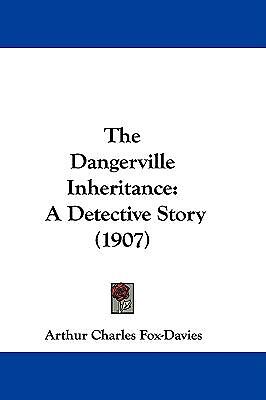
THE DANGERVILLE INHERITANCE.
By A. C. Fox-Davies (1871-1928).
J. Lane Company.
1907. 311 pages.
Online HERE and HERE.
Note: SPOILERS ahead:
A Dangerville Inheritance, by A. C. Fox-Davies, is such a preposterous tale that one feels no scruple in disregarding the accepted ethics in reviewing detective stories, and bluntly revealing the secret on which the whole plot hinges. Indeed, it is no very serious betrayal, because the perspicuous reader can hardly fail to guess the truth from the opening chapter.
The heir presumptive to the Dangerville estates has for years been impatiently awaiting the decease of the old Earl of Dangerville, when news comes from Paris that the latter has taken a young wife, and that a son and heir has been born. The only inaccuracy about the news is in regard to the sex of the child, who happens to be a girl instead of a boy. But the secret is carefully guarded by the Earl, who takes a grim pleasure in keeping the relative he hates out of the inheritance.
The supposed heir eventually comes into the title and the property, enters Parliament, wins renown for brilliant statesmanship, and crowns the fraud by finding another woman who is willing to go through the mockery of a ceremony and masquerade before the world as the Earl of Dangerville's wife.
This other woman is already secretly married; and the fact that the real husband becomes implicated in a baffling murder case drags so many peculiar and questionable happenings into daylight, that the only way to check the growing scandal is to make a full confession. As already intimated, the whole story is too preposterous to be taken seriously. — Frederic Taber Cooper, "Heroines in Fiction and Some Recent Novels," THE BOOKMAN (June 1907; go to page 393, top left)
THE MAULEVERER MURDERS.
By A. C. Fox-Davies.
J. Lane Company.
1907. 349 pages. $1.50
Online HERE and HERE.
One critic considered this one "very sensational"; another was less than impressed:
This is an instance of an introductory novel being written later than its sequel; but those who have not read "The Dangerville Inheritance" will find the present work absolutely complete in itself.
As a detective story the book suffers a little from the same thread of interest not being sustained all through. For the first third, roughly speaking, of the volume the whole problem is the detection of the person who committed the Mauleverer murders.
But from the moment of the arrest of the heroine the interest is transferred to the possibility of proving her innocence. It must be owned that the Duchess of Merioneth, alias Miss Vivian Vane, is not a very attractive person, and the reader finds his attention flag when the main question appears to be not to discover the guilty person, but to free the masquerading Duchess.
The end of the story is brutally horrible, and we are not convinced by the author's production of the real criminal. The book is very sensational, but the reader cannot complain that the title does not give him full warning of this fact. — THE SPECTATOR (31 August 1907)
Mr. Fox-Davies has constructed his story on the principle laid down by the eminent literary light Mr. Archibald Clavering Gunter—that is, something must happen every five hundred words. Beginning with the title, the author furnishes us with a thrill if not in every line, certainly on every page. The plot does not unfold: it rolls up and accumulates like a snowball, and, having opened with five impromptu funerals in the first six chapters, closes with one more, and one in perspective ten or twelve chapters later.
The heroine is introduced thus: "Who's that, Alan? When one is out of England so much, one loses touch with the new beauties."
"Well, if you want to know, she's a mystery"—in these few spirited words Mr. Fox-Davies puts the experienced novel reader "on" at once, and it would be a pity to diddle that worthy out of a series of agreeable shocks by revealing too much of the plot.
The heroine leads a double life, and is suspected of leading a triple or quadruple one. Sums like £150,000 are juggled with airily as feathers; the properties include—bicycles, revolvers, knotted cords, strychnine (wholesale), perfumed handkerchiefs, half-destroyed letters, watches stopped at dreadfully significant hours, and the southeast European kingdom of Moritania—royal line extinct. There is a detective who is not likely to displace Sergeant Cuff or Mr. Sherlock Holmes in our affections, and the mystery is so deep by the one hundred and forty-first page that the author himself is compelled to remark:
"Accustomed as he was to startling assertions and unexpected developments, even he could not, at a few moments' notice, readjust his ideas to an entirely new conception of the whole case."
The reader feels much the same way. — THE NEW YORK TIMES (September 7, 1907)
THE AVERAGE MAN.
By A. C. Fox-Davies.
George Routledge & Sons.
1907. 303 pages. 2s. 6d.
No e-book seems to be available.

This critic considered Fox-Davies to be "a natural master of story-telling":
THERE is an undoubted talent for the Gaboriau style of detective story—a baffling plot pursued through a number of chapters, and unravelled by an investigator who is not above making mistakes at the outset—about Mr. Fox-Davies.
This is a murder mystery of considerable ingenuity, coloured in something of the old Adelphi style, and without much attempt at literary value.
The author has introduced us to his detective before, and it is a relief to find that the cold infallibility of the more modern "criminal agent" of fiction has not destroyed our taste for the more commonplace and convincing cleverness of Mr. Yardley.
Mr. Fox-Davies's imagination, in fact, though forcible enough, never moves outside the conventional rut of a Londoner's life.
There is a good deal of well-managed legal business in the book, and Mr. Ashley Tempest's cross-examining is a triumph of professional cunning.
On the whole, Mr. Fox-Davies may be welcomed as a natural master of story-telling pure and simple. He serves his narrative raw, but it is real narrative. — THE OUTLOOK (August 17, 1907)
THE DUPLICATE DEATH.
By A. C. Fox-Davies.
The Macaualy Co.
1910. 318 pages.
Online HERE, HERE, HERE, and HERE.
THE TESTAMENT OF JOHN HASTINGS.
By A. C. Fox-Davies.
John Long.
1911. 6s.
No e-book available.

A contemporary feels he can "strongly recommend" this one, while another critic finds it "long and tiresome": 
In his latest novel Mr. Fox-Davies once again introduces his remarkable barrister, Ashley Tempest, and that gentleman's ingenious assistant, the private detective Yardley. They again have a problem to work upon which is fully worthy of their powers; indeed, this time it may fairly be said to have been somewhat beyond them.
The book centres around the mystery of a murder, for which no fewer than three different men are tried. The trouble is that there is an excellent case against each one of them, but Mr. Fox-Davies has set out to show the unreliability of purely circumstantial evidence, and show it he does, even at the expense of his hero. 
"The Testament of John Hastings" presents a problem which is not entirely unsolvable, and the book is none the worse for that, but we are quite sure that not one reader in ten will arrive at the correct solution before the author sees fit to supply it.
We can strongly recommend Mr. Fox-Davies's remarkable mystery story. It is a wonderful book in its way. — "Novel Notes," THE BOOKMAN (February 1911)
This is the story of a murder as to which, after hanging the supposed criminal, the authorities have qualms, imagining that they have executed the wrong man. Accordingly they proceed to accuse two others. There are, therefore, no fewer than three trials of persons accused of committing the murder. This is bound to prove not a little tedious.
A real cross-examination is not always interesting reading, and the imitation article is apt to be long and tiresome. The account of the riots in South Wales, instigated by German spies, and the defeat of these latter by the Secret Service agents, is exciting; but, there is no one person in the story in whom it is possible to take any real interest. — THE SPECTATOR (25 March 1911)

Category: Detective fiction

Wednesday, March 12, 2014

"A Pleasant Surprise Awaits the Reader"

THE UNSEEN JURY: A NOVEL.
By Edward Clary Root.
Frederick A. Stokes Co.
1907. 339 pages.
Online HERE.
As far as the Internet is concerned, this book barely exists:
Detective stories involving murder mysteries do not seem likely to offer anything agreeably new. But in this respect a pleasant surprise awaits the reader of The Unseen Jury, by Edward Clary Root.
An old man, highly honoured and deeply beloved in his native town, is found dead one morning in a stream near his home, apparently having been thrown into the water from a rustic bridge just above. Suspicion naturally centres upon a dissipated young fellow who has long sought the dead man's daughter in marriage, and has been heard to utter violent threats against him on account of his persistent opposition.
Circumstantial evidence accumulates until there is not a doubt in the mind of any one in town, save that of the dead man's daughter, that the prisoner is guilty. There is not even a single voice raised to protect his interests, until suddenly, swayed by curiously complex motives, the dead man's foster son, who is a metropolitan lawyer of note, decides to champion him. He, too, has leaped to the conclusion that the prisoner is guilty, and all the more willingly, because they both of them love the same girl and have long regarded each other as rivals.
But now, suddenly, when he sees the other friendless, helpless, menaced with such an imminent danger, a fine sense of honour impels him to give his rival the benefit of the doubt, to force himself to believe in his innocence, to give his days and nights to the task of saving him, even though acquittal might mean the loss to himself of the girl he loves.
So he toils on in the face of the indignant opposition of all his former friends; and every day fresh courage and energy come to him, because every day the conviction grows that he is doing right—that his client is not the guilty man he at first believed him.
And all the while, had he only known it, there is in existence convincing documentary evidence, the reading of which would have spared the jury even a minute's deliberation. But fate willed it that this evidence should not come to light until the last day of the trial, and that even then it should seem best not to use it. But this is precisely the point upon which the main interest of the story turns. — Frederic Taber Cooper, "The Fetich of Form and Some Recent Novels," THE BOOKMAN (May 1907; scroll to page 286, right)
. . . the story of a suspicious death, of an accusation of murder founded on circumstantial evidence carefully provided, and of a great criminal trial in which the hero appears as counsel for his dearest enemy and rival in love, and the author drives a coach and four through the rules of evidence. It is a novel in one dimension. It has length but neither breadth nor depth. — J. B. Kerfoot, "The Latest Books," LIFE (1907)

Category: Detective fiction

"A Horrible Example of the Effect of Trying to Put a Novel of Mystery and a Novel of Manners Between the Same Covers"

WHO KILLED LADY POYNDER?
By Richard Marsh (1857-1915).
D. Appleton and Co.
1907. 337 pages.
No e-book available.
According to Wikipedia:
Richard Marsh was the pseudonym of the British author born Richard Bernard Heldmann. A best-selling and prolific author of the late 19th century and the Edwardian period, Marsh is best known now for his supernatural thriller novel The Beetle, which was published the same year as Bram Stoker's Dracula (1897), and was initially even more popular. The Beetle remained in print until 1960. Marsh produced nearly 80 volumes of fiction and numerous short stories, in genres including horror, crime, romance and humour. Many of these have been republished recently, beginning with The Beetle during 2004. Marsh's grandson Robert Aickman was a notable writer of short "strange stories."
You could never be sure what you would get with a Marsh title, and according to this critic sometimes he would lose control:
Prof. Brander Matthews, who, in a recent magazine article, discussed Poe in his capacity as the father of the short detective story, gave scant attention to the paternity of the long detective story. Possibly Wilkie Collins was its father. At all events, the difference between these two forms of sensational fiction is not merely one of length. Detective stories have a way of being very long or very short. The purely intellectual problems of the short variety are likely to be replaced in the long by a lavishness of plot that is sometimes a superabun-dance.
Who Killed Lady Poynder? is a story of nearly 130,000 words, constructed on the principle which has produced so many rattling stories in the past, that of supplying really damning evidence against every person, male or female, who has any connection with the plot at all. Lady Poynder was shot in her own house in London. The author's ingenuity is expended in showing how many persons had or might have had both opportunity and motive for the murder. As one after another is taken up, accused, and then proved innocent, one thinks of Gilbert's ballad of Pacha Bailey Ben:
But why should I encumber you
With histories of Matthew Coo?
Let Matthew Coo at once take wing
'Tis not of him I'm going to sing
Granting one tremendous coincidence—a coincidence of coincidences, in fact—the reasoning is plausible and the tale entertaining enough. But in respect to method it is a horrible example of the effect of trying to put a novel of mystery and a novel of manners between the same covers. Those who do this sort of writing best are content to kill one bird at a time. — Unsigned, "Current Fiction," THE NATION (September 26, 1907)
Here are several other Marsh items that seem to waver between the supernatural and detective fiction categories:

~ THE DEVIL'S DIAMOND (1893)
Online HERE, HERE and HERE.

~ THE BEETLE (1897)
Online HERE. Concerning the detective in this one, Tim Prasil writes:
Augustus Champnell appeared in Richard Marsh’s novel The Beetle (London: Skeffington, 1897; New York: G.P. Putnam, 1917). Multiple reprints are currently available. Champnell reappeared in the novel The House of Mystery (London: F. V. White, 1898), reprinted in Volume 4 of The Collected Supernatural and Weird Fiction of Richard Marsh (Driffield, England: Leonaur, 2012). Both of these novels have supernatural elements, but Champnell also appeared in five short stories that appear to be restricted to “earthly” crimes, though I’m still working to confirm this. “The Lost Letter,” “Lady Majendie’s Disappearance,” “The Burglary at Azalea Villa,” and “The Stolen Treaty” open his collection An Aristocratic Detective (London: Digby, Long, 1900). “The Robbery on the ‘Stormy Petrel’” is in his collection The Seen and the Unseen (London: Methuen, 1900, pp. 247-63). Champnell investigates crimes, some with supernatural elements, as a novice-detective. — "A Chronological Bibliography of Early Occult Detectives," TIM PRASIL: INVENTOR OF PERSONS. (For more go HERE.)
~ THE CRIME AND THE CRIMINAL (1899)
Online HERE and HERE.

Resource:
- Project Gutenberg has a large collection of Marsh's works in various genres HERE.

Category: Detective fiction

Monday, March 10, 2014

"Detective Stories Are Shouted For"

You might think that people involved in the horror and violence of war, in this instance World War I, would want to read about things much less stressful and disturbing, but you'd be wrong. A few excerpts:
NO ARMIES EVER READ like the armies of to-day, because no armies could read as they can read. It does not need the Evening Post writer to tell us that the reason for this fact is the trench warfare which gives the fighting men a good deal of idle time. So the books actually called for, as the nations long at war have found out, match in variety even the flotsam and jetsam that came at call from garrets and storehouses, to the relief of housekeepers. Almost at the beginning of the war an English committee began supplying books to its soldiers, and The Library Journal of the New York Public Library has issued a pamphlet to tabulate from experience the kind of books soldiers like to read.
. . . The lesson of experience is that no hard and fast rule for soldiers' reading can be laid down: "Boswell and Pepys, Nick Carter, detective stories, the Bible, Nat Gould, Wordsworth's 'Prelude,' 'Famous Boxers,' the Koran, Miss Austen, Mark Twain, Marie Corelli, Macaulay, London Opinion, and the Round Table go side by side. And this not by any chance arrangement, but in response to exprest preferences from the front."
If one insists that there must be some one sort of books that soldiers like better than they like others the answer is, "Detective stories are shouted for." — "What the Soldier Reads," THE LITERARY DIGEST (November 10, 1917)
Resources:

- ONTOS has already dealt with the preferred reading of businessmen HERE.

Category: Detective fiction
Friday, March 7, 2014

Watch the Birdie

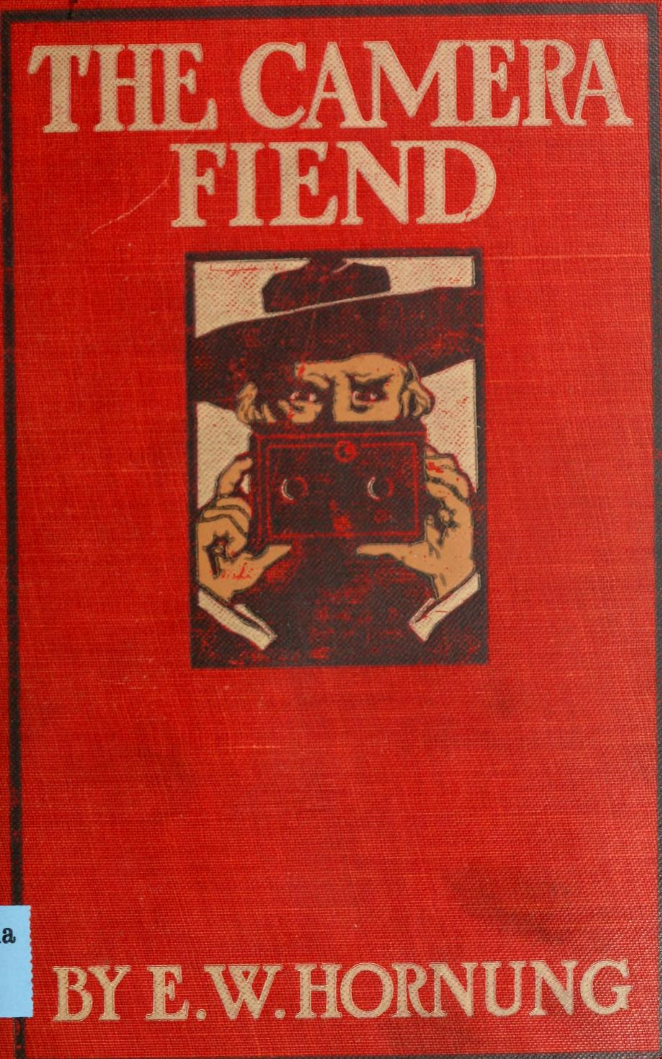
THE CAMERA FIEND.
By E. W. Hornung (1866-1921).
McLeod & Allen.
1911. 346 pages.
Online HERE, HERE, HERE, and HERE.
Hornung didn't just write about Raffles:
"The Camera Fiend," by E. W. Hornung, is a sensational account of the experiences of a conscientious and asthmatic schoolboy, who, by a disconcerting train of incidents, comes very near to death—not by asthma. He falls in with a doctor who holds theories respecting the departure of the soul from the body and strongly desires to photograph that departure. Naturally he has difficulty in finding a subject. Man and boy provide some genuine excitement, but we know that Mr. Hornung can do better than this. — THE BOOKMAN [U.K.] (April 1911)
Tony "Pocket" Upton is almost seventeen-years-old, a student at a resident school in England, and has suffered from asthma as long as he can remember. Pocket makes regular overnight trips into London to meet with his doctor. But this last trip is one that he'll always remember.
Even though the book is written about a teenager, it felt like it was meant for adults. There are so many twists and turns and surprises in this story. Very suspenseful. The author did a very good job of slowly deepening the plot and pulling me into the story. — Lanelle, GOOD READS (September 26, 2013)

Category: Detective fiction
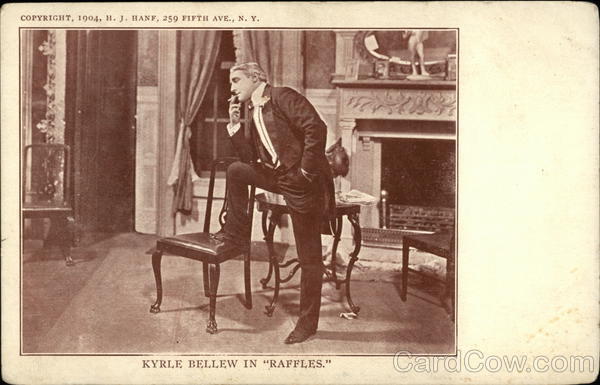
The Histrionic Raffles

E. W. Hornung's gentleman-thief has appeared in at least 15 motion pictures going all the way back to 1905 (IMDb), but few remember that between Raffles's original stories and the films there was a play:
The story of A. J. Raffles was first performed on Broadway as Raffles, The Amateur Cracksman on 27 October 1903 at the Princess Theatre. The play moved to the Savoy Theatre in February 1904 and closed out in March of that year racking up 168 performances. It starred Kyrle Bellew as Raffles, a young Clara Blandick as Gwendolyn and E. M. Holland as Captain Bedford. — Wikipedia
We have personally derived a great deal of pleasure from witnessing Mr. Eugene Presbrey's ingenious play of Raffles at the Princess Theatre, with Mr. Kyrle Bellew and Mr. E. M. Holland in the principal roles. Those who have read Mr. Hornung's two books, The Amateur Cracksman and Raffles, should by all means go to see the play; while those who have seen the play should not fail to read the books from which its material is largely drawn.
Mr. Presbrey's drama bears about the same relation to the Hornung stories as Mr. Gillette's Sherlock Holmes bears to Conan Doyle's original invention. In neither case does the play follow the books, but rather assimilates them and transmutes them into a dramatic form.
In one respect, Mr. Presbrey's play is more effective than Mr. Gillette's; for it reserves its grand climax—a most startling and unexpected one—for the final curtain, whereas in Sherlock Holmes the real climax is the episode of the gas chamber. After that, the rest of the play is comparatively tame. On the other hand, there is nothing so original and creepy in Raffles as this same gas chamber, and the cleverness of Raffles himself has not the superb assurance with which Mr. Gillette so perfectly panoplies his impersonation of Holmes.
Moreover, it jars upon one's sense of the probable to see Raffles in his early fencing with the detective doing everything which in life would draw suspicion upon himself. His continual and suspicious allusions to the Cracksman, his bet with Bedford, and his obvious self-consciousness all through the first act, are neither necessary nor artistic. Mr. Bellew ought to take a lesson here from Mr. Gillette and cultivate a little more self-repression besides cutting some of his lines and modifying some of his business.
When the detective, Bedford, says that he hopes soon to meet the Cracksman face to face, and Raffles replies, "And so do I!" (or words to that effect), it is surely absurd for him to thrust his face forward so as almost to touch his adversary's. Even a Scotland Yard detective—a Lestrade or a Gregson—would have suspected him after that.
Mr. E. M. Holland is delightful as Captain Bedford, repeating both his make-up and his success of twenty years ago as the detective in Jim the Penman. His face is a study at every moment, and his conception of a Dundreary in the role of a criminal expert is inimitably comic. For genuine entertainment, this is one of the very best plays of the season.
The Raffles of Mr. Hornung's books (which are published by the Messrs. Scribner) differs in some respects from the Raffles of the play. The latter is made to appear a genuine amateur in crime and to rob only for the excitement of the thing. This, of course, is to make it easier for the audience to sympathise with him. In the book, he plunders because he is hard up and needs the money.
So, too, with Bunny, who in the play has no share in the misdeeds of Raffles, but who in the book becomes a burglar of his own choice and finally gets a term in prison.
Someone suggested several years ago that Mr. Hornung and Conan Doyle should write a book in collaboration, pitting the clever criminal, Raffles, against the inspired detective, Holmes. But apart from the impossibility of that kind of collaboration (for both authors would have to agree as to which hero should ultimately win), Raffles is not in the same class as Sherlock Holmes. He is several times outwitted in the stories—once by the South African millionaire and again by Captain Mackenzie, a mere Scotchman. In fact, as a criminal he is about on a level with the originator of the Red Headed League. The man who patiently wove a net around Professor Robert Moriarty would have run down Raffles in twenty-four hours. — "Chronicle and Commentary: Raffles," THE BOOKMAN (January 1904)
It wasn't long before an American copycat would appear:
Figuratively speaking, Raffles was originally a Londoner, with chambers at the Albany and a very wide and respectable speaking acquaintance in his favourite thoroughfares of Pall Mall and Bond Street.
Then, metamorphosised into the person of M. Leblanc's Arsene Lupin, he crossed the channel to France, and became a typical Parisian flaneur who could be found of a sunshiny afternoon taking his aperitif at one of the little tin tables in front of the Cafe de la Paix.
Now, in a third incarnation, he reappears on Broadway as Mr. "Frisco" Jackson, the hero of a recent narrative by Mrs. Helen Green. Taking it all in all, we should say that there is rather more basic moral honesty in Mr. Jackson than either his English or French predecessor.
There is nothing ambiguous about his profession, or his attitude toward society. He is just a plain confidence man of the type to be found at Broadway and Forty-second Street, New York. But underlying his rascality there are points of chivalry and forbearance which enlist the sympathy, and with each new incident the reader comes more and more to regard him in the light of a knight errant going down to joust in very sordid lists.
Then again, this Broadway Raffles has known and been influenced by O. Henry's Mr. Jefferson Peters. — "Chronicle and Comment: Raffles on Broadway," THE BOOKMAN (December 1909)
. . . though Sherlock Holmes would forever remain the most popular fictional character, Raffles would rapidly become the second most popular fictional character of the time. — Richard Bleiler, "Raffles: The Gentleman Thief," STRAND MAGAZINE
Resources:
- A RAP SHEET review of Raffles's original adventures is HERE.
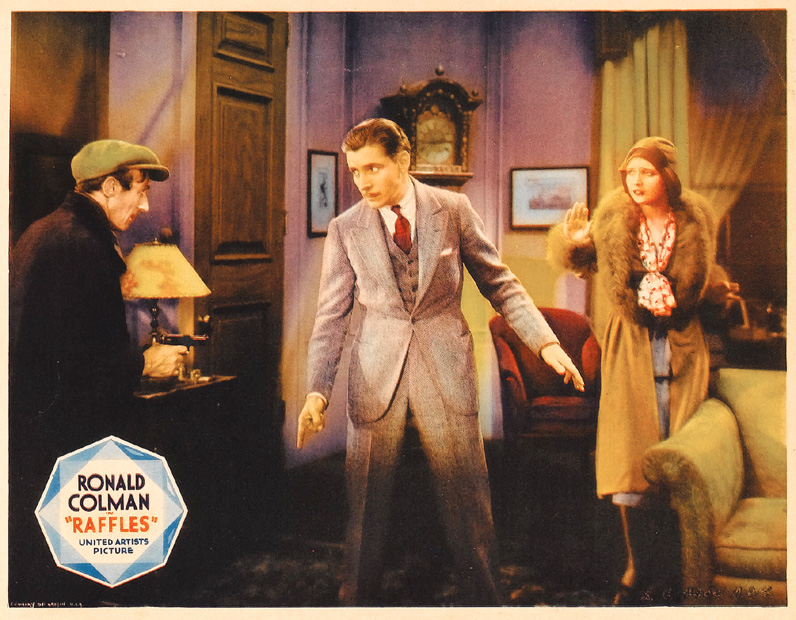
- The most popular film adaptation of the original play is the Ronald Colman version described HERE.

Category: Detective fiction