Wednesday, July 9, 2014

"A Work That Would Have Made a Wonderful Hitchcock Film"

Except for the fact that Charles Wadsworth Camp was the father of the far-more-famous fantasist Madeleine L'Engle, he is now almost completely forgotten. As Bill Ectric has written: "Is Charles Wadsworth Camp’s minimal Internet presence due to lack of interest in his work, or is the lack of interest due to his minimal Internet presence?" Why this should be is a little baffling, as he says: "Camp’s The Abandoned Room (Public Domain) is a little gem of a murder mystery with supernatural overtones. The story is briskly paced, for the most part, with a sustained atmosphere of spookiness. The denouement is no less satisfying than many of the Sherlock Holmes adventures. The Gray Mask is a fun crime serial, part Dick Tracy and part Green Hornet."

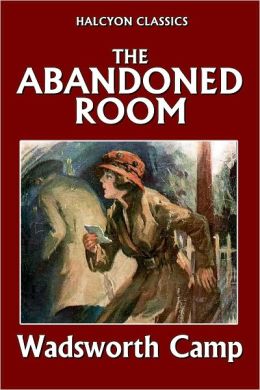
THE ABANDONED ROOM. 
By Wadsworth Camp (1879-1936).
W. R. Caldwell.
1917. 348 pages. $1.35
Online HERE, HERE, and HERE.
First serialized in Every Week, July 30th, August 6th, August 13th, September 17th, September 24th, and October 1st, 1917.
Originally published as by "Tory Hageman" as THE SECRET ROOM MURDERS. Go HERE for more.
A murder is solved by Carlos Paredes, the Panamanian Sherlock Holmes.” — Allen J. Hubin, CRIME FICTION IV (Part 19)
[Excerpt] . . . I really enjoyed this novel and thought the descriptions of the unhappy house and its run down grounds were excellent. The suggested supernatural element is conveyed beautifully, making this a work that would have made a wonderful Hitchcock film, in particular because of a terrific shock near the end when the explanation begins to be revealed.  . . .  — Mary Reed, MYSTERY*FILE (1 July 2008)
Other Camp titles:

SINISTER ISLAND.
By Wadsworth Camp (1879-1936).
Dodd, Mead & Co.
1915. 309 pages.
Online HERE and HERE.
[Excerpt] . . . The whole story is a rather clever study of the insidious workings of superstition, and at the same time a serious [sic] of adventures sufficiently thrilling to make you quite indifferent as to the plausibility of it all. — Frederic Taber Cooper, "A Group of First Novels," THE BOOKMAN (May 1915; go to page 315, top left)
THE HOUSE OF FEAR.
By Wadsworth Camp (1879-1936).
Doubleday, Page.
1916. 342 pages.
Online HERE. See also HERE.
[a.k.a. THE LAST WARNING]

THE GRAY MASK.
By Wadsworth Camp (1879-1936).
Doubleday, Page & Co.
1920. 301 pages.
Online HEREHERE and HERE.
Collection of seven connected novelets, untitled. “Mystery novel of a detective who falls in love with the chief of police’s daughter.” — Allen J. Hubin, CRIME FICTION IV (Part 19)
THE HIDDEN ROAD.
By Wadsworth Camp (1879-1936).
Doubleday, Page & Co.
1922. 334 pages.
First appeared in Collier's, March 11, 1922.

THE COMMUNICATING DOOR.
By Wadsworth Camp (1879-1936).
Doubleday, Page & Co.
1923. 297 pages.
Collection: 7 stories. Ghost tales.

Contents:
(1) "The Communicating Door" [The Popular Magazine, September 15, 1913]
(2) "Hate" [Collier's, April 3, 1920]
(3) "The Dangerous Tavern"
(4) "The Haunted House"
(5) "Defiance"
(6) "Open Evidence"
(7) "The Obscure Move" [Adventure, May 1915; reprinted in EQMM, January 1943].

THE BARBARIAN.
By Wadsworth Camp (1879-1936).
Doubleday.
1925. 367 pages.
First serialized in Collier's, October 4th, November 15th, and November 29th, 1924.
NOTE: This could be a mainstream novel.

Resources:
- Background about Camp is HERE; his famous daughter is discussed HERE.

Category: Horror/fantasy, Crime fiction

Sunday, July 6, 2014

"Scenery Is Delightful, Writing Good, Sleuth Clever, and Criminal Elusive"

Australian author Paul McGuire's involvement in detective fiction lasted for about a decade, after which he unwaveringly turned his attention to world improvement; one reviewer characterized this latter McGuire as "fascinating talker, skilful reconteur, aggressive moralist, and ardent propagandist for the recovery of the 'moral unity of Christendom'." (THE SATURDAY REVIEW, February 14, 1942)

But the earlier Paul McGuire wasn't above murdering people—at least on paper. Like so many Golden Age fictioneers, he sometimes reused characters, one of whom was:
Superintendent Fillinger was created by the Australian writer Paul McGuire and appeared in a number of novels beginning with Three Dead Men (1931). Superintendent Fillinger, who is larger than Nero Wolfe and has an attitude to match, is a policeman in the coastal towns of south west England; with the help of the Chief Constable of Wessex, Major Harslow, he fights crime in those coastal towns. — Jess Nevins, PULP AND ADVENTURE HEROES
MURDER IN BOSTALL.
By Paul McGuire (1903-1978).
Skeffington & Son.
1931. 287 pages.
[a.k.a. THE BLACK ROSE MURDER]
[Review excerpt] . . . The plot isn’t much here. It is the characters of Modstone, a most unusual private investigator—on one occasion he carries a revolver but is “not certain what happened when you pulled the trigger thing”—and Cummings that make the novel enjoyable reading.  . . . — William F. Deeck, MYSTERY*FILE (13 June 2013)
THREE DEAD MEN.
By Paul McGuire (1903-1978).
Brentano's.
1931. 334 pages.
[Full review] Fractionally better than run-of-mine stuff. Scotland Yard and Mr. Bertie Horner, retired merchant, help the rural cops smash a pretty devilish outfit who "accidentally" murder men for pelf. — THE BOOKMAN (September 1932)

MURDER BY THE LAW.
By Paul McGuire (1903-1978).
Skeffington & Son.
1932.  256 pages. 7s. 6d.
[Full review] Mr. McGuire's strong suit is his selection of the weapon used to dispose of an erotic novelist who was about to publish a book of libellously outspoken reminiscences.
Unfortunately the characters in the novel are almost without exception so unpleasant that the reader's interest wanes before the murder is reached.
It is difficult too to believe in the motive for the crime. But for the method he has chosen Mr. McGuire must have full marks. It is simple, subtle and convincing. — Marcus Magill, "Variations On a Criminal Theme," THE BOOKMAN [UK] (November 1932)
[Excerpt] . . . The plot and setting in Law are certainly acceptable but not exceptional. Rather more significant are the characters McGuire sketches for us, and his skillful and evocative use of language, particularly in dialogue.  . . . — Allen J. Hubin, MYSTERY*FILE (28 May 2009)
DEATH FUGUE.
By Paul McGuire (1903-1978).
Skeffington & Son.
1933. 288 pages. 7s. 6d.
[Full review] Caught in a storm on a Devon walking tour, Hugh Thompson finds shelter in an empty but furnished mansion, and an eerie night he spends. Doors lock and unlock themselves, strange music plays, feet are heard shuffling along the corridors, and what appear to be ghosts manifest themselves. To cap all, he finds a warm but rigid corpse seated at the organ with a knife in the back.
Inspector Fillinger is soon on the scene and, aided by a queer author who lives in the vicinity, he proceeds to investigate.
Another body is discovered, the reason why a newly-killed man was held up by rigor mortis is explained, and after the finger of suspicion has hovered over a number of the characters it points directly at the murderer.
"Death Fugue" is an excellent thriller, weakend only by some unnecessary melodrama in the final chapters. — Marcus Magill, "Abominable Deeds," THE BOOKMAN [UK] (November 1933)
THERE SITS DEATH.
By Paul McGuire (1903-1978).
Skeffington & Son.
1933. 256 pages.

MURDER IN HASTE.
By Paul McGuire (1903-1978).
Skeffington & Son.
1934. 288 pages.


DEATH TOLLS THE BELL.
By Paul McGuire (1903-1978).
Coward-McCann.
1933. 336 pages. $2.00
[a.k.a. THE TOWER MYSTERY]
[Full review] American screen star, with troubled mind, is found hanging from bell-rope of English church and Mr. Hupper, the novelist-detective, takes his feet off mantel. - Notable for choice collection of aristocratic wealthy and worthless characters, creepy setting, good dialogue and sleuthing—but marred by a weak ending. - Verdict: So-so. — "The Criminal Record," THE SATURDAY REVIEW (May 13, 1933)
MURDER AT HIGH NOON.
By Paul McGuire (1903-1978).
Crime Club.
1935. 288 pages [UK edition]. $2.00
[a.k.a. DAYLIGHT MURDER]
[Full review] London financial writer found dead in haystack. Local police and Yard engage in deducing-match. - Overabundant financial trimmings slow up action of carefully wrought yarn with surprising conclusion - Verdict: Middlin'. — "The Criminal Record," THE SATURDAY REVIEW (October 19, 1935)
 7.30 VICTORIA.
By Paul McGuire (1903-1978).
Skeffington.
1935. 288 pages.

BORN TO BE HANGED.
By Paul McGuire (1903-1978).
1935.
PROLOGUE TO THE GALLOWS.
By Paul McGuire (1903-1978).
1936.

THREEPENCE TO MARBLE ARCH.
By Paul McGuire (1903-1978).
1936.
CRY ALOUD FOR MURDER.
By Paul McGuire (1903-1978).
Heinemann.
1937. 284 pages.

W1.
By Paul McGuire (1903-1978).
Heinemann.
1937. 274 pages.

A FUNERAL IN EDEN.
By Paul McGuire (1903-1978).
Morrow.
1938. $2.00
[a.k.a. BURIAL SERVICE]
[Full review] Unwanted intruder in idyllic tropic isle dies violently. White "Sultan" unravels this and another murder. - Veers toward talkiness at times but scenery is delightful, writing good, sleuth clever, and criminal elusive. - Verdict: Better grade. — "The Criminal Record," THE SATURDAY REVIEW (August 20, 1938)

ENTER THREE WITCHES.
By Paul McGuire (1903-1978).
Morrow.
1940. 212 pages. $2.00
[a.k.a. THE SPANISH STEPS]
[Full review] Writer slain in Spain turns up alive at Italian villa; strange events culminate in murder. English journalist investigates. - Atmosphere and writing pretty nearly perfect. Sleuthing incidental, but romance, thrills, and mystery blend to queen's taste. - Verdict: Bravissimo! — "The Criminal Record," THE SATURDAY REVIEW (February 24, 1940)
Resources:
- Background information about McGuire is HERE and HERE.

Category: Detective fiction

Friday, July 4, 2014

"The Reversed Detective Motive"

BRASS FACES.
By Charles McEvoy (1879 - ?).
Houghton Mifflin Co.
1913. 285 pages.
Online HERE and HERE.

Sometimes it just doesn't pay for the knight in shining armor to come charging into the fray:
[Full review] This clever story of British origin shows rather a novel aspect of what may be called the reversed detective motive.
The situation is piquant. An innocent idle young man (not so very young in years) is summoned to the rescue of a maiden held in duress in a London house. He gets her away and conceals her in a lonely country place. Whereupon a noble family, whose honor is at stake, set about to recover the runaway and lay hands on the abductor.
An American girl of detective propensities gets on the trail of the chivalrous young man, and there is a mighty good chase, in which the reader, so to speak, runs with the hare.
It is good sport, although towards the end both hare and hounds lag a little. — "Current Fiction," THE NATION (May 8, 1913; go to page 475, top left)
[SPOILER WARNING: Excerpts] The discreet and non-committal title of Brass Faces does not in the least prepare the reader for the Arabian Nights Adventures which begin almost with the opening pages of Mr. McEvoy's amusing tale. Indeed, at the close one feels almost as breathless as the hero must have been at the end of his strenuous five days.  . . .
. . . Immediately on leaving the court room, however, he [our hero] is accosted by a female detective, an American, who demands to know the whereabouts of the girl.  . . .
. . . How the detective makes it impossible for him to see the girl, how he is betrayed by a mercenary friend who cannot withstand a bribe, and how he continues to elude pursuit by means of an aeroplane are added amusing complications.  . . .
. . . Mr. McEvoy does not permit the rapid action of his tale to flag. His character drawing is not so surely done.  . . .
. . . The American detective is quite impossible, as usual. In moments of excitement, she swears, "by Lincoln," which is a new English touch. — "New Books by New Writers," THE BOOKMAN (June 1913)

Category: Mystery/Adventure fiction

"The Female Sherlock Holmes Was Bound to Arrive in Fiction"

LADY MOLLY OF SCOTLAND YARD.
By Baroness Emmuska Orczy (1865-1947).
Cassell & Co.
1910. 344 pages.
Collection: 12 stories.
Online HERE, HERE, and HERE.
Contents:
(1) "The Ninescore Mystery"
(2) "The Frewin Miniatures"
(3) "The Irish-Tweed Coat"
(4) "The Fordwych Castle Mystery"
(5) "A Day's Folly"
(6) "A Castle in Brittany"
(7) "A Christmas Tragedy"
(8) "The Bag of Sand"
(9) "The Man in the Inverness Cafe"
(10) "The Woman in the Big Hat"
(11) "Sir Jeremiah's Will" (Part 1)
(12) "The End" (Part 2 of "Sir Jeremiah's Will").

A contemporary critic thought Lady Molly's adventures were worth continuing but a reader a century later wasn't so impressed; Orczy's the Old Man in the Corner stories usually garner more favorable notice. Nevertheless, Lady Molly was a pioneer of the feminine detective:
[Full review] The female Sherlock Holmes was bound to arrive in fiction, and it was inevitable that she should have her subordinate, Mary Granard, who plays the role of Watson.
Lady Molly, however, works in connection with Scotland Yard, and she has neither chemistry nor the violin as recreation.
The twelve stories in which her feminine wit is described are of the ordinary detective class, put together with the authoress's well-known skill. In the last of them, Lady Molly succeeds in clearing her husband of suspicion on a charge of murder, and this enables her to retire from detective work.
It also enables Miss Granard to explain how her dear lady managed to keep her position in society and at the same time to practise her profession.
People who like the brandy of criminology can have twelve sips in this book. The authoress knows how to blend and serve up her stuff, and probably her large public will be curious to see how she contrives to excite them in this new role.
Probably, also, they will persuade her that Lady Molly's marriage need not interrupt finally her career as a feminine detective. — "Novel Notes," THE BOOKMAN [UK] (October 1910)
[Excerpts] Lady Molly and her uncomfortably devoted assistant, Mary, are part of a new group of female detectives in Scotland Yard. They solve mysteries.  . . .
. . . In every story, Mary tells us about the crimes under investigation, with an astonishing amount of detail considering she never actually witnessed any of them. Then Lady Molly sends her off to investigate, pops up at the very end, and pinpoints the perpetrator. Her "investigative technique" of choice is emotional manipulation, something no one objects to as long as she's manipulating women and not men. Since Mary is the narrator, we hardly ever see Lady Molly investigate anything, and the solutions to the mysteries never quite make sense.  . . .
. . . The best story is probably "The End," since we do get to see a lot of Lady Molly in action, and find out some interesting back story about her. But even in "The End," Lady Molly's investigation is suspect, and the conclusion to the mystery doesn't completely make sense.  . . . — Tasha Brandstatter, THE PROJECT GUTENBERG PROJECT (August 20, 2012)
Resources:
- Mike Grost's article HERE about Orczy is on his megasite, A GUIDE TO CLASSIC MYSTERY AND DETECTION.
- A Wikipedia article is HERE and the GAD Wiki entry is HERE.
- "The Woman in the Big Hat" was filmed for TV as part of The Rivals of Sherlock Holmes series (1971); see HERE. Her Old Man in the Corner story, "The Mysterious Death on the Underground Railway," was also presented on the same series in 1973 but without the Old Man (see HERE).

Category: Detective fiction

Thursday, July 3, 2014

"Dogmatic Detectival Pronouncements, Half-wrong and Half-right"

MR. PEPPER, INVESTIGATOR.
By Basil Thomson (1861-1939).
J. Castle. 1925. 311 pages.
Collection: 15 stories.
Online at Roy Glashan's Library (HERE).
Contents:
1. "I Meet Mr. Pepper"
2. "The Burglary in Middlesex Street"
3. "The Hanover Court Murder"
4. "The Disappearance of Accepted Frewen"
5. "The House in Which Everybody Died"
6. "Blackmailers"
7. "Manning's Funeral"
8. "Mrs. Stoot and Her Ear-rings"
9. "Dust"
10. "The Wedding Present"
11. "The Vanishing of Mrs. Fraser"
12. "How I Stole a Child"
13. "The Scent of Flowers"
14. "My Chief is Threatened"
15. "How England Lost Mr. Pepper".
Basil Thomson, our author, had a varied—and somewhat checkered—career as "a British intelligence officer, police officer, prison governor, colonial administrator, and writer" (Wikipedia); he even spent some time in prison (see the Wikipedia article for all the details). His time spent as Head of the C.I.D. at Scotland Yard might have encouraged him to turn to detective fiction, with generally good results.

On the GAD Wiki, Mike Grost discusses one of Thomson's Mr. Pepper stories, "The Vanishing of Mrs. Fraser":
It is to be found in Dorothy L. Sayers' second omnibus, where I have finally read it, and a delightful story it is. There is a good deal of well done Parisian background, and the detection is vivid. The solution involves science, as in the realist tradition.  . . . Thomson's story is also an early burlesque of detective fiction. Mr. Pepper's dogmatic detectival pronouncements, half-wrong and half-right, and their collision with the ultimate realities of the case, reminded me more that a little bit of Jack Ritchie's 1970's Henry Turnbuckle stories. The comic tone nearly exactly matches that of Ritchie.  . . . — Mike Grost, GAD Wiki ("Basil Thomson")
Some other Thomson titles:

THE STORY OF DARTMOOR PRISON [nonfiction].
By Sir Basil Thomson (1861-1939).
William Heinemann.
1907. 280 pages.
Online HERE.

MY EXPERIENCES AT SCOTLAND YARD [nonfiction].
By Sir Basil Thomson (1861-1939).
Doubleday, Page & Co.
1923. 359 pages. $2.50
[Excerpt] . . . Sir Basil has made a notably interesting book about crime and criminals; it is in turns exciting and amusing.  . . . — "The New Books," THE OUTLOOK (February 28, 1923; go to page 412, left middle)
[Excerpt] . . . Sir Basil's recollections cover eight years (1913-1921) in office as chief of the Criminal Investigation Bureau; and together with chapters on military spies, royal pretenders, and unusual criminals caught up in the meshes of his organization, offer an account of Rasputin's death on "evidence as to what actually happened".  . . . — "Recent Books in Brief Review," THE BOOKMAN (June 1923)
P. C. RICHARDSON'S FIRST CASE.
By Sir Basil Thomson (1861-1939).
Crime Club.
1933. 278 pages. $2.00
Online at Roy Glashan's Library (HERE).
London bobby sees elderly miser "accidentally" killed; finds his wife murdered in miser's antique shop. - Author formerly in charge C.I.D. shows how the Yard really works; includes best quality London atmosphere. - Verdict: Very good. — "The Criminal Record," THE SATURDAY REVIEW (June 17, 1933)
RICHARDSON'S SECOND CASE.
(a.k.a. RICHARDSON SCORES AGAIN)
By Sir Basil Thomson (1861-1939).
Crime Club.
1933. [?] pages. $2.00
Online at Roy Glashan's Library (HERE).
Murder in London suburb. Nice young Detective Serg't Richardson does a thorough job. - Gets coin out of coincidences. Readable yarn with interesting details of Scotland Yard and no brain strain. - Verdict: Pleasant. — "The Criminal Record," THE SATURDAY REVIEW (February 24, 1934)
THE CASE OF NAOMI CLYNES.
(a.k.a. INSPECTOR RICHARDSON, C.I.D.)
By Sir Basil Thomson (1861-1939).
Doubleday, Doran.
1934. 394 pages. $2.00
Online at Roy Glashan's Library (HERE).

Apparent suicide of young writer turns into murder when Inspector Richardson of Scotland Yard takes over. - Straight detecting with few literary frills. Story moves at rapid pace through London and parts of France. - Verdict: Good stuff. — "The Criminal Record," THE SATURDAY REVIEW (September 29, 1934)
THE CASE OF THE DEAD DIPLOMAT.
(a.k.a. RICHARDSON GOES ABROAD)
By Sir Basil Thomson (1861-1939).
Crime Club.
1935. 306 pages. $2.00
Online at Roy Glashan's Library (HERE).
THE STORY OF SCOTLAND YARD [nonfiction].
By Sir Basil Thomson (1861-1939).
Doubleday, Doran.
1936. 323 pages. $2.65
Long, fully illustrated, thoroughly documented story of police and detectives in England from Charles II to now. - Large number of actual cases described plus insight into workings of Yard gives book fascination of fiction. - Verdict: For connoisseurs. — "The Criminal Record," THE SATURDAY REVIEW (June 27, 1936)

WHO KILLED STELLA POMEROY?

By Sir Basil Thomson (1861-1939). 

Crime Club. 1936. 271 pages. $2.00

Online at Roy Glashan's Library (HERE).

Philandering young wife found dead in bathtub. Looks bad for hubby till Supt. Richardson produces proper murderer. - Apparently an English fictional effort based on recognizable cause celèbre—and not too well done at that. — "The Criminal Record," THE SATURDAY REVIEW (August 8, 1936)
THE MYSTERY OF THE FRENCH MILLINER.
(a.k.a. THE MILLINER'S HAT MYSTERY)
By Sir Basil Thomson (1861-1939).
Crime Club.
1937. 275 pages. $2.00
Online at Roy Glashan's Library (HERE).
Murder in England causes Insp. Vincent and Goron of Sûreté much cis- and trans-Channel anguish before solution. - Great amount of painstaking sleuthing, not much action, and penetrating commentary on processes of Justice in France and England. - Verdict: Bit stodgy. — "The Criminal Record," THE SATURDAY REVIEW (May 29, 1937)
WHEN THIEVES FALL OUT.
(a.k.a. A MURDER ARRANGED)
By Sir Basil Thomson (1861-1939).
Crime Club.
1937. 270 pages. $2.00
Online at Roy Glashan's Library (HERE).
Girl's murder in England linked with gang of crooks in France and solved by Insp. Dallas and Chief Richardson. - Alert reader will promptly spot killer but transparent plot is enlivened by fantastic activities of Gallic gang. - Verdict: Pedestrian. — "The Criminal Record," THE SATURDAY REVIEW (November 27, 1937)
- The Basil Thomson collection at Roy Glashan's Library is catalogued (HERE).

Category: Detective fiction

Wednesday, July 2, 2014

"A Mystery Story in Which Practically Every One Concerned Knows from the Beginning Almost All the Essential Points of the Mystery"

THE PROFESSOR'S MYSTERY.
By Wells Southworth Hastings (1878-1923) and Brian Hooker (1880-1946).
Grosset & Dunlap.
1911. 341 pages.
Online HERE, HERE, HERE, HERE, and HERE.
Another lightweight mystery; don't expect much in the way of action or suspense:
[Excerpts] . . . It is quite frankly a mystery story in which practically every one concerned knows from the beginning almost all the essential points of the mystery—with the single exception of the hero himself, and of course the reader.
. . . And the curious thing about the book, the thing which differentiates it from its general class, is that he [the hero], the outsider, the amateur, the one man heavily handicapped by lack of any helping knowledge, actually does get his hand upon the combination of facts that unlocks the puzzle.
. . . The one element which one feels inclined to quarrel with is that of an overcareful style. A high literary finish is of course an admirable thing, other matters being equal. But in a story written frankly for the sake of swift narrative interest, the reader does not want to stop for half a minute in order to admire neat turns of phrase or the pleasant rhythm of sound sequence. As a matter of fact, however, the number of pages in this book in which we feel that the action drags a bit while the authors are luxuriating in sheer good writing are not numerous enough to matter seriously one way or the other.  . . . — "The Theory of Heroes and Some Recent Novels," THE BOOKMAN (April 1911; go to page 194, left bottom)
Plot bullets: A man takes a vacation. He gets involved with the plight of a young girl. The back and forth favor of the girl is puzzling. There is a mystery that he must solve. He has fallen in love. — Henry L. Ratliff, MANYBOOKS
[Excerpt] This vintage mystery was written in 1911 by Wells Hastings. It was a little different in that the mystery was not a murder. It was charming and I did enjoy it.  . . . — Peggy Ann, PEGGY ANN'S POST (September 10, 2011)

Category: Detective fiction

Tuesday, July 1, 2014

"The Solution Is an Anticlimax"

John Thomas McIntyre was a very serious novelist indeed, but in order to pay the bills "he relied on writing short stories, detective mysteries and juvenile fiction to make a living. He invented Ashton-Kirk, a scientific-minded criminologist [and Sherlock Holmes wannabe], and published several books featuring his cases. He also wrote serials for newspapers about a freelance detective named Jerry Mooney" (Wikipedia).

According to modern readers, McIntyre's abilities with the detective story were limited, at best. In this posting we'll concern ourselves mainly, but not exclusively, with reactions to his Ashton-Kirk efforts.

IN THE DEAD OF NIGHT.
By John T. McIntyre (1871-1951).
J. B. Lippincott Co.
1908. 292 pages.
Online HERE and HERE.
[Excerpt] . . . Mr. McIntyre has been unusually successful in ravelling up his mystery, but, as too commonly happens in these stories, the solution is an anticlimax. Too much that excited our curiosity is found to have been the mere work of chance; the dénouement is huddled up and arbitrary.  . . . — "Current Fiction," THE NATION (June 18, 1908; go to page 558, left bottom)
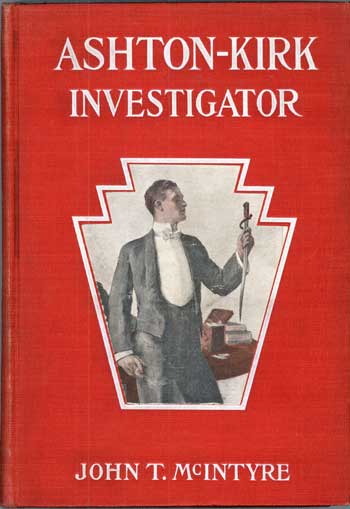
ASHTON-KIRK, INVESTIGATOR.
By John T. McIntyre (1871-1951).
Penn Publishing Co.
1910. 334 pages.
Online HERE, HERE, and HERE.
[Full review] This detective story is in the main well worked out, and is worth reading. At the instance of a friend, Ashton-Kirk begins first to seek the secret of the fear that is haunting Allan Morris, the betrothed of Edyth Vale. Scarcely is he engaged upon this, when Hume, a curio dealer, at No. 478 Chrystle Place, is murdered. All evidence points either to an Italian musician, or more directly to Allan Morris; and Miss Vale, too, it is found, had been at Hume's shop at the time of the murder.
The dead man, as Ashton-Kirk has established, had been the cause of Morris's strange actions toward Miss Vale. She now tries to balk the investigator, and so, as she thinks, to protect Morris, who has disappeared. Ashton-Kirk goes beyond the apparently patent clues and fixes the crime upon the real murderer.
The book is patterned a bit too obviously after the manner of Sir Conan Doyle, and the ending, both in the melodramatic death of the criminal and in the dénouement of the love story, is rather trite. The detective's part, however, is a well-knit piece of reasoning, and furnishes an engaging problem for the reader. — "Current Fiction," THE NATION (December 15, 1910; go to page 580 bottom left)
[Excerpt] . . . Ashton-Kirk, Investigator splits into two almost equal halves. The first half (Chapters 1-13) is a pure mystery tale. The second half is mainly a thriller, with characters chasing each other around the countryside, suspenseful stakeouts, and other mild thriller material. I think that the book's mystery oriented first half is much better. Anyone can read the first half (Chapters 1-13), then some concluding sections of the second, in which some mystery riddles are explained (Chapters 24-25), and get the full plot of the novel. — Mike Grost, GAD Wiki
Ashton-Kirk, who has solved so many mysteries, is himself something of a problem even to those who know him best. Although young, wealthy, and of high social position, he is nevertheless an indefatigable worker in his chosen field. He smiles when men call him a detective. "No; only an investigator," he says. He has never courted notoriety; indeed, his life has been more or less secluded. However, let a man do remarkable work in any line and, as Emerson has observed, "the world will make a beaten path to his door."
Those who have found their way to Ashton-Kirk's door have been of many races and interests. Men of science have often been surprised to find him in touch with the latest discoveries, scholars searching among strange tongues and dialects, and others deep in tattered scrolls, ancient tablets and forgotten books have been his frequent visitors. But among them come many who seek his help in solving problems in crime.
"I'm more curious than some other fellows, that's all," is the way he accounts for himself. "If a puzzle is put in front of me I can't rest till I know the answer." At any rate his natural bent has always been to make plain the mysterious; each well hidden step in the perpetration of a crime has always been for him an exciting lure; and to follow a thread, snarled by circumstances or by another intelligence has been, he admits, his chief delight.
There are many strange things to be written of this remarkable man—but this, the case of the numismatist Hume, has been selected as the first because it is one of the simplest, and yet clearly illustrates Ashton-Kirk's peculiar talents. It will also throw some light on the question, often asked, as to how his cases come to him.  — (Summary by John T. McIntyre, reproduced on LibriVox.)
ASHTON-KIRK, SECRET AGENT.
By John T. McIntyre (1871-1951).
Penn Publishing Co.
1912. 332 pages.
[Excerpt] . . . This uneven, unsuccessful book is nowhere as good as the first novel about sleuth Ashton-Kirk, Ashton-Kirk: Investigator. It also gets Ashton-Kirk involved in spy intrigue, something not present in Ashton-Kirk: Investigator, which is a pure detective novel.  . . . McIntyre does not sustain the pure mystery elements. Soon, we are engulfed in a routine spy novel, imitative of William Le Queux.  . . . — Mike Grost, GAD Wiki
ASHTON-KIRK, SPECIAL DETECTIVE.
By John T. McIntyre (1871-1951).
Penn Publishing Co.
1914.
Reissued in 2007 by Wildside Press.

ASHTON-KIRK, CRIMINOLOGIST.
By John T. McIntyre (1871-1951).
Penn Publishing Co.
1919. 332 pages.
Online HERE, HERE, HERE, and HERE.
[Excerpt] . . . This is the fourth and final detective story, solved by genius consulting-detective Ashton-Kirk. This is a middling mystery. It has virtues and faults intermixed.  . . . There is lots of trailing of suspects. But there is little detective cleverness.  . . . No real detective puzzles are solved. Aside from the choice of killer, there is no ingenuity of mystery plot.  . . . — Mike Grost, GAD Wiki
THE MUSEUM MURDER.
By John T. McIntyre (1871-1951).
Crime Club.
1929. 307 pages.
Online HERE.
[Full review] AN UP-TO-DATE murder in the John Gregory Art Museum of New York. The curator is found stabbed to death with a Moorish dagger, and a millionaire art patron, two of the trustees of the institution and the grandson of the museum's founder, are all involved.
Chalmers, a chubby connoisseur, remarkably fond of his food and comfort, takes charge of the investigation, within twelve hours picks out the perpetrator—and goes back to his gourmandizing. — "Notes on New Books," THE BOOKMAN (January 1930)
Resources:
- MYSTERY*FILE has postings dealing with McIntyre's work HERE and HERE.
- A profile newspaper article about McIntyre is HERE.

Category: Detective fiction