Saturday, March 14, 2015

"Murder in the Void"

"Murder in the Void."
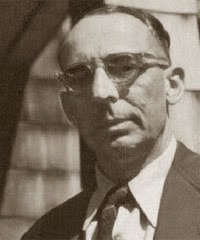
By Edmond Hamilton (1904-77).
Thrilling Wonder Stories, June 1938.
Online at Archive.org HERE.
Crane's bronzed, aquiline face tensed as he crouched for a moment beside a stiff, grotesque shrub. As a member of the Terrestrial Secret Service he had been sent by the TSS to get Doctor Alph's secret weapon and he'd do it or die trying.
Rab Crane of the TSS is on the trail of an unidentified brain thief who likes to snap necks; trouble is, the brain thief knows it only too well and won't hesitate to kill anyone in his way. Let's be honest here: as an agent Crane is no James Bond. As for the plot, it reads like a mashup of a couple of Bond films, Dr. No and Moonraker, with a weak mystery tossed in. In subject matter and style (lots of exclamation marks!!!!!) this one just oozes pulp.

Resources:
- Wikipedia's article about space opera maven Edmond Hamilton is HERE, and his ISFDb bibliography is HERE.
Category: Science fiction (interplanetary spy division)

Like Father, Like . . . You Know Who

"The Master Thief."
By James L. Ford (1854-1928).
In Hypnotic Tales and Other Tales (1894), pages 209-214.
Online HERE and HERE.
Once upon a time there was a retired thief who desired that his son should follow the profession in which he himself had amassed a fortune . . .
There's a lesson in this . . . somewhere.

Category: You name it

"Detective-story Addicts May Be Divided, As Roughly As You Feel Like Handling Them, Into Two Classes . . ."

"Selected Detective Fiction."
By J. Ketch.
Scribner's, December 1936.
Online HERE.

This seems to be the only review signed by "J. Ketch" that we can locate. See if you agree with all of his thumbnail assessments from the Golden Age of Mystery Fiction (the capitals seem appropriate). A few partial excerpts:
Detective-story addicts may be divided, as roughly as you feel like handling them, into two classes: Class A, the man (or woman) who revels in great gobs of gore, palpitating action, tough language, and a detective who can shoot it out with the wickedest of killers; Class B, the man (or woman) who likes a genteel, not-too-frightful murder, a plenitude of infinitesimal clues, a tweed-clad detective who punctuates every movement with scotch and soda, and a sober, slow, but relentless, pursuit of clues and destruction of indestructible alibis until the inevitable end. The following selection from an unusually large and healthy fall and winter output of detective stories is intended to be a judicious admixture of the two classes.  . . .
. . . [Re: Van Dine's The Kidnap Murder Case] has more gun-play and less erudition than other Vance exploits, with the customary water-tight plot and impeccable sleuthing.  . . . [GAD Wiki review is HERE.]
. . . [Re: Christie's Murder in Mesopotamia has] a colorful archeological background atoning for certain weaknesses in the tale.  . . . [GAD Wiki review is HERE.]
. . . [Re: Wheatley's Crime File No. 1: On Bolitho Blane] A super-clever stunt-book, but no masterpiece as a story.  . . .
. . . [Re: Knight's The Wheel That Turned is an] excellent example of the nutmeg and codfish school . . . [GAD Wiki info about Kathleen Moore Knight is HERE.]
. . . [Re: Disney's Death in the Back Seat is one in which] a young artist and his wife encounter murder, kidnaping, robbery, and general frightfulness on a "quiet vacation."  . . . [GAD Wiki review is HERE.]
. . . [Re: In A Puzzle for Fools Quentin] chooses comparatively virgin soil for the scene of his story — a sanitarium for wealthy neurotics and complete nuts where a peculiarly cold-blooded murderer breaks loose.  . . . [At the Scene of the Crime review HERE.]
. . . [Re: Coffin's The Forgotten Fleet Mystery has an] unusual and exceptionally spooky background . . . [The real "Geoffrey Coffin" is discussed HERE.]
. . . [Re: Walling's The Corpse With the Floating Foot] The atmosphere is delightful, the talk good, and the puzzle a hard one to solve.  . . . [GAD Wiki review HERE.]
. . . [Re: In Bush's The Body in the Bonfire] principal puzzle is that of a man whose hand committed a murder tomorrow but who, himself, was killed yesterday — all very perplexing and pleasant reading.  . . . [GAD Wiki review HERE.]
. . . [Re: Croft's Man Overboard is] a sober-sided opus with one tiny mistake leading the killer to his doom.  . . . [GAD Wiki review HERE.]
. . . [Re: Bailey's A Clue for Mr. Fortune features] The ace of all British fictional sleuths . . . [Much about H. C. Bailey is HERE.]
. . . [Re: Heyer's  Behold, Here's Poison! is] a glittering tale of poisoning in a quarrelsome English family, solved by a thoroughly malicious and supremely delightful young Britisher.  . . . [Info about Georgette Heyer is HERE.]
. . . [Re: Bentley's Trent's Own Case] contains some interesting information about wines, among other engrossing matters.  . . . [E. C. Bentley is discussed HERE.]
. . . [Re: Doyle's The Complete Sherlock Holmes features] the mightiest of all detectives . . . [The illustrated Holmes stories are HERE.]
. . . [Re: Oppenheim's omnibus Spies and Intrigues] contains his best mystery novel . . . [More about E. Phillips Oppenheim is HERE.]

Category: Detective and spy fiction

Tuesday, March 10, 2015

"Men Are Such Brutes"

"Men Are Such Brutes."
By Charles Brackett (1892-1969).
Collier's Weekly, October 18, 1930.
Short short short story (1 page).
Online HERE.
Then she knew without doubt that he was a monster. Springing forward, he clapped his hand over the brooch.
A man, a woman, a brooch—what could go wrong?
Resource:
- We believe—but we're not certain—that this Charles Brackett is Charles William Brackett, the Hollywood screenwriter responsible for such classic films as Ninotchka (1939), Ball of Fire (1941), The Major and the Minor (1942), Five Graves to Cairo (1943), The Uninvited (1944), The Lost Weekend (1945), Sunset Boulevard (1950), Edge of Doom (1950), and Niagara (1953); see the Wikipedia article HERE.
Is this our author?

Category: Short short short stories in Collier's Weekly

Monday, March 9, 2015

"When People Talk of the Perfect Murder . . ."

"The Perfect Murder."
By Edmund Pearson (1880-1937).
Scribner's, July 1937.
Online HERE.

Is the perfect crime feasible? Edmund Pearson says yes—but only in fiction. Apparently, as far as murder goes, any attempts by life to imitate art are doomed to failure. Note his frequent references to then quite popular detective story writers. Some excerpts:
. . . In a mechanized age such as this, it is believed that elaborate technical ingenuity, the employment of strange chemicals and complicated engines, make a detective story interesting. And, perhaps as a result of this fallacy, people indulge in gossip about the perfect murder, and fearfully imagine that we may soon live in constant danger of murder through some contraption invented by the winner of the Nobel Prize in physics.
Does it occur to anybody that what chiefly makes crime worth reading about, either as fiction or fact, is the human element, the strange problems it presents in human conduct, the revelations it makes of the dark recesses of the human heart?
. . . In the two motion pictures named for The Thin Man, I wonder if it is not the rollicking nonsense of Mr. Powell, Miss Myrna Loy, and their dog, which makes these film plays so enjoyable? Are there not many others, besides myself, who long ago gave up risking a headache by trying to follow the complicated and over-ingenious plots with which such films and plays are burdened?
. . . Lord Peter is delightful entertainment; but the details of the murders, their methods and causes, make you reach for the aspirin.
It is probable that the authors of detective novels will continue to write as they choose, since their ingenious scientific plots do interest many readers. It does not follow, however, that when novelists invent elaborate and abstruse methods for committing murder they are basing their work on the facts of actual contemporary crime.
Frederick Small: He planned the perfect murder.
. . . Suppose we examine what was perhaps the most carefully plotted and scientifically executed murder ever done in the United States: the killing of Florence Small by her husband [Frederick Small], at Mountainview, New Hampshire.
. . . It must, you think, have been a baffling crime, only to be unraveled by a detective of supreme skill. As a matter of fact, the murderer was under arrest within twelve hours; and was convicted, sentenced, and executed within the briefest limit of time allowed by the laws of the state. The scheme went utterly to smash, and to my mind, its failure makes rather ludicrous much wise talk about "the perfect murder."
. . . Thanks to the efforts of the writers of detective stories, they [people] think of delicate machinery, of mysterious poisons from South America, trained spiders from Sumatra, "death rays" wielded by mad scientists, and all the rest of the armory of weapons which have been invented by novelists.
. . . The persistent belief of a small minority in [Lindbergh baby kidnapper Bruno] Hauptmann's partial or complete innocence is probably due—in no slight degree—to the fact that writers of fiction, in stories, novels, plays, and films, have continued to present the threadbare situation of a prisoner at the bar who is the spotless and pitiable victim of brutal police, ruthless prosecutors, and savage judges. Fiction about the criminal character—or ninety per cent of it—is designed to please emotional rather than rational folk.
A little reading in the fiction of crime, and still a little more about the facts of crime, in England and America, ought to convince anybody that the myth of the marvelous amateur detective has been built up at the expense of the ordinary and frequently honest policeman. It is amusing to have Sherlock Holmes expose Inspector Lestrade as an ass, and to see Philo Vance show up Sergeant Heath as a blustering nincompoop. But it has furnished a little bit too much ammunition to those who are over-ready to work themselves to a boiling point of indignation in behalf of any and every hoodlum and killer who has at last been run down and put where he belongs.
. . . The fingerprint bureaus, the use of photography, of chemical analysis, the examination of footprints, and many other methods have helped to protect innocent persons, as well as to imperil the guilty. But I have not seen it emphasized, in the great number of books and articles on the subject, that the old-fashioned, plodding work of the humble cop is still important.
. . . clergymen, I have observed, are assiduous and intelligent students of crime.
. . . Final advice to those contemplating murder would be: Don't follow the detective novelists. Avoid elaborate and "scientific" methods. Be direct and ruthless, and, instead of fearing witnesses, get as many around you as possible. The more, the luckier. 
Carlyle Harris: Six capsules and a date with the electric chair.
Resources:
- A Wikipedia article discusses would-be perfect murderer Frederick Small HERE, while a more detailed account of his trial is HERE. The Carlyle Harris case is discussed HERE, HERE, and HERE.
- Our last visit with Edmund Pearson was HERE.

Category: True crime vs. detective fiction

Friday, March 6, 2015

The Law According to Nott

If the setting and actors in the endless drama are prosaic and commonplace, the drama itself is not, and its variety is endless.
Justice Charles C. Nott, Jr., very much a product of his time, was one who, like many of his contemporaries, fell under the seductive spell of the eugenics movement, which very likely shaped his outlook on the administration of the law.

"In the District Attorney's Office."
By Charles C. Nott, Jr. (1869-1957).
The Atlantic Monthly (April 1905), pages 476-484.
Online HERE.

Excerpts:
. . . The purpose of this article is to sketch very briefly some of the conditions attending the trial of average, commonplace felonies which are proceeding day after day, during every month of the year, in the county—the old city—of New York.  . . .
The administration of the criminal law in New York, even in important cases, is far from a spectacular affair.  . . .
. . . Crime brings with it other punishments than imprisonment, but as far as the danger of imprisonment in state prison is concerned, the well-connected embezzler's risk, from a business point of view, is not much greater than that incurred by the ordinary business man in embarking on any ordinary commercial venture.  . . .
. . . The question is often asked by laymen, how far an attorney may properly go in the defense of one known by him to be guilty. The answer would seem simple enough.  . . .
. . . Bearing in mind that the defendant's guilt must be proved beyond a reasonable doubt, it is but seldom that a fair-minded prosecuting officer can quarrel with the verdicts of acquittal rendered in the county of New York. Frequently, juries will disagree in the most exasperating manner, owing to the presence of "the eleven obstinate men;" but when a verdict is rendered, it is safe to say that it is a vindication of the wisdom of the fathers in leaving the question of the guilt or innocence of a citizen to the judgment of twelve of his fellow citizens.  . . .
"Coddling the Criminal."
By Charles C. Nott, Jr. (1869-1957).
The Atlantic Monthly (February 1911), pages 164-169.
Online HERE.

Excerpts:
. . . The fact is that our administration of the criminal law has as nearly reached perfection in guarding the innocent (and guilty) from conviction as is possible for any human institution; but in securing the safety and order of the community by the conviction of the guilty it is woefully inadequate.  . . .
. . . The appalling amount of crime in the United States, as compared with many other civilized countries, is due to the fact that it is known generally that the punishment for crime is uncertain and far from severe. The uncertainty of punishment is largely due to the extension in our criminal jurisprudence of two principles of the common law which were originally just and reasonable, but the present application of which is both unjust and unreasonable.  . . .
. . . Under the common law as it existed long after these principles originated, every felony was a capital offense, and every misdemeanor was punished with branding, mutilation, or transportation. There were no prisons except those for detention for trial. After conviction the defendant was hanged, or his ears were cropped, or he was transported to the colonies. At his trial he was not entitled to counsel. He could not take the stand and testify in his own behalf, even if there were no witnesses available to him. If convicted he was allowed no appeal.  . . .
. . . Indeed the trial of a criminal case often degenerates into a proceeding which cannot be dignified by the name of a trial in a court of law, but which amounts simply to a hearing conducted arbitrarily in defiance of all rules of law, and in accordance with the whims of a judge who has taken an oath of office to do justice 'according to law,' and not according to his own whims. It is a safe assertion that, under our present system, fully seventy-five percent of judgments of acquittal could be reversed on appeal for errors committed against the prosecution.  . . .
. . . All of this state of affairs would be practically reformed by two changes in the law . . . [in consequence of which] we should have a marked improvement in both the effectiveness of the criminal law and the moral tone of the courts and criminal bar.
"The Juror's Part in Crime."
By Charles C. Nott, Jr. (1869-1957).
Scribner's (January 1926), pages 94-96.
Online HERE.

Excerpts:
. . .  it is with much hesitation, after twenty-three years spent in the administration of the criminal laws, I advance any ideas on the present conditions of crime in this country.  . . .
. . . If by "the law," the administration of the law is meant, a different situation arises. Undoubtedly the administration of the law in all parts of this country is less efficient than in some other countries; but also undoubtedly in some parts of this country it is at least as efficient as in some other countries—and yet even in such parts the percentage of crime is higher with us.  . . .
. . . In my opinion the weak spot in our administration of the criminal law is not so much in our police forces, or our prosecutors, or our courts as in our juries, which is equivalent to saying—in our people's general attitude to the criminal.  . . .
. . . This quality in American juries is the expression of a wide and underlying attitude in the mass of our people toward the criminal. Of course, every one has, and expresses, a dislike for crime in the abstract, but in dealing with the concrete manifestation of crime, which is the criminal, this attitude of good-natured sympathy and tolerance for him, and of indifference to the evil he accomplishes, goes far toward paralyzing the efforts of judges and prosecutors.  . . .
. . .  This attitude of juries is well illustrated in their attitude toward the police. It may be stated generally that they have no liking for the police, no sympathy with them in the performance of their duties, and that they rarely believe them if there is any excuse whatever for their not doing so. But the moment that a policeman is himself brought to trial as a defendant, he is taken into the sympathy extended to all defendants, his word is taken and believed (although, of course, his motive to falsify is much stronger than in any case where he testifies merely as an officer), and if any of the witnesses against him are criminals, their testimony is regarded, for once, with suspicion.  . . .
"Coddling Criminals."
By Charles C. Nott, Jr. (1869-1957).
Scribner's (May 1926), pages 540-543.
Online HERE.

Excerpts:
A CRIME is not necessarily a sin, nor is a sin necessarily a crime—none of the seven deadly sins denounced by the church are crimes. The law, therefore, is not an institution calling upon the sinner to repent, for it has no concern with sin, as such, but only with crime.  . . .
. . . In considering the matter of the punishment of crime and the treatment of the convict, this underlying distinction must be kept in mind if the punishment of crime is to be worked out along lines to make it effective to accomplish its intended end. During the last fifteen or twenty years, in the State of New York at least, a large, influential, well-meaning, and extremely vociferous body of people and organizations have been doing all in their power to ignore and to compel the authorities to ignore the fundamental difference between reformation of the sinner and punishment as a deterrent to crime. Of course, the result has been, on the one hand, to diminish the force and effect of punishment as a deterrent to crime; while, on the other, the increase in the amount of reformation effected over that obtained by the old system has been negligible.  . . .
. . . a prison is and necessarily must be a most unfavorable place to effect a reformation of the individual. Reformation is a work requiring individual effort of a high order of spiritual quality upon the individual sought to be reformed; it requires a favorable environment and associations, and long-continued watchfulness and care. None of these conditions is or can be found in a prison.  . . .
. . .  many who have had a clear idea of the function of the criminal law had prophesied years ago that carrying the softening of prison discipline to foolish lengths not only would accomplish little in the way of reformation, but would end in increasing crime—and their prophecies have been and are being fulfilled.  . . .
. . . All of the foregoing is only a brief and partial indication of the many ways in which it has been sought during the last twenty years to soften the quality and lessen the quantity of prison discipline, until now a discharged convict knows that if he should subsequently be sentenced, he will retire from the world for a sufficient season to enable him to get the alcohol and venereal disease out of his system, will work minimum hours, get a maximum of recreation and entertainment, and may, if his soul rises above the frivolities of prison life, also acquire an education or learn a trade.  . . . 
. . . Crime is not less in the twentieth than in the eighteenth century because punishment has been diminished; but punishment has been diminished because crime is less. No one is in favor of making punishment more severe than is necessary to accomplish its end. As, therefore, the human race has gradually emerged from the virtual barbarism of those old days, its progress and the progress of civilization have resulted in a lessening of crime—and naturally punishment also has been relaxed. But when it is so relaxed as to become no punishment at all and is so frequently escaped as to warrant the assumption it will be escaped altogether, then there can be no wonder that it fails to act as a deterrent.  . . .
"Old Adam: The Criminal Is Natural Man."
By Charles C. Nott, Jr. (1869-1957).
Scribner's (December 1926), pages 686-688.
Online HERE.

Excerpts:
. . . in the last few years a cult has grown and flourished, along with many other sentimentalized fads, which announces that crime is abnormal and that any man who commits a crime thereby demonstrates that he is and must be mentally abnormal, and is therefore a subject for the psychiatrist (or at least the psychologist) and the asylum or sanitarium rather than for the police, the courts, and the penal institution.  . . .
. . . To any one who has observed and studied the criminal over many years, he seems intensely human—much more human and normal than do the neurasthenic philosophers who proclaim his abnormality. This is not strange, since the criminal is the natural man, animated by the old Adam, taking what he wants when he wants it and "doing up" those whom he dislikes; while the philosophers are an intensely artificial lot who see everything as abnormal which is natural enough to be beyond their unnatural way of regarding things.  . . .
. . . Should it be asked, "Are there no criminals who are insane or abnormal?" of course the answer is yes. There are insane burglars, murderers, and thieves, just as there are insane grocers, lawyers, or plumbers—but their occupation in neither case is in itself evidence of insanity—even admitting the overcrowded condition of the legal profession.  . . .
. . . Why crime and criminals should so often inspire sentimentality is indeed hard to say, for any one who has for years been familiar with them. The honest poor who, through their refusal to steal, finally finish their career in our city poorhouses, inspire no such feeling and are objects of entire indifference to the sentimentalists, although they are very often confined under worse conditions than those existing in many of our prisons.  . . .
Resources:
- A Wikipedia article about Judge Charles C. Nott, Jr. is HERE.
Category: True crime

Tuesday, March 3, 2015

A SMART SET Quartet

The Smart Set endured a sometimes chequered career, undergoing numerous editorial changes over its thirty-year lifetime. The magazine's founder, says Wikipedia, "wanted to provide sophisticated content that would reinforce the social values of New York’s social elite and gave it the subtitle 'The Magazine of Cleverness'." Judge for yourself just how clever the following criminously related pieces are.
"The Unconscious Detective."
By Caroline Duer (1865-1956).
The Smart Set (May 1902), pages 151-157.
Online HERE.

As Miss Marple demonstrated, little old ladies can make good detectives—even unconscious ones:
. . . "I suppose you heard of the burglary," I observed; "and I almost think it served those silly young women right, for wanting to deck themselves out so inappropriately. The idea of bringing their jewels down to the country!"  . . .
"The Great Security Bank Mystery."
By Isaac Anderson (1868-1961).
The Smart Set (December 1902), page 96.
Online HERE.

Did he say "great detective"?
. . . "The burglar," he announced, confidently, "was a man of less than medium height." 
"But how—?" began the president. 
"Very simple, indeed," interrupted the detective.  . . .
"Cause for Suspicion."
By Tom P. Morgan.
The Smart Set (April 1905), page 61.
Online HERE.

What could possibly move the thief to commit burglary? You'd be surprised—then, again, maybe you wouldn't:
. . . "Pshaw! why, Lester Pinney is as honest as the day is long!"  . . .
"More Adventures of Oilock Combs: The Succored Beauty."
By William B. Kahn.
The Smart Set (October 1905), pages 93-95.
Online HERE and on Bill Peschel's blog with his comments HERE.
. . . The manner in which she made this statement as well as the declaration itself seemed to make a deep impression upon Combs. Without uttering one word he sat there for fully four minutes. The way in which he puffed nervously at the pipe showed me that he was thinking. Suddenly, with an exclamation of delight, he dashed out of the room and down the stairs, leaving the amazed duchess and myself in his apartments. But not for long. In forty-three seconds he was again in the room and, dropping into his chair thoroughly exhausted, he triumphantly cried: "I have it!"  . . .

Categories: Humorous detective stories, Sherlock Holmes parodies