Thursday, February 20, 2025

Caveat Emptor Tempus Machina

"Galactic Consumer Reports No. 1: Inexpensive Time Machines."
By John Brunner (1934-95; Wikipedia HERE; the ISFDb HERE; the SFE HERE; and the IMDb HERE).
First appearance: Galaxy, December 1965.
Reprints page (ISFDb HERE).
Reprinted in:
  Time Jump, 1973
  The Best of John Brunner, 1988.
Non-fact article (8 pages).
Online at Archive.org (HERE).

   "Cut-price time machines are now being widely advertised and time travel is bidding fair to rival space travel as a popular vacation pastime."

. . . and, of course, nothing can go wrong with that. Nothing . . . No . . . thing . . .

References:
- Clearly our author is having fun with a well-known consumer advocacy organization (Wikipedia HERE).
- "This was of the type known as an 'Aunt Sally'" (Wikipedia HERE.)
- "a posthumous discussion with Einstein" (Wikipedia HERE.)
- "the University of Spica" (Wikipedia HERE.)
- "weight-lifting in the last Jovian Olympics" (Wikipedia HERE and HERE.)
- "later identified as Mongols" (Wikipedia HERE.)
- "the Confucian Standard" (Wikipedia HERE.)
- "landed twice in the Upper Pleistocene" (Wikipedia HERE) "and the other in the Triassic" (Wikipedia HERE.)
- "the wanderings of the Children of Israel" (Bible Hub HERE.)
- "Buddha under the bo-tree" (Wikipedia HERE.)
- "the Hegira" (Wikipedia HERE.)
- "the Wesleyan list" (Wikipedia HERE.)

Resources:
- John Brunner was responsible for four "Galactic Consumer Reports" in Galaxy:
  (1) "Galactic Consumer Report No. 1: Inexpensive Time Machines" (1965) (above)
  (2) "Galactic Consumer Report No. 2: Automatic Twin-Tube Wishing Machines" (1966) (online HERE)
  (3) "Galactic Consumer Report No. 3: A Survey of the Membership" (1967) (online HERE)
  (4) "Galactic Consumer Report No. 4: Thing-of-the-Month Clubs" (1988) (online HERE).
- As if to refute the subject at hand, you might find this article interesting, "Making Time Travel Work" by John Deakins in Absolute Magnitude, Summer 1999 (4 pages; HERE; go to text page 32). Don't forget: Time travel is also space travel.
- We've already encountered one example of John Brunner's short fiction, "Puzzle for Spacemen" (HERE).

Unless otherwise noted, all bibliographical data are derived from The FictionMags Index created by William G. Contento & edited by Phil Stephensen-Payne.
~~~~~~~~~~~~~~~~~~~~~~~~~~~~~~~~~~~~~~~~~~~~~~~~~~~~~~~~~~~~~~~~~~~~~~~~~~~~

Tuesday, February 18, 2025

"This Little Piece of Glass Is Going To Hang You"

BEFORE THERE WAS an American "Ironside" on television, there was a British "Ironsides" (note the final letter) in dozens of print publications. Here is one of his rare adventures in the short form, in a story aimed at schoolboys:

"The Clue of the Glass Stopper."
By Victor Gunn (Edwy Searles Brooks, 1889-1965; Wikipedia HERE; the ISFDb HERE; the SFE HERE; and the Fan Page HERE and HERE).
First appearance: Collins Boys' Annual (1953).
Short short story (7 pages).
Online at Comic Book Plus (HERE; go to text page 113).

   "It's rather a good thing we came here, after all—because this is a case of murder."

NO, it wasn't an accident, even though the killer wants everybody to think that. Sherlock Holmes derived a life lesson from the look and smell of a flower; Chief Inspector Cromwell will derive a case of murder from the look and smell of a broken bottle . . .

Main characters:
~ Sergeant Johnny Lister ("And why are you looking like a codfish with a diseased liver?"), Professor Martin Jelk ("was still lying crumpled on the floor near the bench, just as he had fallen"), the doctor ("Jelk must have died within a few seconds"), Dr. James Berger ("I've had that thing for years—I amuse myself with it in the country, potting at rabbits"), Thomas Broderick ("What a loss!"), the girl clerk ("The porter's not always in the front lobby, and Mr. Broderick could have used the stairs"), and Chief Inspector Bill Cromwell ("Hold him, Johnny! I think he's going to faint!").

Odd word choice:
   "Cromwell—Scotland Yard," jerked Ironsides.

Resources:
- The murder method here puts us in mind of a 1933 novel by Dorothy Sayers.
- When it comes to sheer pulp fiction output Victor Gunn (whose real name was Edwy Searles Brooks), undoubtedly earns the title of Uberpulpster Supreme. According to Wikipedia: "He is believed to have written around 40 million words." And, yes, he's the one who gave us "Norman Conquest," out of necessity, it seems: "The magazines that had published his stories started running into financial trouble in the 1930s, and Brooks started publishing hardcover novels for the adult market in 1938 with the first novel in the Norman Conquest series under pseudonyms. His serialised novels included the Norman Conquest and Ironsides Cromwell stories." (Wikipedia HERE.)
This is not today's sleuth.
- The definitive article about Edwy Searles Brooks is by Norman Wright in the Ephemera Book and Magazine Collector, October 20, 1998 (online HERE; 13 pages).

Unless otherwise noted, all bibliographical data are derived from The FictionMags Index created by William G. Contento & edited by Phil Stephensen-Payne.
~~~~~~~~~~~~~~~~~~~~~~~~~~~~~~~~~~~~~~~~~~~~~~~~~~~~~~~~~~~~~~~~~~~~~~~~~~~~

Thursday, February 13, 2025

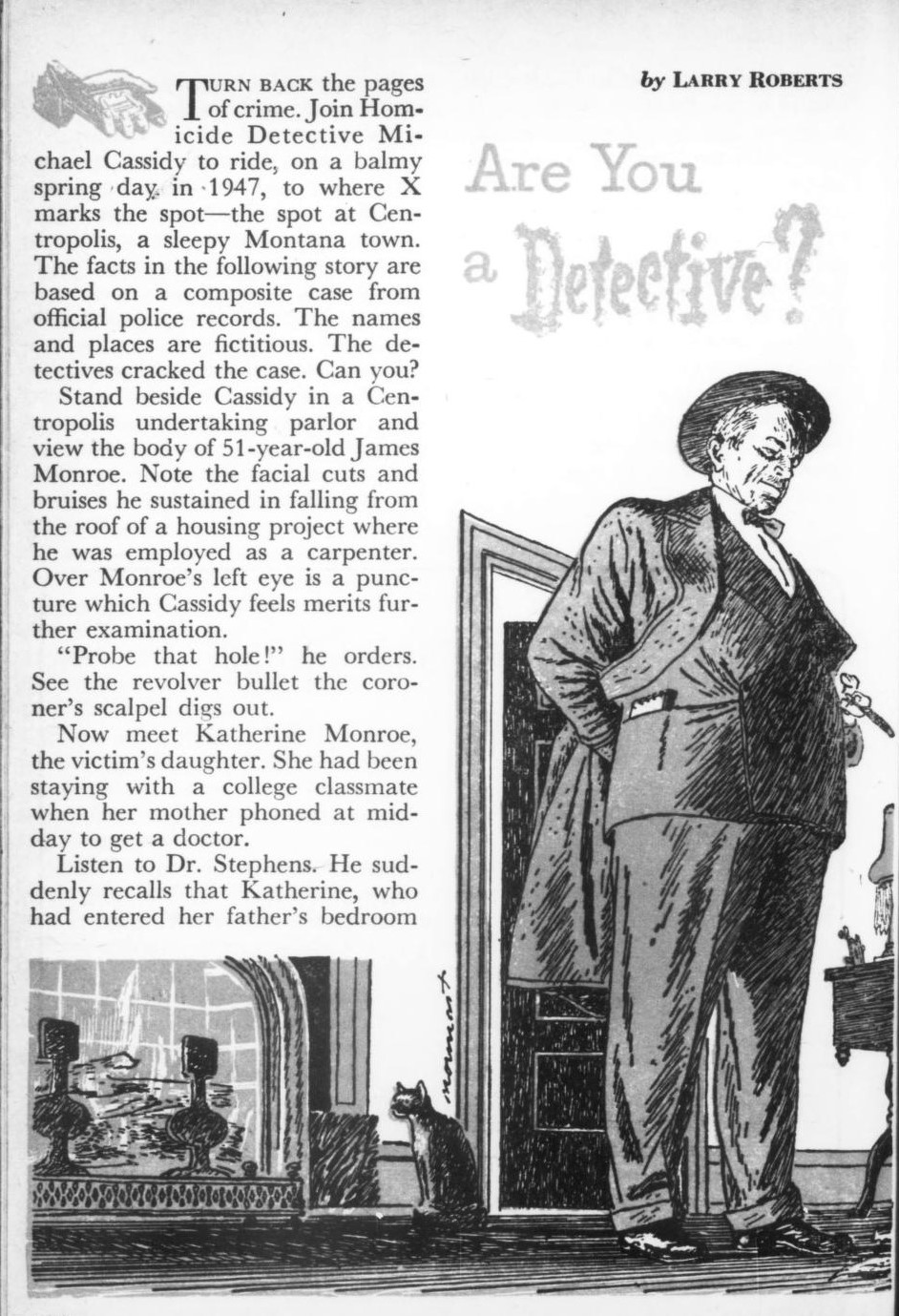
"Are You a Detective?"

HERE'S one of those reader participation articles that show up in magazines from time to time. The answers are below the article, but you're on your honor not to cheat:

Source: "Are You a Detective?" by Larry Roberts, Coronet Magazine, June 1949, starting (HERE) and finishing (HERE).

=====

While we're in June 1949, let's look at the state of detective fiction in England at the time:
Source: "Hi-De-Homicide" by R. G. G. Price in Punch, June 29, 1949 (HERE).

References:
- "Mr. Cyril Hare's" (HERE) "When the Wind Blows" (HERE)
- "Mr. Michael Innes" (HERE) and The Journeying Boy" (HERE)
- "the new Ellery Queen" (HERE) "anthology To the Queen's Taste" (HERE)
- "David Lockwood's" (HERE) "Death Has Scarlet Candles" (HERE)
- "Miss Nancy Spain's" (HERE) "Death Goes on Skis" (HERE).
~~~~~~~~~~~~~~~~~~~~~~~~~~~~~~~~~~~~~~~~~~~~~~~~~~~~~~~~~~~~~~~~~~~~~~~~~~~~

Wednesday, February 12, 2025

"She Has Succeeded in Producing One of the Few Notable for Originality"

THE SATURDAY REVIEW OF LITERATURE issue for July 24, 1926, happened to contain a couple of reviews of detective fiction books that are still being read ninety-nine years later:

The Incredulity of Father Brown is available in a deluxe Standard Ebooks edition (HERE).
Related articles (HERE) and (HERE).

=======

THE author of this review was William Rose Benét (1886-1950; HERE), the older brother of Stephen Vincent Benét (1898-1943; HERE). We previously discussed the younger Benét's involvement with detection fiction (HERE) and (HERE).

References:
- The Murder on the Links (HERE)
- The Secret Adversary (HERE)
- The Secret of Chimneys (HERE)
- Poirot Investigates (HERE)
- J. S. Fletcher (HERE)
- R. Austin Freeman (HERE)
- The House of the Arrow (HERE)
- The Red Lamp (HERE)
- Isabel Ostrander (HERE)
- "one is always an Oliver Twist" (HERE)
- Hercule Poirot (HERE)
  (Not a "Frenchman.")

There's also a deluxe Standard Ebooks version of The Murder of Roger Ackroyd (HERE).
Related articles (HERE), (HERE), (HERE), and (HERE).
~~~~~~~~~~~~~~~~~~~~~~~~~~~~~~~~~~~~~~~~~~~~~~~~~~~~~~~~~~~~~~~~~~~~~~~~~~~~

Tuesday, February 11, 2025

"His Massive Brow Furrowed in Thought, As He Gazed at the Cryptic Letters"

"The Button Extractograph."
By Rex Hummerston (?-?).
Illustrations by Laurie [Lawrence B.] Tayler (1873-?; Design & Art Australia Online HERE).
First appearance: Pearson's Magazine, May 1919.
Short short story (5 pages; 6 illos).
Online at Hathi Trust (HERE).
(Note: Some text faded.)

   "My duty, then, is to demonstrate my method of deducing incontrovertible facts from each and every one of them."

SHERLOCK HOLMES had his methods, and they worked. Professor Bosca has his, and . . . well . . .
Principal characters:
~ Mrs. Mooney ("Oh, Professor, I have come to enlist your services in assisting me to thwart the machinations of a perfidious traitor"), Professor Eeza Bosca ("Scientific deduction," he resumed, "plus intelligent elimination—"), and the "perfidious traitor" ("What the devil do you mean by demanding my presence—").
References:
- "Port Said" (HERE)
- "determined to help win the war" (HERE)
- "the Sphinx" (HERE)
- "the left ear of Charles Peace" (HERE)
- "The Adventures of Sherlock Holmes" (HERE)
- "The Exploits of Craig Kennedy, Scientific Detective" (HERE)
  (There was no such title featuring the formidable Kennedy.)
- "the Anzac" (HERE and especially HERE).
Sources: Wikipedia and Standard EBooks.

Resources:
- "The Button Extractograph" is Rex Hummerston's only FictionMags list item.
- Professor Bosca reminds us very much of Ellis Parker Butler's Philo Gubb (HERE).

Unless otherwise noted, all bibliographical data are derived from The FictionMags Index created by William G. Contento & edited by Phil Stephensen-Payne.
~~~~~~~~~~~~~~~~~~~~~~~~~~~~~~~~~~~~~~~~~~~~~~~~~~~~~~~~~~~~~~~~~~~~~~~~~~~~

Sunday, February 9, 2025

"Poisoned!"

"The Soup That Talked."
By Don Mark Lemon (1877-1961; ISFDb HERE).
First appearance: The Black Cat, June 1907.
Short short short story (2 pages).
Online at SFFAudio (HERE).

   "It was right here in this restaurant that it happened."

SOMETIMES someone's in danger and is completely, blissfully unaware of it; when that's the case, in certain situations it just might be necessary to spell it out . . .

Principal characters:
~ The narrator ("You blamed idiot!"), "a man with a big, ugly scar on his forehead and only one eye" ("accidentally brushed his fork off the table"), and "a meek, smiling little man, in a gray tweed suit" ("I guess I'll take a little soup").

Extra:
  Here's Don Mark Lemon's "The Dunsmuir Will Mystery" in the September 1905 Munsey's Magazine:
Resources:
- Our author, Don Mark Lemon, was a regular contributor to The Black Cat, starting in 1900 and then off and on until 1914, with occasional side trips into Munsey's, All-Story, Argosy, The Scrap Book, The Blue Mule, 10 Story Book, The Bohemian Magazine, The Gray Goose, Short Stories, The Thrill Book, and finishing up in Weird Tales (1923; story online HERE) and Wonder Stories Quarterly (1931; story online HERE). Evidently Lemon didn't use any series characters; from what we've seen so far, he wrote some of his stories in the O. Henry mode, saving a punchy resolution for the end. (FictionMags data.)

Unless otherwise noted, all bibliographical data are derived from The FictionMags Index created by William G. Contento & edited by Phil Stephensen-Payne.
~~~~~~~~~~~~~~~~~~~~~~~~~~~~~~~~~~~~~~~~~~~~~~~~~~~~~~~~~~~~~~~~~~~~~~~~~~~~

Saturday, February 8, 2025

"I Have Found It Necessary To Discriminate Between Books Which Are Detective Fiction Proper and Those Which May Better Be Termed Mystery Stories"

WE HAVE already made note of the enthusiasm which T. S. Eliot, the composer of some of the brainiest literature of the 20th century, had for detective fiction (HERE). Like many fans, he chafed at how impure the product of so-called detective fiction writers could be, at how they would come so close to what he considered a pure detective story to be only to miss the mark. Consequently, on occasion he would make use his literary magazine, The Monthly Criterion, to review and criticize them:

Source: The Monthly Criterion, June 1927.

Typos: "Mr. Croft"; "Dr. Thorndike".

References and resources:
 Titles and authors from the article that we were able to locate (indicated by HERE):
  (1) The Benson Murder Case (HERE); S. S. Van Dine (HERE)
  (2) The Crime at Diana's Pool; Victor L. Whitechurch (HERE)
  (3) The Three Taps (HERE); Ronald A. Knox (HERE)
  (4) The Verdict of You All; Henry Wade (HERE)
  (5) The Venetian Key; Allen Upward (HERE); The Domino Club (HERE); The House 
  of Sin (HERE)
  (6) Mr. Fortune, Please; H. C. Bailey (HERE)
  (7) The Colfax Bookplate (HERE; newspaper version); Agnes Miller
  (8) The Clue in the Glass; W. B. M. Ferguson
  (9) The Mortover Grange Mystery; J. S. Fletcher (HERE)
  (10) The Green Rope (HERE); J. S. Fletcher (HERE)
  (11) The Mellbridge Mystery; Arthur O. Cooke
  (12) The Cathra Mystery; Adam Gordon Macleod
  (13) The Devil's Tower; Oliver Ainsworth
  (14) The Spider's Den; Harrington Strong (HERE)
  (15) Four Knocks on the Door; John Paul Seabrooke
  (16) Murder for Profit (HERE); William Bolitho (HERE)
  (17) Problems of Modern American Crime (HERE); Veronica and Paul King
  (18) and the art critic and collector Mr. Bernard Berenson (HERE).

Eliot, or one of his editors, liked this book ("a really first-rate detective story"):

Source: The Monthly Criterion, July 1927.

S. S. Van Dine's (spelled "van Dyne" here) second novel also pleased:
Source: The Monthly Criterion, October 1927.
Typo: "Mr. Croft".

References and resources:
  (1) J. J. Connington (HERE)
  (2) The Dangerfield Talisman (HERE)
  (3) Murder in the Maze (HERE) and (HERE).

Also see Curtis Evans's "T. S. Eliot, Crime Fiction Critic," CrimeReads, April 29, 2019 (HERE).