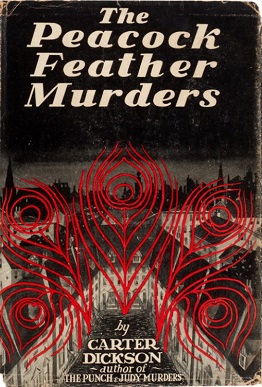
THE PEACOCK FEATHER MURDERS.
By Carter Dickson.
Morrow [U.S.] and Heinemann [U.K.].
1937. 280 pages. $2.00
[a.k.a. THE TEN TEACUPS]
John Dickson Carr's style sometimes grated, but his cleverness seldom flagged:
If you were planning to murder someone . . . would you invite the police to come witness the crime? No, it's not a silly question. It happens - twice - in The Peacock Feather Murders, by John Dickson Carr (writing as Carter Dickson). This 1937 doubly-impossible but fairly clued mystery is the subject of this week's audio review on the Classic Mysteries podcast . . . — Les Blatt, CLASSIC MYSTERIES (May 21, 2012)
All good intriguing stuff one might think but, much as I admire JDC for his ingenuity, there are aspects of his writing (conspicuous in this volume) which I find somewhat wearisome. I can, for example, do without his laboured humour. He never wrote with a light touch and he would have been wise (IMHO of course) to have left the comedy to those with a flair for it. The sequence with Masters being (almost) seduced by the solicitor's wife in the back of a chauffeur driven car is more cringe-making than funny.
I felt also that this was one of those occasions when the Great Man tried just a little too hard to be clever. — Alan P., GAD Wiki
Two different murders in practically sealed rooms with fantastic trappings, and police politely invited, arouse Sir H. Merivale [sic] from lethargy. - First-rate puzzler, with oh-so-simple (once you know it) solution—carefully annotated, with lively talk and interesting people. - Verdict: Dickson de luxe. — THE SATURDAY REVIEW (July 31, 1937)
Category: Detective fiction
Here are further indications of how thoroughly the lore and lure of Sherlock Holmes had penetrated the cultural scene of the late 19th and early 20th centuries:
~ "Inconsistency and Conan Doyle" (1906)
We call attention to authors' inconsistencies and anachronisms not because we believe them to be in themselves of vital importance, but because even when most trivial they are always interesting.
~ "Sherlock Holmes in 'Clarice' " (1906)
Mr. William Gillette might as well accept the fact that his original identity has been destroyed. For a time, perhaps, he may have had a dual personality. He may have been William Gillette off the stage, and Sherlock Holmes only when he was acting in that play. But now and for the rest of his life there is no longer a William Gillette, whether he calls himself that, or the Admirable Crichton, or Dr. Carrington. In whatever costume and character he chooses to appear, he is, in spite of himself, and always must be, Sherlock Holmes. [See also HERE.]
~ "A Sherlock Come to Judgment" (1907)
Mr. Stewart Edward White, who after two years and a half of life on the Pacific coast is again in New York, brings us a story which is new to us and which has all the elements that will appeal strongly to the most approved Sherlockian.
~ "A Sherlock Holmes Understudy" (1907)
An anecdote involving "one rat-tailed shaving brush."
~ "Conan Doyle" (1907)
At the time the first series of stories dealing with Sherlock Holmes was in the full swing of success all kinds of problems of an intricate nature were submitted to the author for solution, probably in the belief that he himself was possessed of the peculiar powers of investigation which he attributed to his hero. Of course, the writer was able to give his correspondents very little practical advice or help. Recently, however, he has applied the Sherlock Holmes methods to an English criminal case and succeeded in bringing about the release of an apparently innocent man.
~ "Conan Doyle in America" (1907)
". . . you will never come to any good!"
~ "A Case of Coincidence: Relating to A. Conan Doyle" (1910)
A minor controversy precipitated by "The Adventure of the Dancing Men."
~ "A Case of Impertinence" (1910)
"To assume for a moment that a man who has invented hundreds of original plots for stories would need to appropriate stealthily and with criminal intent, an idea from a child's magazine, is ludicrous."
~ "Sherlock Holmes" (1911)
We wonder how many of our readers have paused to think that despite certain undeniable literary short-comings, the present age has produced the most widely known character in all fiction. It is now a little over twenty years since the name of Sherlock Holmes was first introduced through the medium of The Study in Scarlet, and to-day it is a byword to millions who have never read any of Conan Doyle's books and who have not the slightest interest in the science of deduction.
Resource:
- "Random Notes on Sherlock and His Creator," a previous ONTOS post.
Category: Detective fiction
Just over a hundred years ago an informal survey was conducted about what businessmen and lawyers were reading for entertainment and relaxation. The results then probably aren't all that different from today.
Portions in the article concerning detective fiction are abstracted below:
While treating of the literary tastes of Wall Street men, the qualifying statement must be made that the grain traders who make up the Produce Exchange do not figure in the above category of novel choices despite the fact that the phrase "Wall Street men" generally includes them in its scope. The members of the wheat and corn pits, the writer has come to learn, seem to champion novels of the Churchill brand, political stories, as well as admittedly more exciting detective stories, such as the recent Mystery of the Yellow Room, The Perfume of the Lady in Black, etc.

. . . . In a discussion bearing on this subject, one of the most prominent lawyers in the business district said recently that the statement that lawyers as a class liked detective stories best, might be made in all truth. "Now and again," he remarked, "you may find a lawyer who says that he does not care for a good old-fashioned detective story, but that lawyer will be one in ten. There is something about a detective novel that possesses a keener fascination for us lawyers than any other kind of story, and that something, I believe, is not to be the obviously inferred idea that the law, in one way or another, figures in the stories and that, consequently, we are the more interested in them. Many lawyers like excitement rather than repose in their spare hours, and this fact, I hold, causes them to pick up a detective story in preference to any other." — George Jean Nathan, "Business Men's Novels," THE BOOKMAN (October 1909)
Category: Detective fiction
This critic's opinion notwithstanding, Green kept on writing:
By no stretch of the imagination can any of Anna Katharine Green's novels be ranked as literature; with the makers of great detective stories—Poe, Gaboriau and Doyle—she has little in common; nevertheless, for work of a certain kind she enjoys a wide and well-deserved popularity.
In a crude way Anna Katharine Green possesses a very strong sense of sensational dramatic effect. Few writers to-day can handle mystery and assassination so picturesquely and effectively.
Even in the days of The Leavenworth Case and Behind Closed Doors she had thoroughly mastered the mechanism of the detective story, and if, as has been said, types such as Dupin and Lecoq and Tir au Clair and Sherlock Holmes are far beyond her powers; in Ebenezer Gryce and his young assistant she has constructed two excellent sleuths of the second order of merit. — "Chronicle and Comment: Anna Katharine Green," THE BOOKMAN (July 1902)
Resources:
- The GAD Wiki entry for Green.
- Another ONTOS posting HERE.
Category: Detective fiction
Expect a surprisingly large body count from Dickens, Dumas, Kipling, even Thackeray, and, of course, Doyle. Follow the link to the entire article:
In a very good sensational story which we read in manuscript a few weeks ago we found some things which we believe to be absolutely new in picturesque assassination in fiction. In this story the man murdered is so surrounded by friends and apparently so completely shut off from any danger that the most ingenious reader will be utterly at a loss to guess how the assassin could possibly have reached him. Yet the explanation is comparatively simple, and probably without a parallel in fiction.
It would be unfair to the author of the book, which will probably be published some time this year, to say anything more than this; but thinking of it calls attention to the variety of devices to which novelists resort to put their characters out of the way when such suppression is necessary.
When it is a case of assassination for dramatic effect, the more outre and ghastly the method used, the keener the reader's sensations; so the clever thrill-maker usually avoids commonplace means of slaying and is careful to bespatter the scene freely with blood, or else to introduce something uncanny, like a subtle poison or some venomous reptile. . . . — "Chronicle and Commentary: Some Assassins of Fiction," THE BOOKMAN (April 1903)
Categories: Detective fiction, Literature
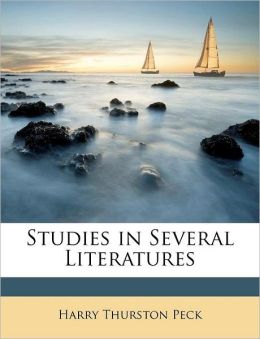
STUDIES IN SEVERAL LITERATURES.
By Harry Thurston Peck (1856-1914).
Dodd, Mead & Co.
1909. 296 pages.
Reviewed HERE. Online HERE.
Chapter XIV: "The Detective Story."
Unlike many scholars of his time, Peck saw something worthwhile in the better detective fiction writers. Excerpts from Chapter XIV follow:
SUPERCILIOUS persons who profess to have a high regard for the dignity of "literature" are loath to admit that detective stories belong to the category of serious writing.
They will make an exception in the case of certain tales by Edgar Allan Poe, but in general they would cast narratives of this sort down from the upper ranges of fine fiction.
They do this because, in the first place, they think that the detective story makes a vulgar appeal through its exploitation of crime.
In the second place, and with some reason, they despise detective stories because most of them are poor, cheap things. Just at present there is a great popular demand for them; and in response to this demand a flood of crude, ill-written, sensational tales comes pouring from the presses of the day.
But a detective story composed by a man of talent, not to say of genius, is quite as worthy of admiration as any other form of novel.
In truth, its interest does not really lie in the crime which gives the writer a sort of starting point.
In many of these stories the crime has occurred before the tale begins; and frequently it happens, as it were, off the stage, in accordance with the traditional precept of Horace.
The real interest of a fine detective story is very largely an intellectual interest. Here we see the conflict of one acutely analytical mind with some other mind which is scarcely less acute and analytical. It is a battle of wits, a mental duel, involving close logic, a certain amount of applied psychology, and also a high degree of daring on the part both of the criminal and of the man who hunts him down.
Here is nothing in itself "sensational" in the popular acceptance of that word.
. . . .Therefore, when we speak of the detective story, and regard it seriously, we do not mean the penny-dreadfuls, the dime-novels, and the books which are hastily thrown together by some hack-writer of the "Nick Carter" school, but the skilfully planned work of one who can construct and work out a complicated problem, definitely and convincingly.
It must not be too complex; for here, as in all art, simplicity is the soul of genius.
The story must appeal to our love of the mysterious, and it must be characterised by ingenuity, without transcending in the least the limits of the possible.
. . . . As has been said elsewhere in this book, no one has surpassed the ingenuity of Poe in the construction of these stories.
It was noted, however, that one's admiration ends with the matter of his constructiveness and reasoning, and I ventured to say that the defect in all these tales lies in the fact that their author could not create a living, breathing character. His personages are nothing but abstractions. He moves them about like chessmen on a board, and we are interested, not in them, but in the problem with which they have to do.
. . . . One grows fond of Sherlock Holmes, not only because of his wonderful mind, but because of his faults and failings. . .We are almost as much interested in his personal whims and prejudices, and in his casual talks with Watson, as we are with his triumphs of detection. And the same interest adheres to Watson . . . .
. . . . Compare [with Doyle's], for instance, the detective stories lately written by Mr. Jacques Futrelle and M. Gaston Leroux. Their work is purely machine work.
. . . . It never occurs to [the critics] that English fiction was permanently enriched when Dr. Doyle, as he then was, began the cycle of stories whose protagonist is Mr. Sherlock Holmes.
. . . . Like all true artists, who do their best work by instinct rather than self-consciously, it is probable that Doyle had no idea of how supremely clever a thing it was to make Watson the companion and chronicler and also the foil of Sherlock Holmes.
. . . . That Sherlock Holmes should have had a brother, superior in inductive reasoning even to Sherlock himself, is interesting; that he should be fat and luxurious and far too lazy to use his gifts in any practical way, is delicious.
. . . it [the reading public] has so strenuously insisted upon having more [Holmes] stories that Dr. Doyle has been obliged to yield to the demand. This compliance has been most unfortunate for the author's reputation. He has written not because he wished to write, but because he was made to do so. Hence, the later stories about Sherlock Holmes are feeble trash . . . .
Category: Detective fiction
"The Gold Bug."
By Edgar Allan Poe.
Short story.
First appeared in Philadelphia Dollar Newspaper, June 1843.
Online HERE.
If you're "in to" codes and ciphers, these might be of some interest.
~ "Edgar Allan Poe on Cryptography" (1903):
An interesting chapter in the life of Edgar Allan Poe, which seems to have been forgotten by most people, although it is curiously illustrative of one important side of his genius, is that which showed his great power in the matter of unravelling and deciphering secret writings.
In "The Gold Bug," he gave a singularly lucid description of the method of translating a cipher message. At first sight the cipher in "The Gold Bug," with its mingling of letters, figures and symbols, appears bafflingly formidable; but after Poe has started us on the scent by pointing out to us that which should have been at once perfectly obvious, we are ready and eager to carry out the reading of the message for ourselves. . . .
~ "A Baffling Cipher" (1903):
The best thing in The Red Triangle, Mr. Arthur Morrison's recent contribution to detective literature, is an exceedingly clever cryptogram which we think we could safely defy the most astute and persevering of our readers to decipher if they would battle with it strictly on the merits of the case and refrain from looking ahead. . . .
Resource:
- An earlier ONTOS posting about Arthur Morrison is HERE.
Category: Detective fiction