Friday, May 13, 2016

"What's So Risky About a Hop to Venus?"

Herbert B. Livingston turned out a substantial amount of pulp fiction over the years under the "H. B. Hickey" alias, with some of it combining SF/fantasy and crime fiction tropes into an agreeable mélange. Here are two such:

(1) "Finished by Hand."
By H. B. Hickey (Herbert B. Livingston, 1916-87).
First appearance: Fantastic Adventures, May 1946.
Short short story (7 pages).
Online at UNZ (HERE).
(Parental caution: Violence.)
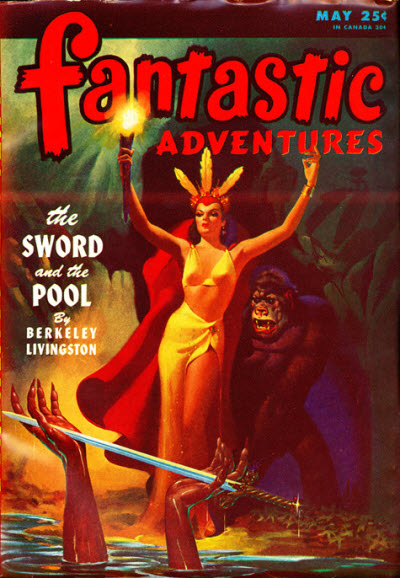
"Carney and Mose thought it was a smart trick to cut off a thief's hands—but they were thieves too!"
An old saying assures us there's no honor among thieves; when Mose, Carney, and Guido carry out a plan to circulate counterfeit bills, one of them proves it by framing one of his partners in crime and then murdering him. The way looks clear for the traitor, until a dead man gives him a hand—in fact, two of them:

   ". . . The red flame that followed the impact engulfed both car and truck. In a few minutes they were fused together in an inseparable tangle . . ."


~~~
(2) "To Dust Returneth."
By H. B. Hickey (Herbert B. Livingston, 1916-87).
First appearance: Fantastic Adventures, February 1948.
Novelette (22 pages).
Online at UNZ HERE.
(Parental caution: Violence.)
"They went to Venus in search of a rare metal — but found instead a dread life-force that crumbled life to dust."
The prospect of a fortune worth millions of dollars has been known to move men to take great risks, but what if that fortune is buried in the crust of a hostile planet twenty-five million miles away, and just getting at it means putting your life in danger every moment? More to the point: When does a legitimate search for wealth turn into an excuse for homicidal greed?

   "He stopped abruptly and stared at Simms. There was complete understanding in the glance that passed between them. Why split at all?"

It's the same old story: Murderers never seem to learn that sooner or later there's a bill coming due for their treachery:

   ". . . across the fantastically jumbled red wasteland of Hanan the living dead implacably plodded toward revenge!"
Nice phraseology:
   "Gathering dusk spread its mantle and the breeze whispered a requiem."
   "The sea had become luridly phosphorescent and the rocket ship showed black against the sea of cold flame."

The planet Venus as imagined in the '40s . . .

   "THE very air glowed red about them, colored by the land beneath. Rock was piled on rock and where there were no rocks the red sand shifted like the waves of a sea. And the sea! Wine red, its roaring surf was like the froth of Sparkling Burgundy. Jim Moyne broke the silence. 'Well, I'll be damned, but this beats 'em all! A grapejuice ocean!'"

   "It was apparent that the storm would be on them in a matter of seconds. The darkness grew ever deeper and was broken only by flashes of lightning which illuminated the scene with a red flame as from an inferno. Thunder which threatened their eardrums rolled in, wave upon wave, until the ground beneath trembled, and the rain was no rain but rather the ocean being inverted."

. . . and Venus as understood today (HERE).
Typo: "If this water is so viscuous".

Resources:
- There's an H. B. Hickey fan page (HERE) and, of course, bibliographical info at the ISFDb (HERE).
- Project Gutenberg (HERE) and ManyBooks (HERE) have precious few of Hickey's works available.
- Last year we highlighted another criminous SF story by this author (HERE).

The bottom line: "We are but dust and shadow."
   — Horace

Wednesday, May 11, 2016

"I Never Could Figure Out These Locked-room Things"

"Really It Was Quite Simple."
By Evelyn E. Smith (1922-2000).
First appearance: EQMM, May 1953.
Reprinted in Ellery Queen's Mystery Magazine (UK), May 1953.
Short short story (5 pages).
Online at SFFAudio HERE (PDF).
"And that was all you did? And here I've been looking for some devilishly ingenious and complicated scheme."
When Colonel Whikehart, for whom travel has obviously been broadening, makes a wager with Sir Odo claiming he can pull off a locked room mystery, there will be a loser; after finishing this story, however, some readers may feel they're the ones who've lost the bet. YOU HAVE BEEN WARNED!

Principal characters:
~ Biestleigh:
   "Why, when I read a thriller, I never understand precisely how the murderer did it, even when it's carefully explained in pages and pages at the end."
~ Sir Odo:
   "Anyhow, those locked room affairs are utterly preposterous. Wouldn't work in reality."
~ Colonel Whikehart:
   "Oh, I don't know. I'll lay you a fiver that I can shut myself up in a room with young Biestleigh here; and, at the end of ten minutes, you can come, find all the doors and windows — except the one you come in by, of course — locked, young Biestleigh dead, and no sign of me."
~ Pottridge:
   "Lot of tosh."

Resources:
- Evelyn E. Smith was primarily a science fiction writer: Wikipedia HERE, the SFE HERE, and the ISFDb HERE; some of her best short SF is available on Project Gutenberg HERE and SFF Audio HERE (14 stories as of January 4, 2025).
- "Really It Was Quite Simple" appears to be her only submission to EQMM to see publica-tion, but she did have a popular mystery series "which," according to Wikipedia, "chronicles the exploits of a middle-aged socialite-turned-assassin":

Miss Melville Mysteries:
    1. Miss Melville Regrets (1986):
    2. Miss Melville Returns (1987):
    3. Miss Melville's Revenge (1989)
    4. "Miss Melville Rejoices" (1991) (short story)
    5. Miss Melville Rides a Tiger (1991):
    6. Miss Melville Runs for Cover (1993).

The bottom line:
   Tenkaichi: "You know, I'm just getting fed up with all these old tricks. Nonetheless, locked-room murders keep on popping up. Why do you think that is?"
   Fuji: "Who knows?"
   Tenkaichi: "That's because 'locked-room murder' is the king of all tricks."
      — Meitantei no Okite

Tuesday, May 10, 2016

"Funny Thing 'appened Tonight"

"The Eighth Lamp."
By Roy Vickers (1889-1965).
First appearance: The Novel Magazine, July 1916.
Reprinted in More Uncanny Stories (1918); Ghost Stories, March 1930; Ghost Stories and Other Queer Tales (1931); The Magazine of Fantasy and Science Fiction, July 1958; John Creasey Mystery Magazine, March 1960; Venture Science Fiction (UK), August 1965; and Macabre Railway Stories (1982).
Short story (15 pages).
Online at SFFAudio HERE (PDF).
"You ain't 'ung him already?"
If they were to learn about his predicament, everybody would say that George is seeing things, and George himself probably wouldn't disagree if he weren't so sure they were happening; but this job of railroad signalman is very important to him, especially with a new and demanding woman to win over and support, so he keeps at it, even though performing his tasks in the dark, dank Cheyne Road railway tunnel long after midnight sometimes has him nearly paralyzed with fear.

For George, the worst part of his job should be the easiest: All he has to do is turn off eight illumination lamps after the last train has run; simple, yes, but simple doesn't always mean easy. In the murky tunnel, something is stalking him, something even stronger, more profound, and deadlier than fear . . .

Principal characters:
~ George Raoul:
   "He had something of considerable importance to report, but he knew that if he were to make that report he would probably be marked down as unfit for night duty, and he could not afford to risk that at present."
~ Jinny:
   "I can put two an' two together, same as anyone else, an' I started takin' notice of what he was talking about in 'is sleep."
~ The constable:
   "Why, you was running like a house afire! What's going on down there, then?"
~ Mabel Owen:
   "Blessed if it ain't George Raoul! 'Ow goes it, George? Seems ages since we met, don't it!"
Others:
~ Mr. Jenkins, the stationmaster; the loafer; and the police Inspector.
Diverting passages:
   "During the last three weeks he had seen something of Jinny's nature; and although his animal love for her had in no way abated, he had a pretty shrewd suspicion that she would not face even temporary destitution with him."
   "In her eye there was nothing of accusation. But there was nothing of doubt."
   "With the first taste of the bitterness of his sin came remorse; and with remorse came, with renewed strength, the terror which he had partly beaten back."
   "The odd fatalism of his class prevented him from shirking the lights on the down-platform. What has to be will be. The same fatalism drove him ultimately to dousing the eighth lamp and turning, like a doomed rat, to face the already rumbling horror of the tunnel."
   "The Inspector waited unmoved. He believed not at all in the genuineness of Jinny's grief; but convention had its claims, and he said nothing until the storm of tears had subsided."

Typo: "the eighth lamps was extinguished."
Resources:
- Just the other day we hit the rails with another train-related mystery; go HERE for that story.
- We've also previously dealt with spectral locomotives HERE.

The bottom line: "Every guilty person is his own hangman."
  — Seneca the Younger

Sunday, May 8, 2016

"There Was Something About This Particular Cat"

"Miss Paisley's Cat."
By Roy Vickers (1889-1965).
First appearance: EQMM, May 1953.
Reprinted in Ellery Queen's Mystery Magazine (UK), May 1953 and Ellery Queen's Mystery Magazine (Australia), July 1953.
Filmed for TV in 1957.
Short story (16 pages).
Online at SFFAudio HERE (PDF).
"It is true that Miss Paisley's cat was the immediate cause of that emotionally emaciated old maid reaching a level of perverted greatness—or stark infamy, according to one's point of view. But this can be explained without resort to mysticism. The cat's behavior was catlike throughout."
It's remarkable how animals can insinuate themselves into people's lives; different creatures they may be, and yet we still embrace them—love them—as fully as if they were members of the family. A lonely relic of the faded past, Miss Paisley, grudgingly at first, bestows her affections on a badly abused alley cat; they have their ups and downs, these two, but their bond holds, until their little idyll is threatened by cruelty . . . and murder.

Principal characters:
~ Miss Paisley:
   "How easy it was to be calm when you had made up your mind!"
~ The cat:
   "A wound from an airgun made one cheek slightly shorter than the other, revealing a glimpse of teeth and giving the face the suggestion of a human sneer. Add that it had a stiff left foreleg, which made its walk ungainly, and you have a very ugly cat . . ."
~ Jenkins:
   "Like most habitual liars, he was always excessively anxious to prove his word when he happened to be telling the truth."
~ Mr. Rinditch:
   "Miss Paisley knew that he was a street bookmaker, with a number of runners who took the actual bets . . ."
~ Man with a dog:
   "Get in under and strike UP!"
~ The boilermaker:
   "Someone cut 'is throat for 'im in the night."
~ The desk sergeant:
   ". . . in — in a state of trance you said, didn't you?"
~ Chief Inspector Green:
   "You knew you couldn't face up to a job like murder, especially with a knife. So you had a brainstorm, or whatever they call it, in which you kidded yourself you had committed the murder."
Resources:
- See Wikipedia HERE, the GAD Wiki HERE, and Classic Crime Fiction's Roy Vickers page HERE for data about our author.
- Along with an Americanized "Miss Paisley's Cat," two other Vickers stories were filmed for the Alfred Hitchcock Presents television series in the late '50s; their plots are described in detail on the IMDb, so BEWARE OF SPOILERS:

   (1) "Miss Paisley's Cat" (December 22, 1957) (IMDb HERE):
   (2) "The Crocodile Case" (May 25, 1958) (IMDb HERE):
   (3) "The Impromptu Murder" (June 22, 1958) (IMDb HERE):
~ ~ ~

The bottom line: "In ancient times cats were worshipped as gods; they have not forgotten this."
Terry Pratchett

"When I Am Finished, Dale, I Shall Probably Kill You"

"The Murder Machine."
By Hugh B. Cave (1910-2004).
First appearance: Astounding Stories of Super-Science, September 1930.
Short story (~18 pages).
Online at Project Gutenberg HERE (may require two or more tries to get there).
"Four Lives Lay Helpless Before the Murder Machine, the Uncanny Device by Which Hypnotic Thought Waves Are Filtered Through Men's Minds to Mold Them Into Murdering Tools."
One evening a confused and panic-stricken Sir John Harmon pays Doctor Dale, a psycholo-gist, an unexpected visit, making extraordinary claims: "Some outside power—God knows what it is—is controlling my very existence," and "Is it a dream to have some damnable force move me about like a mechanical robot?" But before Dale can offer any advice or suggest a course of action, "Sir John turned from me in bitterness. Without offering any word of departure, he pulled open the door and stepped across the sill. The door closed, and I was alone."

Shortly afterward, there is a murder; according to the newspaper, "an unknown murderer entered the home of Franklin White, Jr., well known West-End sportsman, and escaped, leaving behind his strangled victim."

The victim's fiancée (and, as Doctor Dale knows full well, one of several suspects in the killing), a lovely French girl named Margot Vernee, comes to Dale with a tale just as outland-ish as Sir John's: "I was engaged to Franklin for more than a month, Doctor: yet for a week now I have been commanded—commanded—by some awful force, to return to—to a man who knew me more than two years ago. I can't explain it. I did not love this man; I hated him bitterly. Now comes this mad desire, this hungering, to go to him."

Reluctantly Dale has to admit he's out of his depth with this one; since the murder is a major aspect of this bizarre case, his best recourse is to seek the help of an old friend at Scotland Yard, a proactive individual who, despite being gifted with a proleptic mind, is still capable of jumping close enough to the wrong conclusion to put the good doctor in grave danger . . .

Principal characters:
~ Sir John Harmon:
   "I've come to you, Dale, because—because I am on the verge of going mad."
~ Margot Vernee:
   "Doctor, for many days now I have been under some strange power. Something frightful, that compels me to think and act against my will."
~ Doctor Dale (no first name, the narrator):
   "I am a doctor, not a master of hypnotism, or a man who can discover the reasons behind that hypnotism. But London has its Scotland Yard, and Scotland Yard has a man who is one of my greatest comrades...."
~ Inspector Thomas Drake:
   "It will be a blind chase, no doubt of it. And when we have followed the trail to its end, I imagine we shall find something very like a tiger to deal with."
~ Inspector Raoul Hartnett:
   "Naturally, Doctor, we have gone rather deeply into the past life of the lady in question. Your name appears, of course, in a rather unimportant interval when Margot Vernee resided in Paris. And so we come to you in the hope that you can perhaps give us some slight bit of information—something that seems insignificant, perhaps, to you, but which may put us on the right track."
~ Michael Strange:
   "You have heard of hypnotism, Dale? You have heard also of radio? Have you ever thought of combining the two?"

Our Mad Scientist Rant of the Day:
   "Science, in its intricate forms, is probably above the mind of a common medical man, Dale. It would be useless to explain to you how my thoughts—and my will—can be transmit-ted through space. Perhaps you have sat in a theater and stared at a certain person until that person turned to face you. You have? Then you will perhaps understand how I can control the minds of any human creature within the radius of my power. You see, Dale, this intricate little machine gives me the power to transform London into a city of stark murder. I could bring about such a horrible wave of crime that Scotland Yard would be scorned from one end of the world to the other. I could make every man murder his neighbor, until the streets of the city were running with blood!"

Typo: "a single staccato shot split the darkness." (Really?)
Resources:
- Hugh B. Cave was a pulp fiction master who produced stories in just about every genre, Westerns, mysteries, SF/fantasy, and horror (and, yes, he actually did use the nom de plume "Justin Case" for a short period); go to Wikipedia HERE, the SFE HERE, and the ISFDb HERE for more info.
- We recently featured a story about another machine, one that induces people to commit self-murder, which you can find HERE.

The bottom line: "As far as hypnosis is concerned, I had a very serious problem when I was in my twenties. I encountered a man who later became the president of the American Society of Medical Hypnosis. He couldn't hypnotize me."
Theodore Sturgeon

Friday, May 6, 2016

"He Seems to Have Been Attacked and Killed in the Train and Then Thrown Out"

"A Warning in Red."
By Victor Whitechurch (1868-1933) and E. Conway (?-?).
First appearance: The Harmsworth Monthly Pictorial Magazine, December 1899.
Reprinted in Victorian Tales of Mystery and Detection (1992) (TOC HERE).
Collected in a Kindle Megapack HERE.
Short story (10 pages).
Online at SFFAudio HERE (PDF) and ManyBooks HERE.
   'You'd make a good detective, Forbes,' said the Colonel.
   'Not a bit of it,' I replied. 'It's simply because there is a mystery connected with my hobby—railways. That's what makes me a little extra sharp.'


Shortly after Forbes has arrived at Colonel Ward's country estate in Manningford for a short stay, word comes that the body of Geoffrey Anstruthers, a very eccentric neighbor of the Colonel's, has been found lying on the train tracks between London and Manningford. While there's very little doubt that the motive is robbery (the victim insisted on carrying around large amounts of gold), for Forbes a half dozen or so little discordant details surrounding the crime simply don't comport with the obvious version—and, since this is a railway mystery, there will be one large detail involving train timetables that will prove crucial in helping him arrive at the solution.

Principal characters:
~ Forbes (no first name, the narrator):
   "In a moment a clue flashed across my mind, and I searched for a porter."
~ Colonel Ward:
   "Goodnight, old chap. Pleasant dreams. I hope your red sensation is not the preliminary to a nightmare."
~ Monk:
   "Poor Mr. Anstruthers! I knew him well, sir."
~ Geoffrey Anstruthers:
   "It was a gruesome sight, and my friend turned away to ask some questions of the inspector. I looked at the dead man carefully. There were signs of a struggle. His clothes were torn, and one of his hands was tightly clenched. Then I saw what the wily country police had passed undiscovered—a shred of paper clasped in his hand."
~ Dr. Moore:
   "So we called on Dr. Moore on our way to the station. He declared that he had seen poor Anstruthers at six o'clock in the morning, and was positively certain that he must then have been dead seven or eight hours. The mystery was thickening."
Others:
~ Smart, Sutton, a local constable, and two platelayers.
A down goods train
Resources:
- While we were able to find background information about Victor Whitechurch HERE and HERE, we couldn't find anything about "E. Conway."
- Another railway mystery, this one of the locked carriage variety, is discussed HERE.
- Victor Whitechurch must have been a fervent ferroequinologist to judge from his most famous book, Thrilling Stories of the Railway (1912), which is online at Project Gutenberg of Australia HERE; Bryan Morgan contributed a fine foreword to the 1977 edition in which he encapsulates Whitechurch's at-the-time unique series character (who doesn't appear in our story), Thorpe Hazell:
. . . Hazell's primary characteristic, of course, is that which he shared with his creator—his knowledge and understanding of most aspects of railway lore (for Whitechurch was not really a locomotive man) from the apparent dryness of signalling procedure upwards. He is British fiction's only specialised railway detective, though he soon had an American rival: indeed, no less an authority than Ellery Queen has called him the first "speciality detective" of all. He does not, however, fill this book; for only about half of its contents, those of fairly pure detection, are "Thorpe Hazell" tales. The other half consists of stories where the accent is on adventure—and, interestingly, these often have a German villain since writers have always been more astute than soldiers and politicians in knowing where future menace lay. A few of these later tales could easily have been recast as Thorpe Hazell stories, but Whitechurch presumably wanted to divide intellectual from physical action. What binds the two classes is a shining, train-trodden ribbon of steel.

The bottom line: "A railroad station? That was sort of a primitive airport, only you didn't have to take a cab 20 miles out of town to reach it."
  ― Russell Baker

Thursday, May 5, 2016

"What the Baker Street Irregulars Will Make of It Is Uncertain"

Recently we highlighted two of Fletcher Pratt's stories that competently combine detective fiction tropes with science fiction (HERE); but Pratt could also offer intelligent critiques of his chosen field. In this excerpt from one of his Saturday Review columns (1951), he notes how the mystery story in some instances has crossed over into science fiction (or is it the other way round?):
. . . perhaps the most remarkable trend (if it is one) this summer is toward a mariage de convenance between fantasy, scientific or not, and the detective story. John Dickson Carr's "Devil in Velvet" frankly admits the union; after starting as a perfectly classic fantasy with our old friend His Satanic Majesty on stage it turns into a perfectly classic detective story, laid in the days of Charles II of England and accompanied by sword-play and various Carrian complications. For fantasy fans it rates as a good try; what the Baker Street Irregulars will make of it is uncertain.
At exactly the opposite end of the corridor stands A. E. van Vogt's "House That Stood Still," purporting to be science fiction but actually a confused detective story of the type in which the hero gets slugged in every chapter and winds up in the arms of a lulu. The scientific features include a race of immortals, who keep a spaceship underground near the Pacific coast for no discernible reason and who can assume the physical form of anyone else in order to make things more confusing. They are not very convincing.
On the other hand, William F. Temple's science in "Four-Sided Triangle" is extremely convincing, perhaps because he asks you to accept so little of it, perhaps because he has kept it in the background while he deals with the emotional involvements of his characters. The story belongs to the English type of "Why they do it" rather than to the "Whodunit," with the science-fiction element honestly stated at the very beginning.
Jack Williamson's "Dragon Island" must also be included in the list of quasi-detective stories, because its plot turns on intrigue and the solution of a mystery, though the science in it is neither subordinated nor incredible. It is good Williamson, almost as good as his memorable "Darker Than You Think," and one of the first science-fiction stories to combine the idea of a successor race with that of modern genetics in a logically satisfying manner.
. . . IN ERIC FRANK RUSSELL'S "Dreadful Sanctuary" the technical problems of moon-flight have been solved—but the moon-rockets keep blowing up as soon as they are outside the atmosphere. The research into the reason by an inventor who has no intention of seeing his own rocket go "pouf!" makes this one of the better science fiction-cum-detective stories; it also gives the author an opportu-nity for some highly diverting examination of such matters as "How do you know you're sane?" and the scientific effects of revealed religion. The dialogue is a little too peppy, and there is a little too much of it; still, the story is nicely conceived and original. — Fletcher Pratt, "Time, Space & Literature," The Saturday Review, July 28, 1951 (online HERE)
Resources:
- Nick Fuller and Barry Ergang share reviews of The Devil in Velvet HERE.
- Wikipedia's article on The House That Stood Still is HERE (WARNING: SPOILERS).
- Four-Sided Triangle was made into a movie; see Wikipedia HERE (again, WARNING: SPOILERS) (n.b.: "Differences from the novel").
- In Dragon's Island, was Jack Williamson the first to use the term "genetic engineering"? See the article at Biology in Science Fiction HERE for explication.
- Dreadful Sanctuary has received an entry on Wikipedia HERE (guess what: WARNING: SPOILERS).
- Clearly Fletcher Pratt took an interest in not only detective fiction (often incorporating some of its characteristics into his own SF stories) but also true crime, as these two articles from the '30s show:

  (1) "Sherlock Holmes vs. Arsene Lupin."
   By Fletcher Pratt (1897-1956).
   First appearance: The American Mercury, January 1936.
   Online HERE.

. . . and . . .

   (2) "Crime As a Profession."
   By Fletcher Pratt (1897-1956).
   First appearance: The American Mercury, February 1937.
   Online HERE.

Categories: Detective fiction and SF criticism