Monday, November 25, 2013

The Voice of Experience: Valentine Williams on "Shockers"

"You can have your dialogue, and you can keep your plots. Grant me only the gift of construction!"
If anybody would know how to put together a shilling shocker, it was Valentine Williams. Here are some samples of his sage advice to writers and readers:
Your tired business-man who grabs an armful of thrillers at the newsstand and leaves them in the train may not realise that the secret of the good shocker lies, first and last, in its architecture.
. . . the experience I have acquired in perpetrating thrillers myself fills me with a sort of despairing admiration for the brilliant construction which has commanded success for the classic examples of the genre.
. . . how few [thriller writers] are capable of turning out a well-tailored story, one of those yarns as snugly-fitting as a Savile Row dress coat, with a plot that neither bags nor sags nor wrinkles, a supremely skilful blend of romance, mystery, humour, suspense and surprise which, in contemporary fiction, is so hard to light upon and yet, when found, is so easily and so rapturously recognised?
[There are some mysteries with] plots so perfectly turned that in their denouement every piece slides into place as smoothly as the cogs of a Rolls-Royce changing gear.
The argument that incredible situations and amazing coincidences are the commonplaces of everyday life will not avail. Truth is stranger than fiction; but fiction dare not be as strange as truth.
. . . the writer of thrillers who takes his work seriously must spin his web within the framework of strictly ordinary occurrences and, save, perhaps, in his grand climax, must sedulously resist the temptation to go outside it.
No half-dozen chapters for him [the thriller writer] as a sort of leisurely first act for the introduction of characters and motifs. We have to start—literally, very often,—with a bang, and trust to our skill, among the breathless, crowded events of our opening to slip in the indispensable presentation of characters, environment and theme.
Speaking from personal experience I would say that of the two categories of thrillers, adventure or mystery tales and straight detective stories, the latter, as far as technique goes, are the less arduous to write.
Mystery yarns, I maintain, on the other hand, make even more exacting demands upon the writer. He must exercise enormous restraint. The mystery must be dense, but not too complicated; the reader should be fogged but never bewildered; and the veil may not be lifted too soon.
. . . the novelist must retain his sense of proportion for an excess of villainy, even as a multiplicity of villains, inclines towards the ludicrous. Personally, the celebrated Professor Moriarty, the master-mind of crime, has always left me cold, probably for the simple reason that Sherlock Holmes leaves no place for a second super-man upon the canvas.
The growing popularity of the "thriller" has induced many writers, who have made their mark in other walks of literature, to try their skill at this genus of tale. Their varying measure of success would seem to indicate that writing "shockers" is not altogether so easy as it looks.
A sharp distinction must be drawn between the two main divisions into which the "shocker" or "thriller" falls, in order to differentiate the detective story proper from the romance of adventure. People are prone to confound the two, lumping under the head of crime-fiction spy stories like "The Thirty-Nine Steps", or another which modesty forbids me to name, which are, of course, pure romance and have nothing to do with detective tales. The detective story is invariably a mystery story; not necessarily so the tale of derring-do.
In chronological order, the writers who have developed the detective story as we know it today are Vidocq, Poe, Gaboriau and Conan Doyle. If I omit Wilkie Collins from my list it is with no idea of belittling his enormous industry, rich imagination and superbly dramatic powers of characterization, but simply because I cannot find that he added anything to the technique of detective fiction, unless it were the rather wearisome device of telling the story in diary form. The real father of the detective novel was Gaboriau, who admittedly derived from Poe, who in his turn was inspired by Vidocq.
Sherlock Holmes, scrutinized in the cold light of reason, may prove to be preposterous; but to me, and all those of my generation, who watched him emerge, lean and mysterious, complete with "powerful lens" and deerstalker, hypodermic syringe and fiddle, from the pages of the old 'Strand Magazine,' he is, and always will be, a living figure . . . .
My personal feeling has always been that, of the two protagonists of the Holmes saga, the egregious Watson is the more brilliant creation. The genius of Doyle has stamped something so uncompromisingly into the moral make-up of this dull, good fellow that every reader unconsciously slips into the faithful doctor's skin and worships the great criminologist through his humble helper's eyes.
It is obvious that detective fiction differs from other kinds of fiction in that, in a crime-story, the plot is of paramount importance. More than this, the handling of the different episodes, the working-up of the suspense, the gradual disclosure of the mystery, all these are factors by which the tale stands or falls.
. . . if one has to choose, it is the murder, rather than the murderer or the murdered, that must be the author's first care.
Take it from me, there is no type of tale so apt to run to earth as the detective story. A matter of a few minutes in the time-table of the crime; the disposition of a window; the dress of a minor character; what at the outset appears to be the merest trifle may, as the plot unfolds, reveal itself as an insuperable obstacle in the smooth and natural progress to the final denouement.
Plausibility is the touchstone of good detective fiction. Plausible motives, plausible behavior, plausible people, will never fail to carry the reader with a rush through improbable situations.
Planning murders and working them out backwards is great fun. But let no one who thinks of writing a detective story start out with the idea that it is anything but real hard work. Your crime tale seldom runs as smoothly in the writing as your psychological novel or your romance of adventure . . . .
Resources:
THE BOOKMAN (November 1927)
THE BOOKMAN (July 1928)
- Much more about Williams is here and here.
- See also Curt Evans's article on THE PASSING TRAMP.

Category: Detective fiction

Saturday, November 23, 2013

A Penny for Your Thoughts

THE LUCKY POLICEMAN.
By Rupert Penny.
Collins Crime Club.
1938. 7/6

Martin Edwards evaluates a relatively unknown mystery author (DO YOU WRITE UNDER YOUR OWN NAME?, 14 August 2009):
I confess that I fell for Penny’s red herrings and got the solution wrong. The explanation for the mystery is cunning, if inevitably far-fetched . . .
Penny authored only two handfuls of mystery novels altogether:

As by "Rupert Penny":
THE TALKATIVE POLICEMAN (1936) (review)
POLICEMAN'S HOLIDAY (1937) (review)

POLICEMAN IN ARMOUR (1937) (review)
POLICEMAN'S EVIDENCE (1938)
SHE HAD TO HAVE GAS (1939) (review)
SWEET POISON (1940) (review)

SEALED ROOM MURDER (1941) (review)
As by "Martin Tanner":
CUT AND RUN (1941).

Category: Detective fiction
Thirty Days Hath September . . .

THE 31st OF FEBRUARY.
By Julian Symons.
Harper's.
1951. 201 pages. $2.50
Excerpt from Martin Edwards's review (DO YOU WRITE UNDER YOUR OWN NAME?, 24 July 2009):
Symons was an extremely skilled plotter, but he was much more interested in the psychology of crime than many of his predecessors. Ingenuity is put to the service of delineation of character, and the creation of a brooding atmosphere.
Other opinions:
This is perhaps the book that Symons is best known for, but I didn't enjoy it as much as some of his others. 'A Three Pipe Problem' was better. — Cindy
Symons does a good job of getting into the head of a man under pressure. — Nancy
A mean-spirited book with a sour taste. — Robin Winter
A contemporary view (THE SATURDAY REVIEW, February 3, 1951):
Anderson's wife falls to death; then changing calendars, anonymous letters, and anonymous treachery haunt him while Scotland Yard sniffs at his heels. - Sharp satire on English version of advertising game; terror mixed with waspish humor to a breathless denouement. - Verdict: Superior.

For more about the book and its author go here and here.

Adapted for THE ALFRED HITCHCOCK HOUR in 1963.

Category: Detective fiction

C.D.I. Alleyn Investigates a Very Strange Piano

OVERTURE TO DEATH.
By Ngaio Marsh.
Lee Furman.
1939. $2.00
From Les Blatt's podcast website (CLASSIC MYSTERIES, July 20, 2009):
She [Marsh] has long been one of my favorite writers - I like her detective, the other "regulars" in the books, the mysteries themselves (always fairly plotted) and her excellent sense of humor. 'Overture to Death' also features an impossible crime situation . . . .
Another review from seventy years prior (THE SATURDAY REVIEW, June 3, 1939):
Pom! Pom! POM! went Rachmaninoff prelude, and acidulous English spinster executant toppled off piano stool dead. Insp. Roderick Alleyn elucidates. - Identity of killer not very deep secret. Otherwise superbly wrought and cleverly contrived yarn with interesting psychological overtones. - Verdict: Unexcelled.

Category: Detective fiction
Two Different Worlds, We Live in Two Different Worlds

J. D. Hobbs explores the tangential existences of Agatha Christie's two most famous sleuths—and enlists the Kevin Baconian Theory in support. Excerpts:
Many Christie readers have asked themselves why on earth (pun intended) Poirot and Marple have never met.
Perfect answer is from Agatha Christie herself (from 'An Autobiography'): "But why should they?" Christie says these two wouldn't get along at all. She says, "Hercule Poirot, the complete egoist, would not like being taught his business by an elderly spinster lady."
Christie argues that he is a professional and therefore would not have place in Marple's "world", as Christie puts it. She stated that she would never place them in the same story, unless "I feel a sudden and unexpected urge to do so."
I would have always liked it if they had met, but I do agree with Agatha Christie.
He would never have met the Beresford couple, also. Tommy and Tuppence were amateur detectives—why would they work with Poirot?

Category: Detective fiction

Whenever You've Eliminated the Impossible, You're Still Left with the . . . Improbable

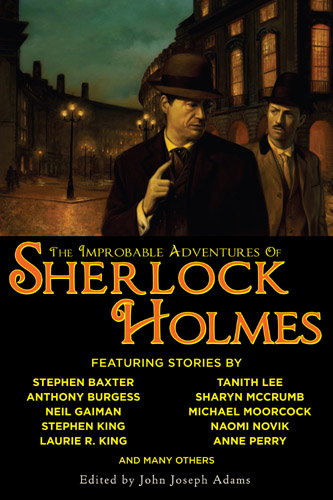
THE IMPROBABLE ADVENTURES OF SHERLOCK HOLMES.
By Various Hands. Edited by John Joseph Adams.
Night Shade Books.
2009. 350 pages.
More than two dozen Holmes pastiches which most reviewers seem to like. These excerpts are from Rod Lott's review (BOOKGASM, December 10, 2009):
Short of revisiting Arthur Conan Doyle’s original texts, you may not have more fun with the great detective than in Night Shade Books’ collection THE IMPROBABLE ADVENTURES OF SHERLOCK HOLMES. For this anthology with a nearly all-star cast of authors, editor John Joseph Adams has rounded up 28 genre-hopping mysteries, as old as 20 years and as new as this year. A handful have never seen print before.
From pirates to spirits, IMPROBABLE covers a lot of genre-fiction tropes, yet every author hews closely to Doyle’s winning, winsome storytelling style.
Another, slightly different take (excerpt):
Some of my favorite stories in this collection are the ones that follow the traditional Doyle formula. And then there are the stories that push the boundaries, taking the reader out of his or her comfort zone and pitting Holmes and Watson against dinosaurs, aliens, demonic spirits, pirates and the like. Some of these unconventional tales are entertaining while others are just too far removed from the Doyle canon for my tastes. — John
A review of the audio book is here.

Category: Detective fiction

Friday, November 22, 2013

What's Up, Doc?

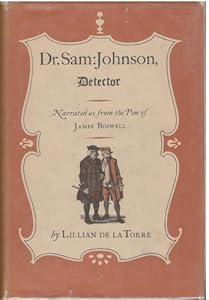
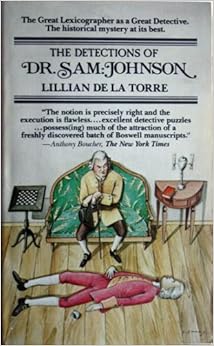
DR. SAM: JOHNSON, DETECTOR.
By Lillian de la Torre.
Knopf. 1946. $2.75
Lillian de la Torre (1902-1993) posthumously explains "How Dr. Sam: Johnson Became a Detector" (CRIMINAL BRIEF, July 20, 2009):
Such were the men, and such was the setting, that flashed into my mind that day. Soon plots of mystery and detection began to form themselves around many of the striking events, the picturesque scenes, and the eccentric personalities of that fascinating time; and Dr. Sam: Johnson as detector dominated them all.
From THE SATURDAY REVIEW (November 30, 1946):
Nine exploits of Great Lexicographer as detective in Georgian England, "narrated as from pen of James Boswell" in flavorous, authentic fashion. - Taken in judicious doses this admirably turned-out book is good hunting and good fun. At one sitting it may be cloying. - Verdict: For specialists.

Category: Detective fiction