Monday, May 16, 2016

April's Top 5

For T. S. Eliot, April might have been the cruelest month but for us here at ONTOS it wasn't half bad (and the same goes for the past two years):

April 2016
(1) An Odd Assortment from '28 - HERE
(2) A MacDonald Duo - HERE
(3) "You Might Say This Is the Story of a Murder — Although Nobody Was Killed" - HERE
(4) "It Was a New Strategy in Criminal Warfare, Killing People with Laughter" - HERE
(5) WHODUNIT Comics - HERE

April 2014
(1) "The Author Outdoes Himself in the Number of People Upon Whom He Brings Suspicion" - HERE
(2) "It Shows Just How Bad a Detective Story Can Be" - HERE
(3) True Crime Roundup - HERE
(4) Samuel Lyle, A Very Obscure Criminologist Indeed - HERE
(5) "He Is Concerned Mainly to Give His Readers the Indispensable Thrill" - HERE

April 2015
(1) A Short Note About Victorian Detective Fiction - HERE
(2) Levram Niatpac! - HERE
(3) A Noir Film (or Maybe It Isn't) That Isn't Noir (or Maybe It Is) - HERE
(4) "I Do Not Dismiss Logic Because I Have Faith" - HERE
(5) SCRIBNER'S Reviews I - HERE

Sunday, May 15, 2016

"It Appears To Be An Impossible Crime, but There Are No Impossible Crimes, Only Misunderstood Crimes"

"The Stolen Saint Simon."
By Michael Kurland (born 1938).
First appearance: The Mammoth Book of Locked-Room Mysteries and Impossible Crimes (2000).
Reprinted in Images, Conceits & Lollygags (2003).
Novelette (24 pages).
Link to story gone.
"It's this old picture. It's disappeared. The way they tell it, there's no way it could have gone, and there isn't anyone who could have taken it, but it's gone any-way."
A painting worth $1.2 million and with a pedigree up to here goes missing from an LA apartment under impossible circumstances, irritating the insurers enough to hire the services of Continental Investigations & Security, who quickly drop the case squarely in PI Stanley Baum's lap.

Before he can complete his investigation of the missing masterpiece, however, Baum is confronted with another crime, a murder in a locked room just across the street from the first one. Are the two cases somehow related? Initially they don't seem to be, but some smudges on a glass pane, a little dab of putty on a window sill, some plaster dust, a coil of rope on top of a garage, a misplaced rung on a curtain rod, and some undue hostility on the part of a suspect all, in our detective's mind, add up to one crime.

Main characters:
At Continental Investigations & Security's Los Angeles branch:
~ Abe Wohlstein (a.k.a. Junior):
   ". . . older than sin and not at all presentable, but he knows everything there is to know and he runs the place."
~ Stanley Baum, our narrator:
   "There was a copy of the original insurance application; an international form with all the questions asked in three languages above neat rectangular boxes just too small to write in the answers. The questions had been answered in English, I noticed, in a small, round hand written with a fine point fountain pen. We detectives notice details like that."
At Fid Mut:
~ Jamieson:
   "A short, narrow, prissy-looking man with a thin black moustache above thin lips, he looked as though he was prepared to disapprove of me at the slightest provocation. But maybe that's just the way he looked."
At large:
~ Graf Maximilian Czeppski:
   "A tall man with rounded corners wearing a brown suit, a white, button-down shirt with vertical green stripes, and a forest-green tie as wide as his smile, he shook my hand with a hardy, vice-like grip. I managed to pull the hand free before any of the larger bones were broken, and returned his smile."
~ Grafin Sylvia Czeppski:
   "She seemed distinctly annoyed at having to speak to me. I couldn't tell whether it was because I was a detective or because the lapels on my jacket were too narrow."
~ Paula Czeppski:
   "The daughter, sitting on the couch at the short end of the L, was the woman I had been dreaming about at least once a week since I was seventeen. I won't tell you what sort of dreams they were, but I imagine you can guess."
~ Gibson:
   "'Don't say anything else until I read you your rights. This time we’ve got you cold!' His name was Gibson, and we'd worked together on a few cases here and there in the past."
Others:
~ Feodore, Maria, Estafia, and Dr. Gadolfus.
Arresting passages:

   "'The way they tell it, it's simply impossible.' He smirked. 'But we know there's nothing impossible, don't we?'
   "I told Jamieson that I'd take his word for it, that epistemology wasn't my field, and sug-gested that he get on with the story. He looked at me with a hurt expression, as though he had just been bitten by a pet guppy."

   "'You offering a reward?' I asked. A polite way of asking whether Fiduciary Mutual was willing to buy the painting back from the thieves. They always were unless they thought it was an inside job. Most insurance companies have the ethical standards of rattlesnakes without the rattles. They should be required by law to tie rattles on as a warning when 
dealing with claimants."

   "'The police and I have different goals.'
   "'Yes,' Grafin Sylvia said. 'The police are trying to catch the miscreant who took our picture. You are trying to find a way to avoid paying us one million and two hundred thousand dollars'."

   "'I think what we got here is the invisible man. You know – like the Shadow. The guy possesses the power to walk out of rooms without nobody seeing him.'
   "I raised one eyebrow, a gesture I've been trying to perfect since high school. 'Life is a glorious cycle of song!' I said. 'Two impossible crimes on the same day'."

Typo: "Fid Must".
Resources:
- Unlike so many authors who have appeared in these webpages, Michael Kurland is still happily very much with us, turning out fine Sherlock Holmes/Professor Moriarty and Lord Darcy pastiches, with more than a few nifty impossible crimes tossed into the mix: Wikipedia HERE, the SFE HERE, the ISFDb HERE, and his own webpage HERE.

The bottom line: "'I have committed another crime, Hadley,' he said. 'I have guessed the truth again'."
   — Gideon Fell

Saturday, May 14, 2016

"This Bandit Robs with the Law Behind Him"

"Prospectors of Space."
By Malcolm Jameson (1891-1945).
First appearance: Thrilling Wonder Stories, September 1940.
Collected in The Giant Atom (2013).
Short story (10 pages).
Online at UNZ HERE.
"'Join Spaceways and See the Universe' Was the Slogan for All Pilots—But Not if You Wanted a Place in the Sun!"
First come the pioneers, the explorers who take all the chances; afterwards, usually sooner than later, comes bureaucracy to stifle free enterprise, at which point even the entire Solar System isn't big enough.

Neil Allen and his dad, freelance asteroid prospectors and miners on the Klondike, are feeling the dead hand of corporate state monopoly clamping down on their shoulders, pushing them away from what is theirs by right and, indirectly, costing the old man his life:

   "Allen closed his eyes. Neil waited, but the old man had dropped off to sleep. He never woke up . . ."

Unlike his father, though, young Neil refuses to give in to the pressure:

   "After his father's funeral on Earth, Neil Allen wasted no time in the personnel offices of the big companies. There was only one that he knew much about. But the thought of that one filled his heart with bitter rage, a hatred he focused on Horvick, its managing director and principal stockholder. His love of independence, inherited from his father, made him scorn employees as mere robots manipulated by schemers. Instead, he planned . . ."

Along with his planning Neil will do some smart lateral thinking, including a clever applica-tion of the jū yoku gō o seisu principle, letting his enemies bring themselves down.

Major characters:
~ Old man Allen, Neil's father:
   "Let's face facts, Neil! Space prospecting is a thing of the past. As a freelance, I was able to follow my hunches and not have to wrangle with a bunch of Earth-bound directors. You won't be able to freelance. You've learned an obsolete occupation. In my day, there was the whole Solar System to work in . . ."
~ Horvick, General Superintendent of Space Mines:
   "You have your notice, Allen. Call your men and get out."
~ Neil Allen, captain of the Klondike:
   "I appeal to you in the name of the Law. This man has no right to put me off my ship into the void."
~ Sam Bowen, captain of the Golconda:
   ". . . Horvick won't take it lying down. Our dads were pretty foxy, and he cleaned 'em every time. I'm with you a hundred per cent, but he's got me plenty worried."

Typo: "transcient vessels"
Resources:
- Malcolm Jameson's great-granddaughter, Wendy McClure, has a site dedicated to him HERE.
- There's more about our author HERE (Wikipedia), HERE (the SFE), and HERE (the ISFDb).
- Jameson evolved his own analog of Horatio Hornblower in a popular sequence of stories; Fletcher Pratt briefly reviewed a posthumous collection of them:
"Bullard of the Space Patrol," by the late Malcolm Jameson, which is quite frankly a series of connected shorts and quite as frankly directed at the upper level of adolescent readers. Jameson, a Naval officer himself, has simply and ingeniously altered the problems and customs of the U. S. Navy to what might be encountered in a space navy, taking his Bullard from cadet up to high admiral. The result is really good reading for the age group intended. — Fletcher Pratt, "Fiction Flights in Space & Time," The Saturday Review, February 23, 1952 (HERE).
The Bullard stories:
   1. "Admiral's Inspection" (1940)
   2. "White Mutiny" (1940)
   3. "Blockade Runner" (1941)
   4. "Slacker's Paradise" (1941)
   5. "Devil's Powder" (1941)
   6. "Bullard Reflects" (1941)
   7. "Brimstone Bill" (1942)
   8. "The Bureaucrat" (1944)
   9. "Orders" (1945)
   Collection: Bullard of the Space Patrol (1951) (for sale HERE).
- Jameson's science in this story is a little sketchy, especially regarding the Draconids meteor shower; go HERE for facts about the Draconids.

The bottom line: "Wealth stays with us a little moment, if at all: only our characters are steadfast, not our gold."
— Euripides

Friday, May 13, 2016

"A Concentrated Silent Rage"

"Levison's Victim."
By Mary Elizabeth Braddon (1835-1915).
First appearance: (?).
Collected in Weavers and Weft, and Other Stories (1877).
Reprinted in Victorian Tales of Mystery and Detection (1992).
Short story (15 pages).
Online at SFFAudio HERE (PDF) and HERE (go to page 228).
"Ah, Horace, I see there is a woman at the bottom of your trouble!"
A couple of college chums encounter an old acquaintance during their holiday in Germany—Horace Wynward, a young man who seems far different from how they remember him, now damaged with life's cares and so distracted that at first he doesn't even recognize them. He finally, if reluctantly, relates his tale of woe to his friends; and what a story it is, a sad account of unrequited love, violent jealousy verging on madness, blackmail leading to a forced marriage—and murder (in other words, Victorian sensation fiction at its best). Poor Horace has every right to just curl up into a ball and die, but he refuses to do that until he has tried a little "experiment" first . . .

Principal characters:
~ George Theobald:
   "I saw quite enough. His face has a worn haggard expression—he looks like a man who never sleeps; and there's a fierceness about the eyes—a contraction of the brows, a kind of restless searching look—as if he were on the watch for some one or some thing."
~ Horace Wynward:
   "I would shoot that man down with as little compunction as I would kill a mad dog."
~ Francis (Frank) Lorrimore:
   "I hope you may never meet him."
~ Emily Daventry:
   "The experiment which you proposed has succeeded only too well."
~ Laura Daventry:
   ". . . to my mind, the loveliest girl that ever the sun shone upon.  . . . She was the dearest, brightest of girls, with a happy disposition that won her friends in every direction; and a man must have had a dull unimpressionable nature who could have withstood her charm."
~ Mr. Daventry:
   "He was very ill, with the stamp of death upon his face, and had a craven look that convinced me it was to him I was indebted for my sorrow."
~ Michael Levison:
   "He told me that he had never seen anything so appalling as Levison's jealousy; not an open fury, but a concentrated silent rage, which gave an almost devilish expression to the man's parchment face."

Resources:
- Several articles that discuss Mary Elizabeth Braddon are HERE (Wikipedia), HERE (Dr. Pete Orford), HERE (Victorian Web), and HERE (Curtis Evans); for her supernatural tales she rates a mention on the ISFDb HERE.
- ManyBooks, for one, has quite a few of Braddon's productions HERE.

The bottom line:
   "You seem to have quite a taste for discussing these horrible subjects," she said, rather scornfully; "you ought to have been a detective police officer."
   "I sometimes think I should have been a good one."
   "Why?"
   "Because I am patient."
      ― Lady Audley's Secret

"What's So Risky About a Hop to Venus?"

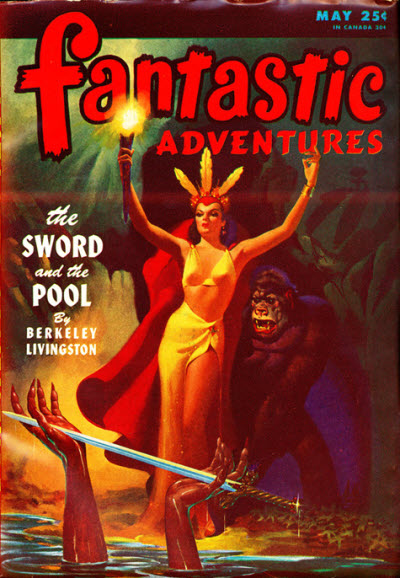
Herbert B. Livingston turned out a substantial amount of pulp fiction over the years under the "H. B. Hickey" alias, with some of it combining SF/fantasy and crime fiction tropes into an agreeable mélange. Here are two such:

(1) "Finished by Hand."
By H. B. Hickey (Herbert B. Livingston, 1916-87).
First appearance: Fantastic Adventures, May 1946.
Short short story (7 pages).
Online at UNZ (HERE).
(Parental caution: Violence.)
"Carney and Mose thought it was a smart trick to cut off a thief's hands—but they were thieves too!"
An old saying assures us there's no honor among thieves; when Mose, Carney, and Guido carry out a plan to circulate counterfeit bills, one of them proves it by framing one of his partners in crime and then murdering him. The way looks clear for the traitor, until a dead man gives him a hand—in fact, two of them:

   ". . . The red flame that followed the impact engulfed both car and truck. In a few minutes they were fused together in an inseparable tangle . . ."


~~~
(2) "To Dust Returneth."
By H. B. Hickey (Herbert B. Livingston, 1916-87).
First appearance: Fantastic Adventures, February 1948.
Novelette (22 pages).
Online at UNZ HERE.
(Parental caution: Violence.)
"They went to Venus in search of a rare metal — but found instead a dread life-force that crumbled life to dust."
The prospect of a fortune worth millions of dollars has been known to move men to take great risks, but what if that fortune is buried in the crust of a hostile planet twenty-five million miles away, and just getting at it means putting your life in danger every moment? More to the point: When does a legitimate search for wealth turn into an excuse for homicidal greed?

   "He stopped abruptly and stared at Simms. There was complete understanding in the glance that passed between them. Why split at all?"

It's the same old story: Murderers never seem to learn that sooner or later there's a bill coming due for their treachery:

   ". . . across the fantastically jumbled red wasteland of Hanan the living dead implacably plodded toward revenge!"
Nice phraseology:
   "Gathering dusk spread its mantle and the breeze whispered a requiem."
   "The sea had become luridly phosphorescent and the rocket ship showed black against the sea of cold flame."

The planet Venus as imagined in the '40s . . .

   "THE very air glowed red about them, colored by the land beneath. Rock was piled on rock and where there were no rocks the red sand shifted like the waves of a sea. And the sea! Wine red, its roaring surf was like the froth of Sparkling Burgundy. Jim Moyne broke the silence. 'Well, I'll be damned, but this beats 'em all! A grapejuice ocean!'"

   "It was apparent that the storm would be on them in a matter of seconds. The darkness grew ever deeper and was broken only by flashes of lightning which illuminated the scene with a red flame as from an inferno. Thunder which threatened their eardrums rolled in, wave upon wave, until the ground beneath trembled, and the rain was no rain but rather the ocean being inverted."

. . . and Venus as understood today (HERE).
Typo: "If this water is so viscuous".

Resources:
- There's an H. B. Hickey fan page (HERE) and, of course, bibliographical info at the ISFDb (HERE).
- Project Gutenberg (HERE) and ManyBooks (HERE) have precious few of Hickey's works available.
- Last year we highlighted another criminous SF story by this author (HERE).

The bottom line: "We are but dust and shadow."
   — Horace

Wednesday, May 11, 2016

"I Never Could Figure Out These Locked-room Things"

"Really It Was Quite Simple."
By Evelyn E. Smith (1922-2000).
First appearance: EQMM, May 1953.
Reprinted in Ellery Queen's Mystery Magazine (UK), May 1953.
Short short story (5 pages).
Online at SFFAudio HERE (PDF).
"And that was all you did? And here I've been looking for some devilishly ingenious and complicated scheme."
When Colonel Whikehart, for whom travel has obviously been broadening, makes a wager with Sir Odo claiming he can pull off a locked room mystery, there will be a loser; after finishing this story, however, some readers may feel they're the ones who've lost the bet. YOU HAVE BEEN WARNED!

Principal characters:
~ Biestleigh:
   "Why, when I read a thriller, I never understand precisely how the murderer did it, even when it's carefully explained in pages and pages at the end."
~ Sir Odo:
   "Anyhow, those locked room affairs are utterly preposterous. Wouldn't work in reality."
~ Colonel Whikehart:
   "Oh, I don't know. I'll lay you a fiver that I can shut myself up in a room with young Biestleigh here; and, at the end of ten minutes, you can come, find all the doors and windows — except the one you come in by, of course — locked, young Biestleigh dead, and no sign of me."
~ Pottridge:
   "Lot of tosh."

Resources:
- Evelyn E. Smith was primarily a science fiction writer: Wikipedia HERE, the SFE HERE, and the ISFDb HERE; some of her best short SF is available on Project Gutenberg HERE and SFF Audio HERE (14 stories as of January 4, 2025).
- "Really It Was Quite Simple" appears to be her only submission to EQMM to see publica-tion, but she did have a popular mystery series "which," according to Wikipedia, "chronicles the exploits of a middle-aged socialite-turned-assassin":

Miss Melville Mysteries:
    1. Miss Melville Regrets (1986):
    2. Miss Melville Returns (1987):
    3. Miss Melville's Revenge (1989)
    4. "Miss Melville Rejoices" (1991) (short story)
    5. Miss Melville Rides a Tiger (1991):
    6. Miss Melville Runs for Cover (1993).

The bottom line:
   Tenkaichi: "You know, I'm just getting fed up with all these old tricks. Nonetheless, locked-room murders keep on popping up. Why do you think that is?"
   Fuji: "Who knows?"
   Tenkaichi: "That's because 'locked-room murder' is the king of all tricks."
      — Meitantei no Okite

Tuesday, May 10, 2016

"Funny Thing 'appened Tonight"

"The Eighth Lamp."
By Roy Vickers (1889-1965).
First appearance: The Novel Magazine, July 1916.
Reprinted in More Uncanny Stories (1918); Ghost Stories, March 1930; Ghost Stories and Other Queer Tales (1931); The Magazine of Fantasy and Science Fiction, July 1958; John Creasey Mystery Magazine, March 1960; Venture Science Fiction (UK), August 1965; and Macabre Railway Stories (1982).
Short story (15 pages).
Online at SFFAudio HERE (PDF).
"You ain't 'ung him already?"
If they were to learn about his predicament, everybody would say that George is seeing things, and George himself probably wouldn't disagree if he weren't so sure they were happening; but this job of railroad signalman is very important to him, especially with a new and demanding woman to win over and support, so he keeps at it, even though performing his tasks in the dark, dank Cheyne Road railway tunnel long after midnight sometimes has him nearly paralyzed with fear.

For George, the worst part of his job should be the easiest: All he has to do is turn off eight illumination lamps after the last train has run; simple, yes, but simple doesn't always mean easy. In the murky tunnel, something is stalking him, something even stronger, more profound, and deadlier than fear . . .

Principal characters:
~ George Raoul:
   "He had something of considerable importance to report, but he knew that if he were to make that report he would probably be marked down as unfit for night duty, and he could not afford to risk that at present."
~ Jinny:
   "I can put two an' two together, same as anyone else, an' I started takin' notice of what he was talking about in 'is sleep."
~ The constable:
   "Why, you was running like a house afire! What's going on down there, then?"
~ Mabel Owen:
   "Blessed if it ain't George Raoul! 'Ow goes it, George? Seems ages since we met, don't it!"
Others:
~ Mr. Jenkins, the stationmaster; the loafer; and the police Inspector.
Diverting passages:
   "During the last three weeks he had seen something of Jinny's nature; and although his animal love for her had in no way abated, he had a pretty shrewd suspicion that she would not face even temporary destitution with him."
   "In her eye there was nothing of accusation. But there was nothing of doubt."
   "With the first taste of the bitterness of his sin came remorse; and with remorse came, with renewed strength, the terror which he had partly beaten back."
   "The odd fatalism of his class prevented him from shirking the lights on the down-platform. What has to be will be. The same fatalism drove him ultimately to dousing the eighth lamp and turning, like a doomed rat, to face the already rumbling horror of the tunnel."
   "The Inspector waited unmoved. He believed not at all in the genuineness of Jinny's grief; but convention had its claims, and he said nothing until the storm of tears had subsided."

Typo: "the eighth lamps was extinguished."
Resources:
- Just the other day we hit the rails with another train-related mystery; go HERE for that story.
- We've also previously dealt with spectral locomotives HERE.

The bottom line: "Every guilty person is his own hangman."
  — Seneca the Younger