Friday, November 22, 2013

Four Classics from CLASSIC MYSTERIES

Les Blatt reviews Gladys Mitchell's THE RISING OF THE MOON (1945), featuring "the always eccentric and occasionally horrifying Mrs. Bradley":
[Mitchell's] books are often favorably compared to Agatha Christie and Margery Allingham. She was never as popular in the United States as in Britain. I found 'The Rising of the Moon' to be one of her most accessible to an American audience.
From the GAD Wiki:
One of the most over-rated mysteries (for it cannot be called a "detective story" proper) of the previous century. Despite the pervasive first-class atmosphere, the plot is very weak, the ending so opaque as to be totally confusing . . . [In general] her books are comic, surreal and full of vitality and energy, and more interested in people's eccentricities and foibles and the small joys of life (history, travel, food, literature, architecture, mythology, landscape) than in unbreakable alibis. One always remembers the setting and people more than the plots. — Nick Fuller
If this novel is typical of Mitchell, then she is one of those bad writers who is nonetheless an original. Like, for instance, Harry Stephen Keeler, she appears to know exactly what she wants to do, and will not be deterred by any considerations of realism or even common sense. — John
Les also has a discussion of John Sladek's INVISIBLE GREEN (1977):
. . . a well-plotted (and fairly convoluted) impossible crime mystery [in which] a freelance detective, Thackeray Phin, must try to solve what appears to be a motiveless string of impossible crimes. One death, for example, takes place in a locked room. Another took place in a house that was closely watched. Is the murderer, the elusive Mr. Green, really invisible?
Additionally, Les reviews R. Austin Freeman's THE MYSTERY AT NUMBER 31, NEW INN (1911):
It's a solid, well-constructed mystery, featuring Dr. Thorndyke, who became a favorite among mystery readers through much of the first half of the 20th century.
Also from the GAD Wiki:
'31 New Inn' shows Thorndyke at his most typical . . . The crime itself is particularly nasty, and all the more so in that it is presented without all the explicit gore and horror one would find in a modern author. As usual, there are some nicely quotable passages . . . As a pure detective story, the novel is rather weak (the author then being a novice) . . . — Wyatt James
And let's not forget Christianna Brand's GREEN FOR DANGER (1944):
. . . a well-written, fully developed novel with believable, sympathetic characters—and while we are soaking up the atmosphere and enjoying those characters, the author suddenly produces a series of plot twists and developments which will leave readers dazzled. And yet the deceit is scrupulously fair.
The Wiki again:
Inspector Cockrill is tasked to determine whodunit when the head nurse is killed after revealing that the death of a patient under anesthesia was no accident. Cockrill states at one point, "My presence lay over the hospital like a pall—I found it all tremendously enjoyable."

Category: Detective fiction

A Galloping Plot

JULIET DIES TWICE.
By Lange Lewis.
Bobbs-Merrill.
1943. $2.00

John (PRETTY SINISTER BOOKS, November 20, 2013) feels this one is a mixed bag.  Excerpts:
. . . when I encountered three bugaboos of mystery fiction I thought "Uh oh" and the red flags went off for a trip into the land of cliche and run-of-the-mill plotting.
There are a few twists that call to mind some of the best from Agatha Christie’s cabinet of magic tricks.
[However] the story is redeemed by Lewis' crisp writing and her cast of supporting players.
A contemporary opinion (THE SATURDAY REVIEW, February 20, 1943):
Cal. amateur actress fatally bludgeoned in prop room. Girl psychology student finds corpse and Lieut. Tuck carries on from there. - Abnormal human behavior made disturbingly real in plot that gallops through tense situations to startling climax in Hollywood Bowl. - Verdict: Loud applause.
Other Lange Lewis reviews:

MURDER AMONG FRIENDS (1942):
"Out-of-the-ordinary."
"... a heart wrenching story of a woman seemingly doomed by Fate and circumstance ..."

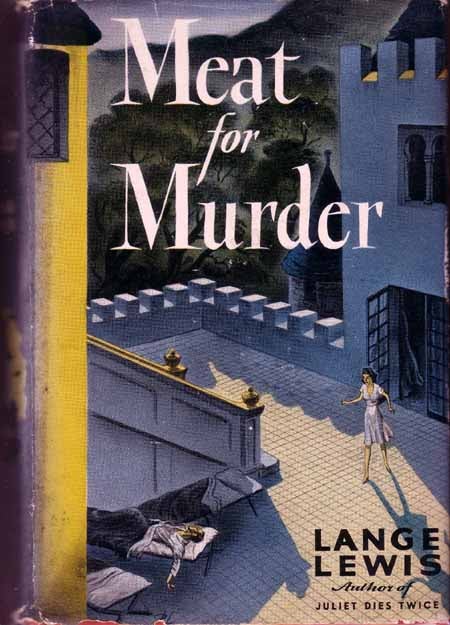
MEAT FOR MURDER (1943):
"Plenty of fantastic local color . . ."
THE BIRTHDAY MURDER (1945):
". . . a solution that may or may not be cricket."
THE PASSIONATE VICTIMS (1952):
"Worthwhile."

Category: Detective fiction

Thursday, November 21, 2013

"The Ultimate in Uniqueness"

THE DAFFODIL AFFAIR.
By Michael Innes.
Dodd, Mead.
1942. $2.00
A review of Michael Innes's novel is on Steve Lewis's MYSTERY*FILE weblog:
I have never read a mystery or detective story that is ANYTHING like this one. In terms of being unique, this one's the ultimate in uniqueness.
Other views:
Utterly bizarre, yet quintessential Innes . . . the plot is solid and complex enough, rendering what would otherwise be very silly, believable. — Nick Fuller
Although there is some detection of a sort, it's probably more accurate to classify this as an Edgar Wallace style thriller, possibly the best such ever written. — Curt Evans
A contemporary review (THE SATURDAY REVIEW, September 26, 1942):
Girl, horse and house disappear from London and York. Inspector Appleby traces them all. - Amazing goings on in England and South America. Breaks all the rules, but is good writing and swell fun. - Verdict: For initiates.
Category: Detective fiction

"The Detective Story Boiled Down to Its Essential Parts"

MANY A SLIP.
By Freeman Wills Crofts.
Hodder & Stoughton.
1955. 188 pages. Used copies: Pricey.
Short story collection.
Online at Archive.org (HERE; borrow only).

Martin Edwards reminds us of a largely overlooked book by Freeman Wills Crofts:
Crofts was one of the giants of detective fiction's Golden Age, creator of Inspector French and master of plots hinging upon a seemingly unbreakable alibi. His most famous books were novels, but 'Many a Slip' is a collection of short stories.
For some readers, however, Crofts has been less than endearing:
There is no doubt that Freeman Wills Crofts is often highly ingenious, adept at constructing elaborate murder plots based on the ramifications of train timetables or the speed of motorboats. There is equally little doubt that he is also the dullest writer of detective fiction ever.
His much-vaunted ingenuity is the horrible ingenuity of an algebraic statement which may be satisfying to solve once, but becomes excruciating over forty years and nearly forty books.
His characters are sheer cardboard; his detective, Inspector French, does nothing but plod from place to place, devouring British Railway sandwiches with delight while interrogating witness after witness, a process which saves him having to use his brain; and the books are extremely repetitious and formulaic. There is no life to them—nothing to make the reader want to keep turning the pages except for the puzzle-solving instinct.
They are the detective story boiled down to its essential parts—and as stodgy and unappetising as cold porridge. — GAD Wiki

Category: Detective fiction

An Unsettling Sense of Justice

CARNIVAL OF CRIME: THE BEST MYSTERY STORIES OF FREDRIC BROWN.
By Fredric Brown. Edited by Francis M. Nevins and Martin H. Greenberg. Introduction by Bill Pronzini.
Southern Illinois University Press.
1985. 336 pages. Current prices: $49 and up.
Collection: 23 stories.
No e-book available.

Cullen Gallagher (PULP SERENADE, May 2, 2009) reviews this posthumous collection of stories by Fredric Brown:
. . . I was struck with this realization: Yes, Fredric Brown does believe in justice—but what an unsettling, discomforting sense of justice. The old adage is that the punishment should fit the crime, but in Brown's paradoxical world, the punishment always fits the criminal. A slight difference in rhetoric, but astronomical when put into practice.
More about Brown is here.

Category: Detective fiction

Wednesday, November 20, 2013

"I Have Always Had a Suppressed Desire to See a Grave Opened"

THE VERDICT.
Warner Brothers.
1946. 86 minutes.
Wikipedia offers a spoiler-free description of this film starring the irreproducible screen team of Greenstreet and Lorre.
As for Zangwill's original story:
One of the burning questions in 'The Big Bow Mystery' is how the culprit carried out the crime, given the bedroom door was not only locked but also bolted on the inside. Various theories are suggested in letters to the press, including a monkey with a razor coming down the chimney, the removal and replacement of a window pane or a door panel, a culprit hiding in the wardrobe who managed to escape unnoticed when the door was broken down, and secret passages and trap-doors! — Mary Reed
Clues are fairly thin on the ground, and the solution turns out to be one that a modern reader would have entertained from the beginning. It remains quite readable, though, and there is some nice interplay between the characters which is well observed. — Jon Jermey
A related article is here.

Category: Detective fiction

A Fatal Osculation

THE DEATH KISS.
Tiffany Pictures.
1932. 75 minutes.
Bela Lugosi once made a whodunit. No, really:
'The Death Kiss' should be a nice surprise for those who like traditional murder mysteries. It's a movie within a movie and both have the same title . . . There are enough red herrings to keep the viewer guessing and the pacing is quite fast even with limited action sequences. — "aimless-46" on IMDb
Creepy and criminous:
On the surface, Edwin L. Marin's 'The Death Kiss' appears to be a return to Transylvanian terror—especially since Lugosi was joined in the cast by two other 'Dracula' principals: David Manners and Edward Van Sloan. The title and the casting seem to indicate that Lugosi would once again be creeping into sleeping maidens' boudoirs and preying on their innocence. But he doesn't.
'The Death Kiss' is full of surprises, and this is just one way in which the film toys with the audience's expectations. Not just another vampire movie, this low-budget production is actually a whodunit mystery, cleverly set on the soundstages of a financially strapped movie studio. — Bret Wood on TCM Movie Database (where there be SPOILERS).
The film was based on the 1932 novel of the same name by Madelon St. Dennis.

Category: Detective fiction