Monday, March 7, 2022

"No One Escapes from Hades"

"Faithfully Yours."
By Lou Tabakow (1915-81).
Illustrations by Emsh (1925-90; HERE).
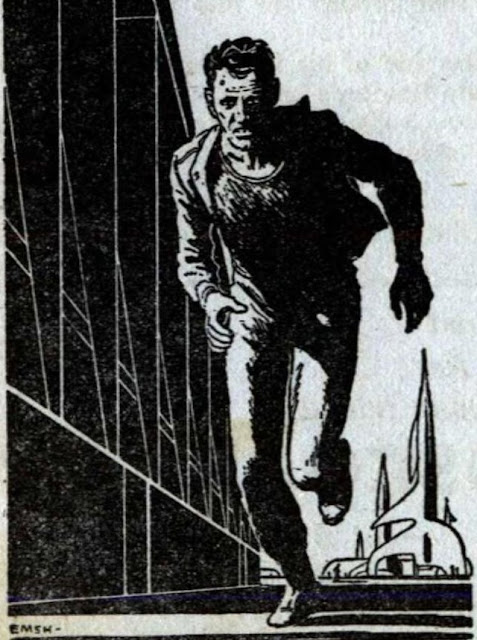
First appearance: Astounding Science Fiction, December 1955.
Reprints page (HERE).
Short story (15 pages).
Online at Archive.org (HERE).
     
     "On and on past the thinning stars raced the patient electronic bloodhound; invisible, irreversible, indestructible; slowly, but inexorably accelerating."

Just like Dante in his Divine Comedy, Tee Ormond must travel through Hell and Purgatory, to reach, at long last, Heaven; it's too bad he can't stay there . . . .

Main characters:
~ The biophysicist:
  "He got clean away."
~ The Director:
  "You have the pattern, I presume. Feed it to Fido!"
~ Jo:
  "How about another rainbow? If you get enough of them in you, you won’t notice the heat — you won’t notice anything."
~ Tee Ormond:
  "Tee whipped a stun-gun from inside his jacket and waved it at the clerk’s back. It caught him in midstride, and unbalanced, he crashed heavily to the floor. Tee glanced briefly down as he stepped over the paralyzed form, avoiding the accusing eyes, and snatched the magnetic key off the hook."
~ Yule Larson:
  "I'm offering you a full partnership on a two million credit salvage deal and you want to back out because it’ll take six months. On top of that you’re broke and stranded and your hanger bill gets bigger every day. If you don’t take me up on this deal, you’ll still be sitting here six months from now wondering how to get your ship out of hock — if you don’t get caught first."
~ Jenner:
  "You can’t wait a month? We’ve got four million tied up in that ship and you tell me you can’t wait a month."
~ The prison administrator:
  "Hades has six billion prisoners at any given time. If one did manage to escape, they couldn't very well alert a million planets. Each planet has its own police force and handles its internal crime in its own way. What’s legal on Aurora might very well be illegal on ten thousand other planets and vice versa."
~ Dr. Chensi:
  "Yes, the old settlers named our planet well."
~ Lara:
  "I think we should start the patient walking tomorrow. Now you’d better get some sleep. You’re still very weak, you know."
~ Ary Mefford:
  "It’s already too late. I’m sorry."

Typo: "hanger bill".

References and resources:
- "the Okefenokee Swamp": "Way down upon the Swanee River":
  "The Okefenokee Swamp is a shallow, 438,000-acre (177,000 ha), peat-filled wetland straddling the Georgia–Florida line in the United States" (Wikipedia HERE; also see HERE).
- "a type G sun": Like everything in nature, stars come in all sizes and colors:
  "A G-type main-sequence star (Spectral type: G-V), often called a yellow dwarf, or G star, is a main-sequence star (luminosity class V) of spectral type G. Such a star has about 0.9 to 1.1 solar masses and an effective temperature between about 5,300 and 6,000 K. Like other main-sequence stars, a G-type main-sequence star is converting the element hydrogen to helium in its core by means of nuclear fusion. The Sun, the star to which the Earth is gravitationally bound in the Solar System, is an example of a G-type main-sequence star (G2V type)" (Wikipedia HERE).
- "Elysia. I seem to remember an old old myth brought from the original Earth":
  "Elysium, otherwise known as the Elysian Fields (Ancient Greek: Ἠλύσιον πεδίον, Ēlýsion pedíon) or Elysian Plains, is a conception of the afterlife that developed over time and was maintained by some Greek religious and philosophical sects and cults. It was initially separated from the Greek underworld—the realm of Hades. Only mortals related to the gods and other heroes could be admitted past the river Styx. Later, the conception of who could enter was expanded to include those chosen by the gods, the righteous, and the heroic. They would remain at the Elysian Fields after death, to live a blessed and happy life, and indulge in whatever employment they had enjoyed in life" (Wikipedia HERE).
- "A line from an old poem sprang to his mind: 'We are the dead, row on row we lie — '": Over a hundred years old but still not completely forgotten:
  "'In Flanders Fields' is a war poem in the form of a rondeau, written during the First World War by Canadian physician Lieutenant-Colonel John McCrae. He was inspired to write it on May 3, 1915, after presiding over the funeral of friend and fellow soldier Lieutenant Alexis Helmer, who died in the Second Battle of Ypres" (Wikipedia HERE).
- "The close-packed suns of the central hub lay far behind. Here at the rim of the galaxy the stars lay scattered, separated by vast distances": The Milky Way galaxy is, to put it mildly, rather large—and yet, compared to the universe, it's like a grain of sand on a beach:
  "The Milky Way is a barred spiral galaxy with an estimated visible diameter of 100,000–200,000 light-years. Recent simulations suggest that a dark matter area, also containing some visible stars, may extend up to a diameter of almost 2 million light-years. The Milky Way has several satellite galaxies and is part of the Local Group of galaxies, which form part of the Virgo Supercluster, which is itself a component of the Laniakea Supercluster. It is estimated to contain 100–400 billion stars and at least that number of planets. The Solar System is located at a radius of about 27,000 light-years from the Galactic Center, on the inner edge of the Orion Arm, one of the spiral-shaped concentrations of gas and dust" (Wikipedia HERE).
~~~~~~~~~~~~~~~~~~~~~~~~~~~~~~~~~~~~~~~~~~~~~~~~~~~~~~~~~~~~~~~~~~~~~~~~~

Wednesday, March 2, 2022

"Ojay Dart"

AT FIRST everything about the dead woman's estate seemed copacetic, until . . .

"The Furniture Talked."
By Everett Rhodes Castle (1894-1968).
Illustration by Walter Skor.
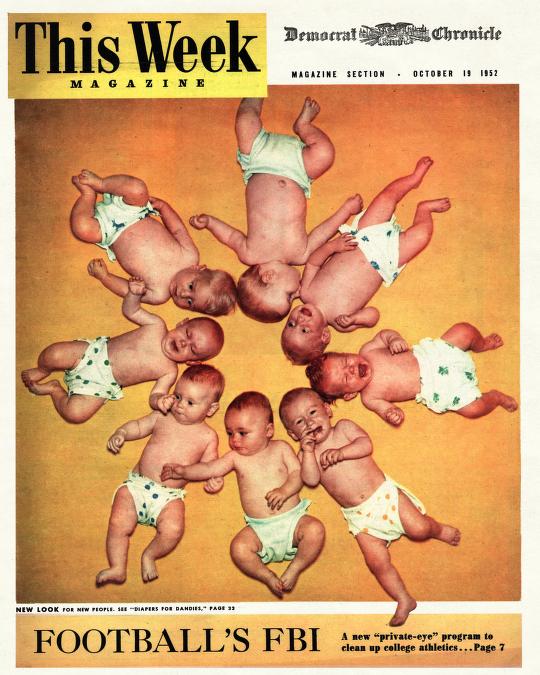
First appearance: This Week Magazine, October 19, 1952.
Short short story (6 pages).
Online at Archive.org starting (HERE), continuing (HERE), and finishing (HERE).

     "The thing didn't hit me until almost an hour later."

You can learn a lot from a lamp . . . .

Principal characters:
~ Doc Breene:
  "I had no idea when my telephone rang at two minutes of ten, that Fate had selected me to put the finger on one of the most audacious criminal conspiracies to hit our town in decades."
~ Lieutenant Arthur Mayo:
  "Hanky-panky."
~ Max Scoville:
  ". . . played it smart, too. He knew Martha wouldn't live forever."
~ Meggat:
  "With a tired little gurgle the butler pitched forward."

References and resources:
- "the Hepplewhite bookcase in front of me": If you happen to have one, you're set for life:
  "Hepplewhite produced designs that were slender, more curvilinear in shape and well balanced. There are some characteristics that hint at a Hepplewhite design, such as shorter more curved chair arms, straight legs, shield-shape chair backs, all without carving" (Wikipedia HERE).
- "a Chippendale card table": It'll cost you a pretty penny to play solitaire on it:
  "Chippendale furniture is much valued; a padouk cabinet that was offered for auction during 2008 sold for £2,729,250" (Wikipedia HERE).
- "genuine K'ang Hsi worth a king's ransom": Over 400 years old and still in one piece:
  "Delicate K'ang Hsi porcelain was loaded onto the 1715 Fleet galleons after a voyage halfway around the world from China aboard the Manilla Galleons in the Pacific Ocean. Mule trains from Acapulco to Vera Cruz would connect the trade routes and transport goods from the Pacific Fleet into the Atlantic Fleet" (Wikipedia HERE; info about the Chinese emperor who unwittingly lent his name to this style is HERE).
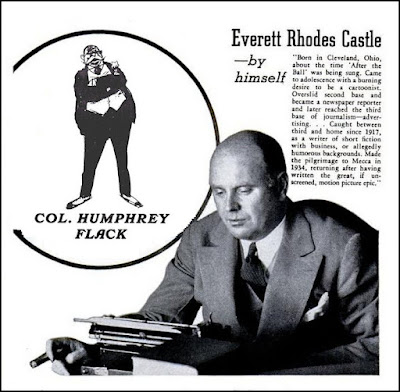
- From all appearances, Everett Rhodes Castle's publishing career was a long and lucrative one for him, stretching from 1917 to 1956 (FictionMags data), almost entirely in the high-paying slicks of the era. Castle had several series characters: Wet Smacks for the Saturday Evening Post (1931-32); Mr. Bullfinch in the Post (1933); Margaret Reddy, also in the Post (1934); Col. Humphrey Flack in the Post (1936-38, 1943, 1945, and 1946); Jefferson Davis Pope (in This Week, 1936-37); and Mrs. Tupper (This Week, 1938-39). One of them went on to star in the early days of TV.
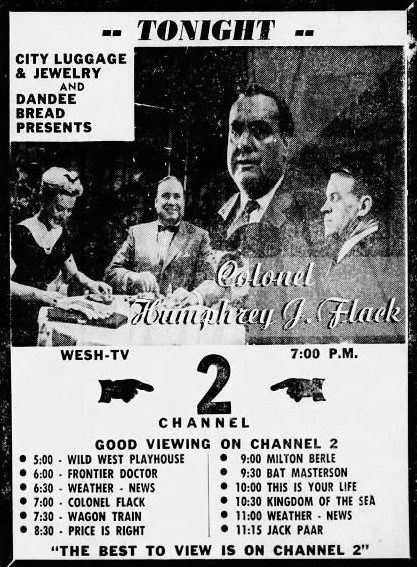
- Our author was also coincidentally involved with the pioneering efforts of post-World War II television programs through one of his series characters:
  "Colonel Humphrey Flack — Alan Mowbray, one of the founding members of the Screen Actors Guild, starred as the titular Flack, a con man who partnered with Uthas P. Garvey (played by Frank Jenks) to con other con men, and gave part of the money they 'borrowed' to those in need. The show, based on the short stories of Everett Rhodes Castle in the Saturday Evening Post, first aired on Wednesdays on 9 p.m. (then Saturday, then Friday) and ran from October 1953-July 1954, when it was cancelled (not before two guest appearances by Jack Klugman, however). But four years later, in a move that makes re-making The Incredible Hulk less than 40 months after Hulk seem sensible, the cast and crew of Humphrey Flack got back together, and re-shot every episode, scene-by-scene, for CBS Films, presumably for the added quality. It was re-named Colonel Flack, and later, The Fabulous Fraud, a much better and accurate title" (Vulture HERE; also see Wikipedia HERE and the IMDb HERE).
~~~~~~~~~~~~~~~~~~~~~~~~~~~~~~~~~~~~~~~~~~~~~~~~~~~~~~~~~~~~~~~~~~~~~~~~~

Saturday, February 26, 2022

"I Don't Believe They Are Entitled To Be Called Literature, Not Even When They Are Written by Conan Doyle"

BY THE TIME this article appeared, Sherlock Holmes had been "dead" for about a year (see "The Final Problem"), with his Adventures and Memoirs readily available in hardcover and the prospect of his reemergence exceedingly dim. It was at this point that today's author decided to consult . . .

"A Detective on Detective Stories."
By W. E. Grey (?-?).
First appearance: Cassell's Family Magazine, December 1894.
Article (6 pages).
Online at Hathi Trust (HERE; preferable) and below.
     ". . . still, I feel pleased he has stopped writing them."

In a previous article (HERE), we weren't surprised that at least one high-level Scotland Yard official didn't hold the Sherlock Holmes stories in as high regard as the general reading public of the time did; this interview with an anonymous lower-ranking police detective echoes that sentiment and broadens it to all detective stories:
References and resources:
- Wikipedia has a page listing the Sherlock Holmes canon (HERE).
- "Seven Dials": Referenced in an Agatha Christie story:
  "Seven Dials is a road junction in the St Giles district of the London Borough of Camden, close to Covent Garden in the West End of London. Seven streets converge at the roughly circular junction, at the centre of which is a column bearing six sundials – the column had been commissioned before a late-stage alteration of the plans from an original six roads to seven" (Wikipedia HERE).
- "Austin succeeded in forging a Bank of England note": Does the detective mean Austin Bidwell?
  "From 21 January to 28 February 1873, four American con-artists defrauded the Bank of England of £102,217, equivalent to nearly £10 million in 2015. The four men responsible for the Bank of England forgeries, brothers George and Austin Bidwell, George MacDonnell and Edwin Noyes were convicted at the Old Bailey and sentenced to life imprisonment" (Wikipedia HERE).
- "another detective story in which the forger leaves his trade and takes to stealing the plans of a new torpedo": That would be Arthur Morrison's "The Case of the Dixon Torpedo" (HERE).
- "Mr. Springfield was the author": One writer who would fit the time and description would be Lincoln Springfield (1865-1950); FictionMags's thumbnail: "Born in West Ham, England; journalist in London; died in Salisbury, then Southern Rhodesia." FictionMags lists three possible stories:
  (1) "The Hyde Park Gardens Tragedy," The Idler, May 1894 (which is probably the one discussed)
  (2) "Mohican’s Derby," The Idler, June 1894
  (3) "The Matrimonial Agency," The Idler, September 1894.
~~~~~~~~~~~~~~~~~~~~~~~~~~~~~~~~~~~~~~~~~~~~~~~~~~~~~~~~~~~~~~~~~~~~~~~~~
Monday, February 21, 2022

"Sherlock Holmes Interests Us, but No One Either Admires or Hates Him"

WITH THE RECENT restoration to life of Sherlock Holmes as chronicled in the serialization of The Hound of the Baskervilles (1901) and the publication of "The Adventure of the Empty House" (1903), popular attention again returned to the exploits of the Sage of Baker Street. Almost on cue (to capitalize on the sleuth's return, perhaps?), Holmes came under official scrutiny with . . .

"Sherlock Holmes, Detective: As Seen by Scotland Yard."
By Sir Robert Anderson, K.C.B. (1841-1918).
First appearance: T. P.'s Weekly, October 2, 1903.
Article (2 pages).
Online at Hathi Trust (HERE) and below.

Sir Robert takes umbrage at how the police are treated in the Holmes tales, which is perfectly understandable when you learn that Anderson was "the second Assistant Commissioner (Crime) of the London Metropolitan Police, from 1888 to 1901" (Wikipedia HERE). Further augmenting his offenses, Holmes engages in "feats of felony-compounding," displaying "his magnificent contempt for law" in such stories as "The Blue Carbuncle" and "The Beryl Coronet." In the end, though, Sir Robert sees social value in Doyle's stories because they do not "give us pattern cases of crime detection in order to instruct police officers in their duties—some of his best stories, indeed, have no relation whatever to crime—but to promote in all of us the habit of thinking; and to teach us, as he himself expresses it, 'to think analytically'."

Holmes stories that are mentioned: "The Resident Patient," "The Final Problem," "The [sic] Study in Scarlet," "The Man with the Twisted Lip," "The Sign of Four," "The Blue Carbuncle," "The Beryl Coronet," and "The Boscombe Valley Mystery."


Anderson's article prompted this message:
Which provoked this response:
References and resources:
- "Charles Reade, no mean authority": His popularity, like so many authors, waxed and then waned:
  "Reade fell out of fashion by the turn of the century—'it is unusual to meet anyone who has voluntarily read him,' wrote George Orwell in an essay on Reade—but during the 19th century Reade was one of England's most popular novelists. He was not highly regarded by critics" (Wikipedia HERE).
- "Mr. Watts, R.A.": Well known in his time:
  "George Frederic Watts, OM RA (1817–1904) was a British painter and sculptor associated with the Symbolist movement. He said, 'I paint ideas, not things.' Watts became famous in his lifetime for his allegorical works, such as Hope and Love and Life. These paintings were intended to form part of an epic symbolic cycle called the 'House of Life', in which the emotions and aspirations of life would all be represented in a universal symbolic language" (Wikipedia HERE; also see The Royal Academy page HERE).
- The Holmes stories are (HERE; PDF).
- The number of times that Sherlock Holmes has appeared on this weblog would amount to dozens, at the very least; here are just a few:
  - "The Cybernetic Sherlock" (HERE)
  - "The Ted Nickerson-Tom Corbett-Sherlock Holmes Connection" (HERE)
  - "Plum Throws Pies at the Great Detective" (HERE)
  - "Whenever You've Eliminated the Impossible, You're Still Left with the . . . Improbable" (HERE)
  - "Sherlock, Hercule, and Jane — Mental Cases All" (HERE)
  - "They're Brilliant, but They Can Drive You Up the Wall" (HERE). (Note: The Thrilling Detective Website Banacek page is now HERE).
  - "A TV Sherlock You Might Never Have Heard Of" (HERE)
  - "Half a Book of Sherlock Holmes" (HERE)
  - "Resurrecting Holmes" (HERE)
  - "Sherlock's First Theatrical Outing" (HERE)
  - "The Reappearance of Sherlock Holmes" (HERE).

We could go on, but life's too short.
~~~~~~~~~~~~~~~~~~~~~~~~~~~~~~~~~~~~~~~~~~~~~~~~~~~~~~~~~~~~~~~~~~~~~~~~~

Wednesday, February 16, 2022

"All the Members and Their Guests Are Pledged to Secrecy about the Happenings at the Dinners"

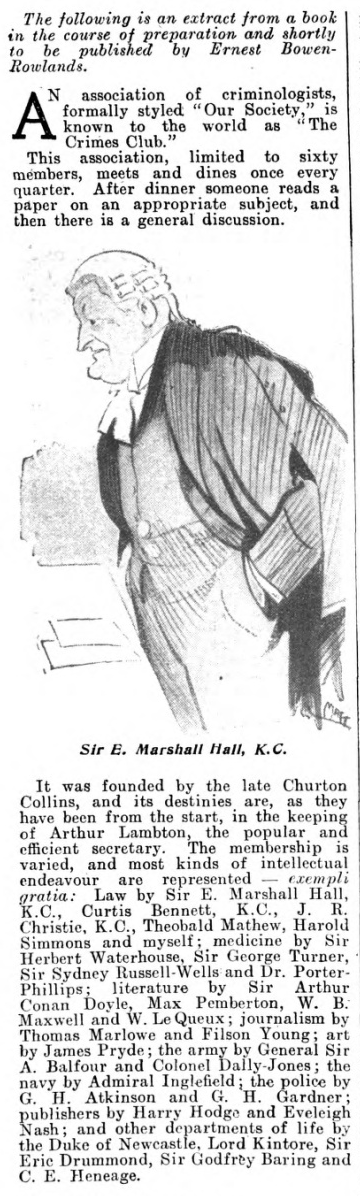
"Inner Secrets of the Crimes Club."
First appearance: Cassell's Weekly, August 8, 1923.
Article (1 page).
Online at Hathi Trust (HERE).
(Note: Text somewhat distorted but legible.)

     "Do you mean that Smith hypnotized his wives into committing suicide?"

Crime, we must never forget, is a human endeavor, and, as Hamlet observes, is therefore subject to "the thousand natural shocks that flesh is heir to"—the countless vagaries stemming from the human condition that can lead people as directly to criminality as to virtuous conduct. A book that came out almost a hundred years ago shows how capricious and human crime can be; it's a book which we have been unable to find anywhere and about which we know only what's said concerning it in the article:
Comment: It's not certain that this Crimes Club was the inspiration for Isaac Asimov's Black Widowers (HERE) through another group known as the Trap Door Spiders (HERE) beyond the obvious parallels given in the article, so we'll let you decide.

Resources:
- Is it simply a coincidence that at around this time William Le Queux, who is mentioned in the article, produced a story collection entitled The Crimes Club? The book can be found at Roy Glashan's Library (HERE), Fadedpage (HERE), and Archive.org (HERE):
  "The Crimes Club was a secret organization to which no outsider was ever admitted under any pretext, while its proceedings were never mentioned in the newspapers. Besides studying crime, its unique purpose was to assist the police of France, or of any other country, to unravel the mysteries that baffled them. In certain bewildering cases the club had met with marked success, but . . . ."
~~~~~~~~~~~~~~~~~~~~~~~~~~~~~~~~~~~~~~~~~~~~~~~~~~~~~~~~~~~~~~~~~~~~~~~~

Friday, February 11, 2022

"You Figgered on a Perfect Alibi"

"Foolproof."
By John Russell Fearn (1908-60).
First appearance: Vengeance Shorts #2 (1946).
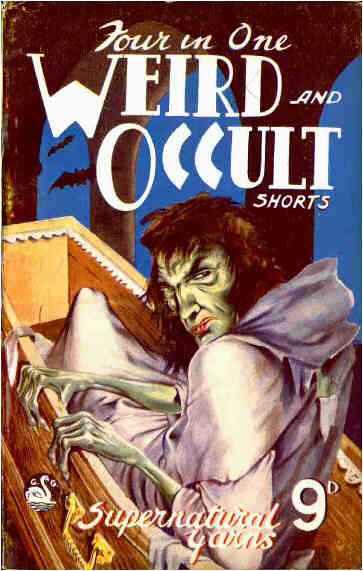
Reprinted in Four in One Weird and Occult Shorts [1948?].
Short short story (6 pages as a PDF).
Online at Fadedpage (HERE).

     "No, not the executioner. This job is foolproof. See?"

The pen is supposed to be mightier than the sword; in this instance, it's far more eloquent . . .

Main characters:
~ Judge Rufus Langton:
  "If you kill me, they’ll find my body before you have a chance to—"
~ Joseph Gell:
  ". . . was transformed into a man of action. Tearing off his wet hat and mackintosh, he hung them on the fireplace so they dripped to the warm hearth. Then he removed his solitary glove and substituted rubber gloves on both hands, flexed his fingers for a moment."
~ Sheriff Ingleby:
  ". . . thin and angular, with a bald head fringed with white fluff, was sitting reading beside the glowing iron stove, pipe in mouth, glasses on nose. He looked up in surprise over his lenses . . ."

Resource:
- You've got to give John Russell Fearn credit for trying to combine crime and science fiction, even if the results were, shall we say, highly variable; a case in point is his story "The Mental Gangster" (HERE).
~~~~~~~~~~~~~~~~~~~~~~~~~~~~~~~~~~~~~~~~~~~~~~~~~~~~~~~~~~~~~~~~~~~~~~~~~

Wednesday, February 9, 2022

"Was He in Some Squirrel Cage of Fate?"

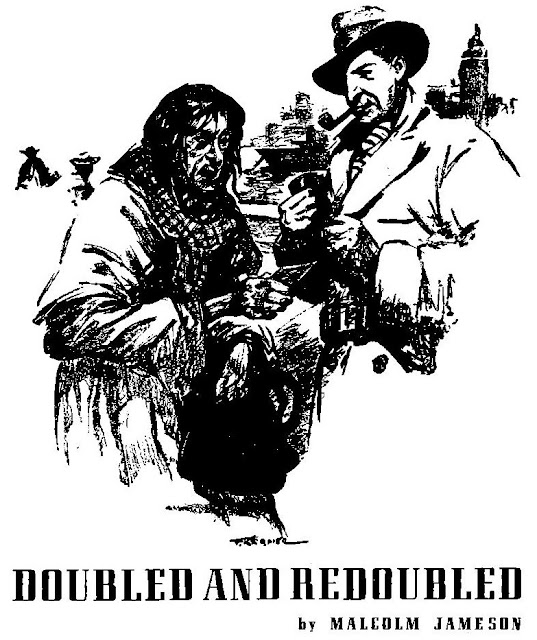
"Doubled and Redoubled."
By Malcolm Jameson (1891-1945).
Illustration by Kramer (1905-93; HERE).
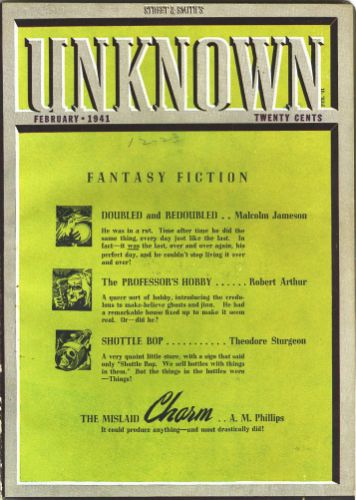
First appearance: Unknown Fantasy Fiction, February 1941.
Reprints page (HERE).
Short story.
Online at Fadedpage (HERE; 12 pages) and Archive.org (HERE; original text: 13 pages).

     "I perceive you are the victim of a blessing that misfired."

At this point in his life, if you were to ask him, Jimmy honestly couldn't tell you the difference between a blessing and a curse . . . .

Principal characters:
~ Jimmy Childers:
  "That night he threw the alarm clock out the window."
~ Genevieve:
  "Why, Jimmy, you seem to be perfectly at home here."
~ The cigar store clerk:
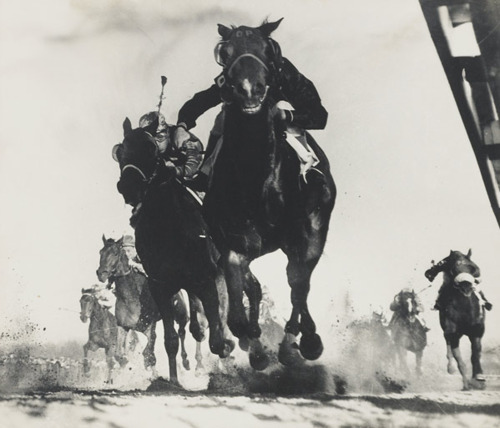
  "I gotta hot one for you today—Swiss Rhapsody in the first at Aqueduct. She’s sure fire, even if she’s a long shot."
~ Minnie the Malicious:
  "The young men of this generation have no manners whatever!"
~ The Old Man:
  "Childers, we’ve watched you for some time and we like your style."
~ The bank robber:
  "Shell out—everything in the cage but the silver!"
~ Kelly:
  "Optimistic, ain’t you?"
~ The doctor:
  "Take this before you go to bed. It is simply something to make you sleep better. Then come back tomorrow at this same hour."
~ The necromancer:
  "Sorry, but I only deal with the dead. That is my specialty. Now if you want a corpse raised, or anything like that—"
~ Master Charlatan:
  "That, my friend, is a mystery I’d advise you not to look into."

References and resources:
- "at Aqueduct": And they're off!:
  "Aqueduct Racetrack is a thoroughbred horse racing facility and casino in the South Ozone Park and Jamaica neighborhoods of Queens, New York City, United States. Aqueduct is the only racetrack located within New York City limits" (Wikipedia HERE).
- "He had read it all before—June 14th, PARIS FALLS": A reference to the war in Europe before the United States entered the fray; note how this dates the time of the story precisely:
  "June 14, 1940, in the early hours of the morning: One lone German soldier entered Paris from the east and crossed Place Voltaire. Not a single shot was fired. Paris fell into enemy hands during WWII without a single bit of resistance" (Judy McCarver.com HERE; for the bigger historical picture see Wikipedia HERE).
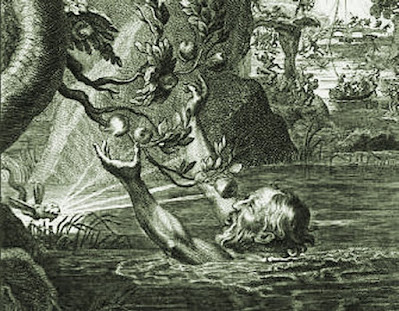
- Jimmy's situation at times reminds us of what happened to Tantalus in Greek mythology:
  "The Greeks of classical times claimed to be horrified by Tantalus's doings; cannibal-ism and filicide were atrocities and taboo. Tantalus's punishment for his act, now a proverbial term for temptation without satisfaction (the source of the English word tantalize), was to stand in a pool of water beneath a fruit tree with low branches. Whenever he reached for the fruit, the branches raised his intended meal from his grasp. Whenever he bent down to get a drink, the water receded before he could get any" (Wikipedia HERE).
- The notion of repeating the same day over and over seems to have had a strong allure for Hollywood; see Wikipedia (WARNING! SPOILERS! HERE), TV Tropes (WARNING! SPOILERS! HERE), and Lifehacker.com (WARNING! SPOILERS! HERE).
- Our latest contact with Malcolm Jameson was his SFFnal thriller "Out of the Iron Womb!" (HERE).
~~~~~~~~~~~~~~~~~~~~~~~~~~~~~~~~~~~~~~~~~~~~~~~~~~~~~~~~~~~~~~~~~~~~~~~~~