
Category: Detective fiction

At one o'clock of a stifling August night the hero is roused from a troubled sleep by a strangely distinct cry, "Ask Nancy Cornish!" Rising, he looks out of the window. In the apartment house across the street one room is brightly lighted, but the translucent blinds are drawn. Some one is playing superbly and there are voices in excited conversation. Then the shadow of a woman, "lithe and tense," appears on the blind.
"Suddenly she flung one arm up and out in such a strange and splendid gesture, of such free and desperate passion, as Herrick had never seen. For a full minute she stood so; and then the gesture broke, as though she might have covered her face. The music, scurrying onward from its crash, had never ceased; it had risen again, ringing triumphantly into the march from Faust, a man's voice rising furiously with it. . . . Then the sound of a pistol-shot split through the night. Immediately behind the blind, the lights went out."
"The untangling of that mystery," says the publisher's notice, "leads the reader through chapter after chapter of unexpected turns, sensational thrills, and puzzling climaxes." But there are so many sharp corners turned, so many "presto changes," that the reader gets bewildered. Nevertheless, those who like to play detective will find here an excellent chance to use their wits. — "Current Fiction," THE NATION (January 21, 1915; scroll to page 81)

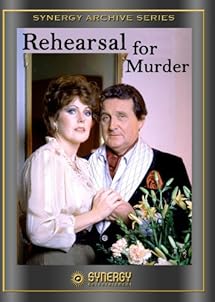
Whenever you see the names "Levinson" and "Link" in the writing credits, you can be assured of a well scripted, unique whodunit, with plot twists that would give Dame Agatha a run for her money.
". . . unusual form—a mystery—you take the audience by the hand and you lead them—in the wrong direction." Those are the prophetic words of playwright Alex Dennison in this Levinson and Link play within a play, called 'Rehearsal for Murder.' Dennison (Robert Preston) reunites five show-biz friends, ostensibly to get feedback on his new mystery novel. The real reason for the reunion is to unmask the killer of Monica Welles, Dennison's fiancee, who was murdered a year earlier. Which of the five friends is the killer?

'Rehearsal for Murder' is a filmed stage play, which means that the emphasis is on the crafts of script and acting, both of which here are excellent, and production design which in this case is adequate. The multiple plot twists make the screenplay ingenious, if perhaps a little far-fetched. The entire cast gives a fine performance, though I must confess to a preference for Robert Preston, one of the most credible actors of all time.
There's no heavy duty "message" in this film, no special effects, no cinematic gimmicks. It's just an old-fashioned, entertaining murder mystery for viewers who like whodunits. I have long considered 'Murder by Natural Causes' (1979) to be Levinson and Link's best work. But 'Rehearsal for Murder' is not far behind. — Lechuquilla, IMDb
Of all the productions Levinson and Link did for television, this one comes off as probably their best. While there are several twists in the tale that seemingly come out of nowhere, in retrospect we must admit we were prepared for them with carefully placed clues. — Mike Tooney, MYSTERY*FILE (31 January 2012)Resources:

. . . a winning mystery . . . Briskly paced, humorous and fleshed out with characters who complicate the investigation—the secretary who's a little too willing to aid in the investigation, a deputy commissioner who indulges in a little eavesdropping and political backstabbing, and two hissably sadistic thugs. [The main sleuth Cy] Hatch engages in some scientific detection and the usual rounding-up-of-the-suspects conclusion . . . — Darrell, THE STUDY LAMP (7 March 2012)
Quadruple murder of N.Y. private detective and disappearance of lovely girl nearly terminate careers of Cy Hatch and bodyguard. - Plentifully supplied with plot, amazingly outspoken in spots, amusing, rapid, and packed with surprises—especially at end. - Verdict: Class A. — THE SATURDAY REVIEW (January 7, 1939)Davis used several aliases:

THE murderous old adage, "Dead men tell no tales," is no longer true, if it ever was so. Belief in it has doubtless been responsible for a long and bloody catalog of deaths, and many a modern assassin has acted on it, only to find, in many cases, that he has been leaning on a broken reed. Dead men, to be sure, are not as voluble as live ones, but the tales that they do tell are not to be gainsaid. To-day, writes Davina Waterson in The Alienist and Neurologist, an assassin has to reckon with the physicist, the chemist, and the Roentgenologist, who force him to face damning, dispassionate scientific facts, and with equal zeal these facts are used to clear the innocent man condemned by circumstantial evidence. — Unsigned, "The Tales That Dead Men Tell," THE LITERARY DIGEST (December 26, 1914)


"Now, if a man is found shot through the head and with a pistol in his hand, what more rational than a verdict of suicide? But in real suicide the weapon is held so firmly that force is required to dislodge it. It seems as if the muscular spasm persists until rigor mortis occurs and sets it. Several experts have tried to make the hand of a corpse grip a weapon, but have never succeeded, and their knowledge of this fact has often opened the avenue to detection of murder. Again, if you found your grandfather on the floor with a rope round his neck and the other end dangling from a nail in the wall, certainly you would say that he had hanged himself and his weight had broken the rope.
"But the medicolegalist is as well up in knots as a sailor and knows a suicide will tie them one way, a murderer another. There was a case in Paris of a grandfather who had, apparently, hanged himself in the manner described. But he had not tied the rope, declared the expert, and, in face of such uncanny knowledge, two neighbors confest they had from their window seen the son-in-law strangle his father and arrange the other piece of rope. . . ."
"Lynx-eyed Science is rendering it ever more difficult to dispose of a body or hide the crime of murder. Human blood and hair and bones have characteristics distinctly their own. The 'gory knife' of melodrama is no longer sufficient to fix a crime, and even if, as seems possible, the penny novelist should kill his hero with radium, why, the physicist would come along with the electroscope and with it absolutely refute or conflrm the accusation." — "The Tales That Dead Men Tell," op. cit.Category: Detective fiction

Brown's own acknowledgment, the citation in the American Review, and the details of the story make it almost impossible to doubt that this "Account" is the original of "Wieland" . . . the progress of Wieland's frenzy is given with detail and sympathy.
This, indeed, is, for Brown, the chief interest of the whole theme. He does create a Godwinian "principal person" who hurts all who come near him with ugly, and often unintended, mischief. But though Carwin "the Biloquist" is the reigning spirit of evil in the book, and actually sets going the train of thought which terminates in Wieland's crime, he does no more than arouse from unsuspected depths a fanaticism already latent in Wieland. The birth and growth of this fanaticism are Brown's own creation; they merely prepare for events of which Brown had heard, and which he wanted to explain in a more scientific way than by ascribing [the real life murderer's] acts, as the pious reporter of the "Account" had done, to the devil. — Carl Van Doren, "Book Notes and Byways: Early American Realism," THE NATION (November 12, 1914)
 |
| He read the papers. |

. . . Niven would rewrite the short story as the script of an Animated STAR TREK episode. The episode was entitled "The Slaver Weapon" and originally aired on December 15, 1973. "The Slaver Weapon" was one of the best STAR TREK stories ever to air on television. The story was exciting, intelligent and thought provoking and is one of the chief reasons why the Animated STAR TREK series should be taken seriously as a science fiction series. — Curt Danhauser, GUIDE TO THE ANIMATED 'STAR TREK' (HERE and HERE)
Spock, Uhura, and Sulu are en-route on a shuttlecraft to deliver a Slaver stasis box—an artifact from a long-dead civilization inside of which time stands still—to Starbase 25. On their way, the box gives off a signal that another box is nearby. Investigating, they determine that the 2nd box is on an ice world. Once there, they are captured by the Kzinti, a feline race that wish to return to their dominance they once had. The Kzinti hope that the others' stasis box holds a means to do that. One thing in that box is a device of sorts that transforms into various devices: a Slaver Weapon. Knowing that in the wrong hands, the Slaver Weapon could bring havoc to the Galaxy, Spock and his team escape and try to get the weapon back . . . — Tony-B4, IMDb

