Friday, March 7, 2014

Sherlock, Raffles, Poe, and a Whole Lot More

Here is a quick tour of early 20th century snippets relating to detective fiction culled from magazines of the time; at least most of them are short:

~ "The Confessions of a Dime-Novelist—An Interview" (1902)
~ "Morals of Adventure Stories" (1904)
~ "Dime Novel Makers" (1904)
~ "Arthur Morrison" (1905)
~ "Jacques Futrelle" (1906)
~ "Jules Verne and E. A. Poe" (1907)
~ "Phantom Wires" (1907)
~ Poe and Detective Fiction (1907):
"In the whole range of fiction there is nothing which in itself is of more ephemeral interest than the detective story. The mystery once solved, what is there ever to call you back to it again? And yet, at the hands of Poe, even the detective story has acquired a power of appeal which outlives long familiarity. You may know 'The Purloined Letter' and 'The Mystery in the Rue Morgue' like a well-conned lesson, and yet you are lured back to read them once more, through sheer delight in the inimitable art of their construction."
~ "Confederate Cipher Codes" (1907)
~ "Arsene Lupin" (1907)
~ "The Woman in White" (1909)
~ "Poe and Jules Verne" (1909)
~ "Some Recent French Thrillers" (1909; covers only)
~ "The Heart of Poe" (1909)
~ "Edgar Jepson" (1911)
~ "The Deep Purple" (1911, a play; see page 31)
~ "The Bruce Parkington [sic] Plans" (1911) and "Retraction" (1911)
~ "Some Wills in Fiction" (1911)
~ "Migratory Anecdotes" (1911) [re: Conan Doyle]
~ "The Nationality of the Villain" (1912)
~ "The Boule Cabinet" (1912)
~ "Robert Barr and Conan Doyle" (1912)
~ "Doyle's Crowborough Home" (1913)
~ "Arthur B. Reeve" (1913)
~ "E. W. Hornung" (1913)
~ "Some Poe Questions" (1912)
~ "The Poe Mystery" (1913)
~ "Poe and Dickens" (1915)
~ "The Mysterious Card" (1914)
~ "Doyle's First Visit" (1914)
~ "Secret Service" (1914) [Doyle-related]
~ "The Hound in the Movies" (1914)
~ "Sherlock in the Fleet" (1915)
~ "Señor Sherlock Holmes" (1915)
~ "John C. Raffles" (1915)
~ "Father Brown and Others" (1915)
~ "Edgar Allan Poe in England and Scotland" (1916)
~ "The Doom of the Paper Thriller" (1916)

Category: Detective fiction

"A Yarn with Genuine Thrills"

THE MARATHON MYSTERY.
By Burton E. Stevenson.
Henry Holt & Co.
1904. 323 pages. $1.50
Online HERE and HERE.

This was Stevenson's sequel to THE HOLLADAY CASE (reviewed HERE). Two full contemporary reviews follow:
This is a detective story of ingenious plot and method. Despite the fact that in the beginning, the middle, and the end of the book a murder is chronicled, it is also a very pleasing and well-written narrative. — "Books of the Week," THE OUTLOOK (December 31, 1904; scroll to page 1096)
Mr. Stevenson's The Marathon Mystery is far and away a better story than his Holladay Case. With it the author has stepped at once to the front rank among American writers of detective tales. It is a yarn with genuine thrills, a yarn that will cause the most steady-nerved, while reading, to start at sudden shadows and exaggerate unexplained noises, and that, after all, is a pretty good test of one kind of a detective story.
In a general way The Marathon Mystery belongs to the type that Anna Katharine Green introduced to us ten or fifteen years ago with The Leavenworth Case and Behind Closed Doors. It is written or at least constructed backwards. The writer plans the last half dozen chapters of the book, mapping out the vital complications and every detail of what happened in the room in Chapter One or Two of the story.
With this well in hand the first two or three hundred pages may safely be given over to mystifying the reader by the introduction of new people and episodes, false clues and by diverting suspicion from one character to another, while keeping the real culprit well in the background. The very simplicity of the formula makes the dearth of good detective stories the more amazing.
As a story The Marathon Mystery is as good as Behind Closed Doors, That Mainwaring Affair or The Leavenworth Case. It does not keep you so long in the dark so far as picking out the villain is concerned; but the English is better and cleaner cut, the love passages are never maudlin, there is throughout more dignity and sense, and the book shows a far wider knowledge of the logical technique of detective fiction. 
Mr. Stevenson knows his "Purloined Letter" and his Affaire Lerouge and Crime d'Orcival. Perhaps Mrs. Rohlfs does also, but she has not as yet convinced us on this point.
There is just one feature about The Marathon Mystery with which the present reviewer wishes to express dissatisfaction. At times the people do not talk like New Yorkers at all. The reporter is not a New York reporter. The slang is not the slang of any one year of New York, but a strange jargon of the incongruous expressions and phrases which have found the way into print as having emanated from New York during the past ten or twelve years. But this, after all, is a feature of the book of relative unimportance. And so being, it is perhaps hypercritical to dwell upon it in a story otherwise so good, and so generous in the number, nature, and variety of its thrills as The Marathon Mystery. — Arthur Bartlett Maurice, "Six Books of the Month," THE BOOKMAN (February 1905)

Category: Detective fiction

Thursday, March 6, 2014

What Would Edwardian Detectives Do If Someone Didn't Steal a Jewel or Two?

BRITZ OF HEADQUARTERS.
By Marcin Barber.
Moffat, Yard & Co.
1910. 394 pages. $1.50
Online HERE and HERE.
This must have been Britz's only known adventure. Three full contemporary reviews:
It may not be fair to expect much knowledge of the Orient from a maker of detective stories, although he centres his plot about the oft-used theft of a great Oriental diamond. But even a writer who seems to have watched the world from the windows opposite the old headquarters on Mulberry Street should not set a band of Brahmins on the recovery of a stone which had once been in a Buddhist temple.
Mr. Barber does not make Fifth Avenue society much more real than his Brahmin-Buddhists; but his Britz is a good detective of the old school, with yet a tinge of originality in his make-up, and the plot which Britz unravels is sufficiently devious and doubtful to satisfy the taste of an exacting connoisseur of this branch of fiction. — "Current Fiction," THE NATION (June 9, 1910; scroll to page 587)
It was to be expected that the crop of summer novels should include a few dealing with the time-honoured theme of stolen jewels; and of these, two volumes [the other is Viola Burhans's The Cave-Woman] seem to be of sufficiently sincere workmanship to warrant a brief mention.
Britz of Headquarters, by Marcin Barber, is best defined as The Moonstone brought up to date. The machinery of the two tales is identical: a priceless gem stolen from a Hindoo temple; a dauntless band of high-caste Brahmins pledged to its recovery; the present owner mysteriously robbed of this gem, of whose earlier history she is ignorant; and a dozen men and women of various callings and social grades brought successively under suspicion.
Britz of Headquarters is good in so far as it attains that breathlessness of suspense which is the very warp and woof of detective novels. But in one respect it is not quite honest, for it disregards an established law of its class; namely, that the real culprit shall be introduced to the reader early in the story, if not in the opening chapter. In Britz of Headquarters we have no reason even to guess the existence of the person who is the actual thief until very near the close of the volume. — Frederic Taber Cooper, "The Question of Earnestness and Some Recent Books," THE BOOKMAN (August 1910; scroll to page 643)
If you love a good detective story, get "Britz of Headquarters" and sit up all night to finish it—though that last need not be said, for nothing but force can take the book out of your hand once it is begun.
Britz, the hero who names the story, is a member of the central office force of New York City. He is of the "deducing" variety of detectives and, like the great Sherlock Holmes, solves most of his difficult problems at his desk.
The Missioner Diamond case is most mysterious. Mrs. Missioner, a very rich widow, is occupying her box at the opera one night and has three guests, two men and a young girl.
During the performance the clasp of her diamond necklace parts and it falls to the floor broken. All join in the search and all the stones are found but one, the treasure of her entire collection, called the Maharanee Diamond.
At the last moment one of the men guests, moving back quickly, steps on something and crushes it beneath his heel. It proves to be the diamond, or at least a paste imitation of it. Mrs. Missioner sends for an expert when she reaches her home and is informed that the whole necklace is paste. When was the substitution made and by whom?
Britz is brought into the case directly, and his moves are most interesting. The persons involved have a pretty difficult time and there is excitement aplenty to suit everybody. Romance is here, too, but not much, for all the attention is given to Britz, and he has no time for anything like that.
Not a hint can be given as to the solution of the mystery and the crimes, but it all comes right in the end. The Orientals who figure in the tale are the weakest spots in the picture, but Britz is the main thing, and he could not be improved upon. — THE SAN FRANCISCO CALL (July 10, 1910)

Category: Detective fiction

Tuesday, March 4, 2014

"Melodrama Running Amuck"

EMPTY POCKETS.
By Rupert Hughes (1872-1956).
Harper & Brothers.
1915. 606 pages.
Filmed in 1918.
Online HERE and HERE.
In his lifetime, Rupert Hughes was a multimedia presence in print, theater, and the movies; he was also related to the reclusive billionaire Howard Hughes.

Perhaps it's a good thing Hughes didn't try to write more mysteries:
Empty Pockets, by Rupert Hughes, is a queer conglomeration of minute realistic studies of the New York slums, fantastic pictures of fashionable life verging upon burlesque, and a glorified Nick Carteresque series of abductions, seductions and sudden deaths that can only be described as melodrama running amuck. And yet the reviewer must plead guilty to having enjoyed himself immensely in reading, and having, what is more, read it slowly, to make it last the longer.
The volume opens with a promising mystery. On top of one of the most sordid and grimy tenements in the unsavoury neighbourhood of Allen Street, a certain Perry Merithew, model of fashion, incurable spendthrift and ruiner of women's reputations, is found dead, and still grasping in his clenched hand the severed tips of some copper-coloured tresses.
Now, it would seem a simple task for a detective to discover what women, with copper-coloured tresses, had played a part in the life of so scandalously well known a personage as Perry Merithew. But when it develops that he had a predilection for hair of that special hue, and that his fair friends possessing it included a Polish cloak model, a society girl of fragile reputation, a vicious little cabaret singer and the pampered daughter of New York's leading millionaire, it becomes evident that the detective's task is less simple than was expected.
Much of the narrative takes us on breathless and utterly impossible taxi-cab chases through midnight streets, with gun-men shooting recklessly, and hitting everything excepting what they aim at. But the moving pictures have been educating the public to believe in the preposterous. And it is no more than fair to accredit Mr. Hughes with having succeeded in reducing a typical photoplay melodrama to the more difficult medium of printer's-ink. — Frederic Taber Cooper, "Some Novels of the Month," THE BOOKMAN (July 1915; scroll to page 550)
Resources:
- A Wikipedia article about the author is HERE.
- More about Hughes's Hollywood involvement is HERE and HERE.

Category: Detective fiction

Monday, March 3, 2014

Two by Brebner

Two by who? Percy James Brebner's detective fiction reputation seems to rest on his two volumes featuring Christopher Quarles, whose method of detection defiantly stands that of Sherlock Holmes on its head. Some 21st-century readers find the stories a snooze fest, but others disagree.

About Brebner's first collection, Tony Posante at Librivox writes:
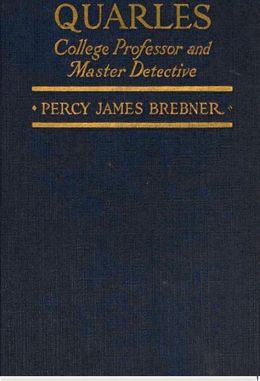
Christopher Quarles is a professor of philosophy and a private consulting detective. Quarles, along with his granddaughter Zena, assists Police Detective Murray Wigan in solving various crimes and mysteries in Victorian England. Whereas the police look for facts and then form a theory of a case, Quarles first forms a theory, often seemingly absurd and based on little more than intuition, then seeks facts in support of it. Of course, to the astonishment of all concerned, Quarles' theories usually prove to be quite right! Christopher Quarles: College Professor and Master Detective was written by Percy James Brebner (1864-1922) and first published in 1914, a time when motor cars and electric lights were new marvels of the industrial age.
CHRISTOPHER QUARLES: COLLEGE PROFESSOR AND MASTER DETECTIVE.
By Percy James Brebner (1864-1922).
E. P. Dutton & Company.
1914. 299 pages. $1.25
Collection: 16 stories.
Online HERE, HERE, HERE, and HERE.
Contents:
1. "The Affair of the Ivory Boxes"
2. "The Identity of the Final Victim"
3. "The Riddle of the Circular Counters"
4. "The Strange Case of Michael Hall"
5. "The Evidence of the Cigarette-End"
6. "The Mystery of 'Old Mrs. Jardine' "
7. "The Death-trap in the Tudor Room"
8. "The Mystery of Cross Roads Farm"
9. "The Conundrum of the Golf Links"
10. "The Diamond Necklace Scandal"
11. "The Disappearance of Dr. Smith"
12. "The Affair of the Stolen Gold"
13. "The Will of the Eccentric Mr. Frisby"
14. "The Case of the Murdered Financier"
15. "The Strange Affair of the Florentine Chest"
16. "The Search for the Missing Fortune".

Meanwhile, back in the early 20th century this first reviewer rather liked the book:
The fascination about a detective story, which makes it the favourite light literature of men of large affairs. . . .according to their own frequent confessions, casts its spell also over writers who have made themselves felt in other fields. Mr. Brebner, whose work hitherto has shown no leanings in this respect, comes into the arena with a new detective. As the aim of each new detective—or of his creator—is to be as unlike the conventional idea of a detective as possible, Christopher Quarles may easily be said to distance those already in the field by several lengths. And before we go further here, it would be interesting to have some one tell us what the conventional idea of a detective really is, since every new writer tells us his man is something quite different!
But certainly Professor Quarles is the most lovable, the most learned, the most unpoliceman-like detective we have yet met. As a matter of fact he is not a detective at all, but a scholar, specialising in philosophy and keenly interested in the human motives behind every act. Criminal cases interest him only when it is necessary to find this motive. He confesses that he does not make his theory from facts. He finds his theory of motives first and makes the facts fit it. It is an interesting method, and as after all human nature, even if warped and twisted out of humanity by circumstances, is at the back of every crime, the professor is not so far wrong when he insists that philosophy and imagination are good guides for detective work. As he tells the bright young detective who has won his interest, and who eventually wins the heart and hand of Professor Quarles's granddaughter:
You are very clever, but you lack imagination to step out as far as you ought to do. Cultivate imagination and don't be too bound up by common-sense. Common-sense is merely the knowledge with which fools on the dead level are content. Imagination carries one to the hills and shows something of the truth which lies behind what we call truth.
Equipped with his imagination and love for psychic motivation, and aided by Murray Wigan's natural cleverness and practical knowledge of his work, the Professor unravels many mysteries, some of which can rank well up in the front of similar plots.
Such rich store of good things is offered that it is hard to select any special ones particularly worthy of mention. Yet, as a guide for hurried readers, in the matter of gruesomeness the cases scheduled as "The Identity of the Final Victim," and "The Case of the Murdered Financier" will easily bear off the palm. For ingenuity of solution the "Riddle of the Circular Counters" and "The Disappearance of Dr. Smith" should be commended.
The completeness of each story in itself, connected by the personalities of Quarles, his granddaughter Zena, and the young detective, Murray Wigan, make the book a particularly handy one for the busy man or woman who like the solution of an imaginary mystery but have seldom more than a short half hour or so to indulge their inclination. It is safe to prophesy that they will enjoy having Christopher Quarles close at hand when this lazy half-hour comes. — Cornelia Van Pelt, "Nine Books of the Month," THE BOOKMAN (November 1914)
The next reviewer seems to have trouble with counting:
The professor of philosophy who gives his name to "Christopher Quarles," by Percy James Brebner, belongs to the new class of amateur scientific detectives of crime. This interesting pursuit is the occupation of his leisure hours; and he takes only cases that interest him. He combines, therefore, the fresh spirit of the amateur with the scientific and artistic methods of the expert. Of the thirty-six [?] stories which make up this volume, some are good and some are commonplace.
It cannot be said that at any point Professor Quarles reaches the level of his great English and French models. He is, however, an interesting person whose indifference to monetary considerations in the pursuit of the calling of a detective gives him a right to be dictatorial and irritating. It is the special joy of the amateur detective to treat the professionals with more or less ironical contempt. — "Out of Many Novels," THE OUTLOOK (November 11, 1914; scroll to page 604)
This reviewer detects "a certain monotony":
MORE than a quarter-century has slipped by since Sherlock Holmes usurped the scene in detective fiction. New writers still have to be careful, above all not to offend us with pseudo-Sherlocks. We demand something "distinctively different" in make-up and method. Young girls, beautiful society women, lusty athletes, doddering ancients—from any source sufficiently unsherlockian our fresh masters of detection may arise.
One ingenious contriver (in "The Lost Naval Papers" of Bennet Copplestone) has gone so far as to wrench a genius out of Scotland Yard itself! Now, "Christopher Quarles, College Professor and Master Detective," bears evidence of novelty on its very title-page.
It is true that old gentleman's professorial status is left rather vague; from beginning to end, indeed, we lack data as to what or where he professes. Luckily for us, at all events, he has plenty of leisure for our business. His Doctor Watson (alas! these analogies seem inevitable) is a professional detective who works somewhat according to the Holmes formula. Not so Quarles; his method rests, to put it vulgarly, on "the hunch."
Wigan, the chronicler, a professional detective, follows the sacred rules of induction—or was it deduction? Quarles depends frankly on intuition. "My methods are not those of a detective," he admits. "You argue from facts; I am more inclined to form a theory, and then look for facts to fit it." And in forming his theory he is moved by hints often hardly tangible.
He does, to be sure, make suspicious use now and then of Baker Street ways—the worship of cigarette ends and the stowing away in envelopes of bits of fluff and refuse gathered on "the premises."
But these are secondary matters. His genius lies in jumping at conclusions—commonly from the take-off of some apparently casual question of his granddaughter Zena, whose middle name (in the current idiom) is Hunch.
There is a certain monotony in the working out of these tales, each of which really ends at the point when Quarles has perfected his theory; after that we merely follow the facts for verification. Their machinery apart, the stories have more novelty and ingenuity than we can often look for in this much-worked field. — "Substance and Mechanism," THE NATION (July 20, 1918)
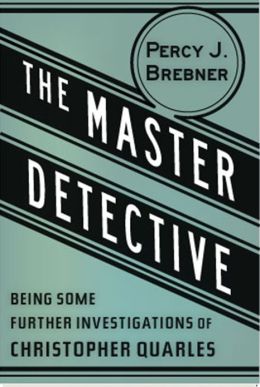
THE MASTER DETECTIVE: BEING SOME FURTHER INVESTIGATIONS OF CHRISTOPHER QUARLES.
By Percy James Brebner (1864-1922).
E. P. Dutton & Company.
1916. 308 pages.
Collection: 15 stories.
Online HERE, HERE, HERE, and HERE.
Contents:
1. "The Strange Case of Sir Grenville Rusholm"
2. "The Kidnaping of Eva Wilkinson"
3. "The Delverton Affair"
4. "The Mysterious House in Manleigh Road"
5. "The Difficulty of Brother Pythagoras"
6. "The Tragedy in Duke's Mansions"
7. "The Stolen Aeroplane Model"
8. "The Affair of the Contessa's Pearls"
9. "The Disappearance of Madame Vatrotski"
10. "The Mystery of the Man at Warburton's"
11. "The Strange Case of Daniel Hardiman"
12. "The Crime in the Yellow Taxi"
13. "The Affair of the Jeweled Chalice"
14. "The Adventure of the Forty-Ton Yawl"
15. "The Solution of the Grange Park Mystery".

A reviewer pegs Quarles as one of a host of "degenerate Sherlocks":
Pretty well all the detectives of recent fiction, and certainly the best of them, are no more than degenerate Sherlocks in disguise. Christopher Quarles, in the two volumes of stories by Percy James Brebner, is as good as any. He produces an occasional effect of reasoning, and the stories themselves are well thought of.
. . . Probably fame and fortune await the creator of the next really original and striking specialist in crime. But he will not be found easily, because original ideas do not come by prayer and fasting, nor always to those who can use them to good advantage. Meanwhile, we may be content with such as are good stories, though lacking an important hero. And indeed that is enough to ask. There is nothing easier to write than a detective story, if the mere writing were all: it does not need to be well written; and the trick of suspense upon which its structure depends is simply the most facile tool in every author's workshop. But to invent a good detective plot is very difficult indeed, and calls for more combined brains and honesty and willing labor than many authors can compass. — Brian Hooker, "Concerning Yarns," THE BOOKMAN (May 1919; scroll to page 312)

Category: Detective fiction

Sunday, March 2, 2014

"A Crime So Grewsome and Diabolically Conceived"

"The Adventure of the Norwood Builder."
By Arthur Conan Doyle.
Short story.
First appearance: The Strand, 1903.
Collected in THE RETURN OF SHERLOCK HOLMES (1905).
First filmed in 1912 as THE HYPNOTIC DETECTIVE.
Filmed for TV in 1985.
Online HERE and HERE.
An early film company decided to do a Sherlock Holmes movie without Sherlock Holmes—at least, without naming him Sherlock. SPOILER ALERT: Since almost none of us can expect to see this rare film (a print of which is at UCLA), we're reproducing the blabber-mouthed reviewer's article in full, in the hopes that you have already read the story or seen the Jeremy Brett version:
At last we have had a chance to greet our old friend Mr. Sherlock Holmes, of Upper Baker Street, in the moving pictures. The fact, however, that he appears under the name of Professor Locksley, that he sports a long moustache and carries a monocle, leads to the grave suspicion that the presentation has not been authorised either by Sir Arthur Conan Doyle or by the publishers of his books.
Be that as it may, "The Hypnotic Detective" is in every incident "The Adventure of the Norwood Builder" of The Return of Sherlock Holmes.
The film play opens with a scene showing the rascally builder being refused by the mother of the hero and threatening dire vengeance. The second scene shows the hero, a young solicitor, in his office in the city. The builder enters, tells him that he has decided to make him his heir, and requests him to go that night to the country to draw up the will.
In his country home the builder and two accomplices, a woman housekeeper and a man-servant, await the coming of the victim. Tom Norton—that is the name the hero bears in the play—arrives, the will is drawn, and Tom takes his departure after vainly looking for his walking stick, which has been secreted by the housekeeper.
Then the builder proceeds to disappear after planting evidence that will throw suspicion on Tom Norton. The walking stick is broken as if in a struggle, a dummy figure dressed in the builder's clothes is placed in an outhouse which is fired, and the builder and the man-servant, plentifully provided with provisions, hide in a secret chamber in an upper story of the residence. The fire in the outhouse draws the fire department and the constabulary, and the housekeeper, questioned, gives evidence that points to Tom as the murderer of the missing builder.
The next morning Tom, in his lodgings, picks up the paper to read of the supposed crime and his alleged share in it. The police are already on his track and their knocking is heard at the door as he slips out of a window to go seek the advice of the eminent Professor Locksley, the hypnotic detective. The latter, as we have said, is of rather a Watsonian than a Sherlockian mien. After the manner of the stage Englishman he tugs at his long moustache as he listens to Tom's story, and reassures the excited youth just as the police arrive to effect the arrest.
A brief glimpse of Tom in his prison cell and then back to the house of the builder with Professor Locksley arriving on the scene to begin his investigations. The police in charge think they have a convincing case against Tom and greet the professor with ill-concealed amusement. The housekeeper, however, recognises a dangerous foe.
Through his monocle Locksley examines everything everywhere and finally recognises that discrepancy in the plans of the house which conceals the secret chamber.
A little episode which is not drawn from the Doyle story is that which precipitates Locksley through a trap door to a cellar, where he is confronted by the man-servant accomplice who holds a pistol in his hand. Here the professor's hypnotic eye comes into play, he disarms the cowed accomplice and delivers him into the hands of the official police, and the moment has come for the last scene of the little drama.
It is not worth while to hunt for the missing builder; a better idea would be to make him disclose himself. Piles of straw are lighted and clouds of smoke roll up into the secret room where the builder has been chuckling over the success of his evil plans. Forgetting everything but what he believes to be his imminent peril, the builder rushes forth into the hands of Professor Locksley and the police. — "Chronicle and Comment: Sherlock in the Films," THE BOOKMAN (October 1912)
The release flier for the film.

Category: Detective fiction

Saturday, March 1, 2014

"A Tale of Secret and Unexplained Evil Happenings"

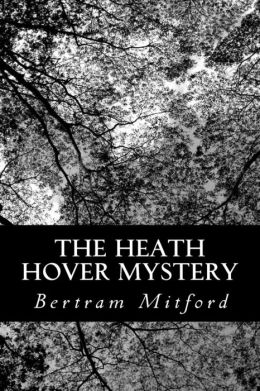
THE HEATH HOVER MYSTERY.
By Bertram Mitford (1855-1914).
Ward, Lock & Co.
1911. 320 pages.
Online HERE, HERE, and HERE.
Available on Kindle.
Mitford was "a colonial writer, novelist, essayist and cultural critic who wrote forty-four books, most of which are set in South Africa" [Wikipedia]:
"The Heath Hover Mystery," by Bertram Mitford, is frankly a tale of secret and unexplained evil happenings, touched with the glamour of Eastern romance. The important thing in the story is a star with deadly points, and its fateful influence on an otherwise normal English household is told of with a skilful prolonging of the mystery. — "Of Many Countries," THE BOOKMAN [U.K.] (August 1911)

Category: Detective fiction