Tuesday, March 25, 2014

The Wild Blue Yonder

BIRDS OF PREY.
ABC-TV/Tomorrow Entertainment.
1973. 81 minutes.
IMDb listing.
The first and only time I saw Birds of Prey forty-one years ago, it blew me away. As action films go, I still think it's superior to many; and the fact that it was made for television on a minimal budget makes it even more remarkable.

David Janssen plays an ex-World War Two Flying Tigers fighter pilot whose aviation career is winding down; he's now relegated to being a traffic reporter flying over Salt Lake City and quietly going nuts from boredom.

One day he happens to observe a bank robbery in progress, which he duly reports to his good pal from the war (Ralph Meeker), who is now a police captain with the Salt Lake City PD. But Meeker doesn't believe him at first, thinking it's another one of Janssen's middle-aged pranks.

That's all it takes: Janssen sees it as a challenge—and the chase is on. From this point forward, the film is indeed one giant chase sequence. The bad guys transfer themselves, their loot, and a hostage to a helicopter only to be relentlessly harried by Janssen every step of the way. The pacing is terrific.
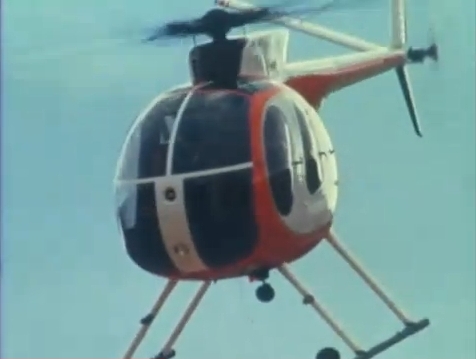
In addition to two good performances from Janssen (settling into his world-weary Harry O character) and Meeker, the helicopters also star here. This was long before CGI (computer-generated visual effects); when the choppers swoop under freeway overpasses with a foot or less separating the rotor blades from the concrete abutments, it's the real thing. Another amazing sequence happens INSIDE an aircraft hanger, when Janssen corners the bad guys' copter; this needs to be seen to be believed. The margin for error, with both copters swaying uncertainly in a Mexican standoff, has to be two or three inches at most.

Kudos to the late James W. Gavin for these sequences. Whenever Hollywood needed a master pilot who could also deliver lines in an acceptable fashion, Gavin was their go-to guy. He did lots of screen work in films and TV series, such as Adam 12.

If you really get into the characters in this film—as I did—then the final line will be especially poignant: "Damn you, Walker! I didn't ask you to do that!"

Tech note: If I remember correctly, Janssen's chopper was a Hughes 500D while the criminals had an Aerospatiale Alouette.
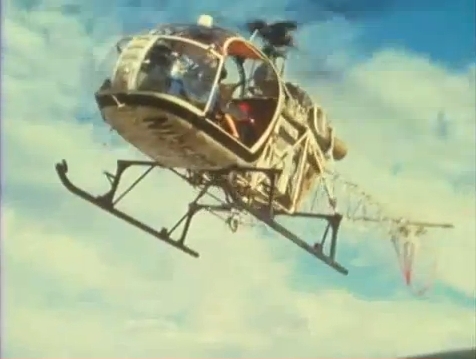
Birds of Prey is available on video, but some customers complain that the Second World War-era Big Band music featured in the film's network broadcast—music that is integral and meaningful to the two lead characters—has been replaced with something different, so be aware that you're not getting the original film.

NOTE: A slightly different version of this article appeared on Steve Lewis's MYSTERY*FILE weblog HERE.

Category: Detective fiction

Monday, March 24, 2014

Crimes and Hallucinations

PEACOCK HOUSE, AND OTHER MYSTERIES.
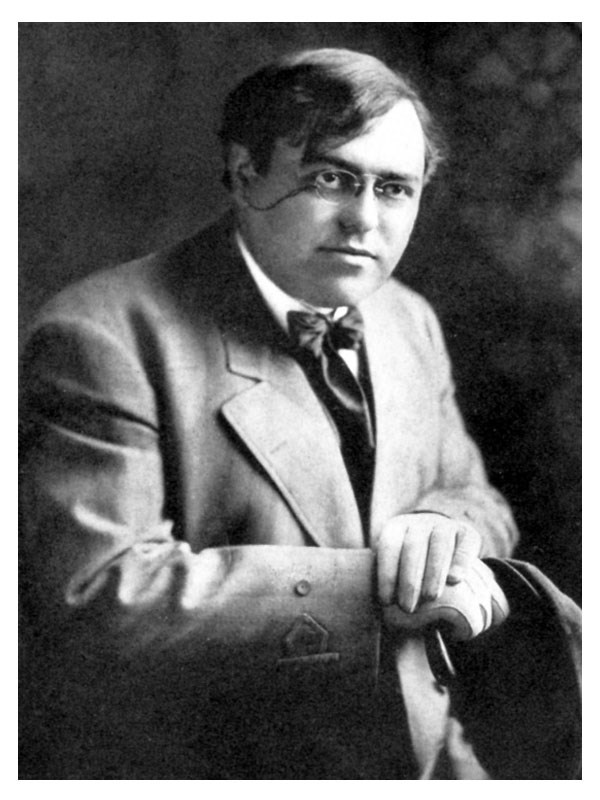
By Eden Phillpotts (1862-1960).
Macmillan.
1926. [?] pages. $2.50
Collection: 15 stories.

Contents:
1. "Peacock House"
2. "The King of Kanga"
3. "Count Rollo"
4. "Red Dragon"
5. "Crazywell"
6. "The Iron Pineapple" [online HERE]
7. "Grey Lady Drive"
8. "Three Dead Men"
9. "Madonna of the Fireflies"
10. "My First Murder"
11. "The Astral Lady"
12. "Yellow Peril"
13. "The Cairn"
14. "Stepan Trofimitch"
15. "The Mother of the Violets".
Mr. Phillpotts is hampered yet humanised by his desire to let his characters work out their own destiny; their personalities frequently escape from the plot which enmeshes them. — L. P. Hartley
Excerpts from several contemporary reviews:
Mr. Phillpotts's main concern is Mystery. He taps almost every source of the mysterious, going for his effects as far afield as studies in neurosis and psycho-analysis.
. . . How protean is Mr. Phillpotts! . . . Though he gets a thrill into his tales of horror, none of them is, judged by the standard of his achievement in other fields, quite first-rate; his quality shows better in the piece than in the pattern. He lacks the concentration and finesse of the best short-story writers, and that medium only partially reveals his chief strength—his point of view. No contemporary writer, expecting so little of human beings, seems to get so much out of them, or to render with so much sureness of touch the long, slow cadences of life. — L. P. Hartley, "A Quartet," THE BOOKMAN [U.K.] (October 1926; Jump To page 52)
Fifteen shortish bafflers of superior grade containing mental quirks, crimes galore, and—an iron pineapple. — "The Bookman's Guide to Fiction," THE BOOKMAN (June 1927; scroll to page 464, top left)
Tales of horror and mystery may be so hauntingly inexplicable as to leave the reader speculating and shuddering long after the book has been laid aside. Or, like the common detective story, they may be builded with mathematical neatness to reveal in a surprising conclusion the simple explanation for all the unsolved enigmas that have gone before. The short stories in "Peacock House" belong, with one or two exceptions, to the second category. . . . For the most part, the people involved are too dull to stimulate much interest in their crimes or hallucinations, and somehow even the most fiendish of their murders seems more inky than bloody. — "The New Books," THE SATURDAY REVIEW (June 25, 1927)
Resource:
- The GAD Wiki file for Eden Phillpotts is HERE.

Category: Detective fiction

Doyle and Oppenheim React to Critics

Back in the mid-'20s, The Bookman [U.K.] asked different authors what value, if any, professional criticism might have for them, among whom were Arthur Conan Doyle (1859-1930) and E. Phillips Oppenheim (1866-1946).

Neither author mentions mystery fiction per se, and ACD seems more annoyed by what critics had to say about his interest in spiritualism ("the greatest of all subjects," in his words), which he regarded as scientifically confirmed, than anything else. Because his reputation as a fictioneer was clearly secured for all time thanks to his wildly successful Holmes stories, Doyle could afford to write:
In dealing with fiction I have always found the critics fair and reasonable, but I cannot say that I have ever had anything of value from their criticism. That may have been my own fault, but the fact remains. . . . I am offended by the way in which editors choose their critics for particular books, picking out in many cases those men who are least likely to give an unbiased opinion. . . . On the whole, however, as I look back upon my long literary life I do not feel that I have much to complain of, and I have a recollection of much that is kind. — "The Value of Criticism," THE BOOKMAN [U.K.] (October 1926)
As successful as he was, Oppenheim could also sympathize with Doyle and his fellow fiction authors:
. . . I should say that the practical value of criticism to an author is scarcely so great to-day as some fifteen or twenty years ago. The reading public nowadays have formed their own ideas as to what they like and what they don't like, and in these times of universal novel-reading are not so easily influenced.
. . . A favourable and appreciative notice of his work is often an inspiration to the writer, whereas those few sarcastic lines, which a short time ago were rather the fashion amongst a certain type of reviewer, although they may do him little harm with the public, are often unduly depressing to their sensitive victim. — "The Value of Criticism," op cit.
Resources:
- The GAD Wiki offers gateways to the works of Conan Doyle HERE and of Oppenheim HERE.

Category: Detective fiction

Saturday, March 22, 2014

Sherlock from Many Angles

Many thanks to ALWAYS 1895 for finding these public domain items in the Hathi Trust Digital Library; we hope all of these works are accessible to our readers.

A Doctor Enjoys Sherlock Holmes (1959), Edward J. Van Liere [New York: Vantage Press].
. . . Dr. Van Liere (1895-1979) delivers just what the title suggests: a collection of short essays (many previously published in the BSJ, Harvard Medical Alumni Journal, The West Virginia Medical Journal, etc.) discussing minutiae of the [Sherlock Holmes] canon from a doctor’s perspective. Topics include dogs, 'brain fever,' various medical topics in relation to the cases of Sherlock Holmes and Dr. Watson qua medical man.
- Also see Batgrl's goodreads summary HERE.

Sherlock Holmes in Portrait and Profile (1963), Walter Klinefelter [New York: Syracuse University Press].

A short, 97-page profile of Sherlock Holmes with an introduction by the venerable Vincent Starrett focuses on various visual portrayals of Sherlock Holmes in the many magazines that ran ACD’s stories. Mr. Klinefelter’s interesting little publication is a “story-by-story or book-by-book account of what the detective’s various portrayers made of him as the piecemeal records of his cases were inconsecutively released.”
William Gillette As Sherlock Holmes: As Produced at the Garrick Theatre, New York (1900). Published with the Authorization of Mr. Charles Frohman [New York: R. H. Russell].
A very short pamphlet made-up of vintage William Gillette photographs in the role of Sherlock Holmes. A window into the time before Brett, Rathbone, Cushing or Wilmer had yet donned the persona of the great detective and Gillette was the face of Sherlock Holmes.
Resource:
- A previous ONTOS article about Holmes's first appearance on stage is HERE.

Category: Detective fiction

Two Victorian Thrillers

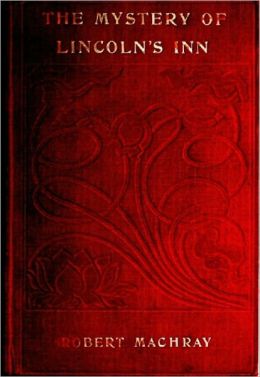
THE MYSTERY OF LINCOLN'S INN.
By Robert Machray (1857-1946).
Chatto and Windus.
1903. 343 pages. 6s.
Reprinted in 2013.
Available on Kindle.
Online HERE and HERE.
A contemporary review, from which we have had to excise the SPOILERS because the critic promises not to give the plot away yet goes right ahead and does it anyway:
Mr. Robert Machray is not a man who believes in half measures; he means a mystery to be a mystery right up to the last chapter, and has evidently written The Mystery of Lincoln's Inn on this admirable principle.
It is a most ingenious story, but it would be a shame to give Mr. Machray away by unfolding the details of his intricate plot.
Suffice it to say that this is a tale of . . . [SPOILERS DELETED] . . . long enough to restore the stolen property. — "Notes on New Books," THE BOOKMAN [U.K.] (October 1903)
THE AMBASSADOR'S GLOVE.
By Robert Machray.
John Long.
1904. 315 pages. 6s.
No e-version seems to be available.

The same goes for this review:
A story that opens with a daring and mysterious midnight robbery of jewels from the bedroom of a great London hotel, and in whose second chapter a British Ambassador, who has suddenly arrived in England, dies mysteriously, and is found to have been poisoned, promises something uncommonly strong in the way of sensational fiction, and in "The Ambassador's Glove" the promise is amply fulfilled. . . . [SPOILERS DELETED] . . . It is, every way, a capital story of its kind, and carries the reader on with unflagging interest through every page to the last. — "Novel Notes," THE BOOKMAN [U.K.] (December 1904)
Category: Detective fiction

Friday, March 21, 2014

"The Author's Ingenuity Is Great, but . . ."

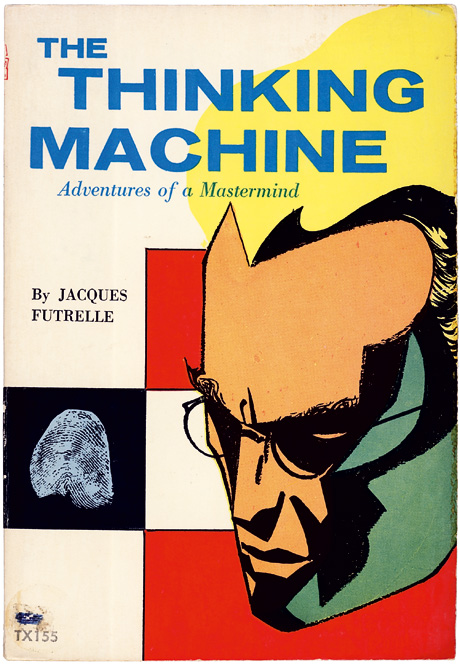
THE THINKING MACHINE.
By Jacques Futrelle.
Dodd, Mead & Co.
1907. 342 pages. $1.50
Collection: 7 stories.
Contents:
1. "The Problem of Cell 13"
2. "The Scarlet Thread"
3. "The Man Who Was Lost"
4. "The Great Auto Mystery"
5. "The Flaming Phantom"
6. "The Ralston Bank Burglary"
7. "The Mystery of a Studio"
Professor Augustus S. F. X. Van Dusen, Ph.D., LL.D., F.R.S., M.D., M.D.S. is a fictional character in a series of detective short stories and two novels by Jacques Futrelle. Some of the short stories were originally published in The Saturday Evening Post and the Boston American. — Wikipedia
Michael Grost, one of our contemporaries, has written:
Jacques Futrelle's tales of the Thinking Machine are some of the best detective stories even written. The Thinking Machine, a professor who received his nickname from the press for his intellectual acuity, appeared in a series of around 50 stories, from 1905 to Futrelle's death on the Titanic in 1912. Even the less successful Thinking Machine tales have features which make them enjoyable and worth reading. — GAD Wiki
But how did Futrelle's contemporaries feel about the Thinking Machine? One critic from a century ago agrees with Grost (as do we). Excerpts from his review:
"The Thinking Machine" is a name given to a certain Professor van Dusen, who is the incarnation of unemotional science. His logic is without a flaw; his mental processes are infallible. Sherlock Holmes was partly a man of action; but Professor van Dusen is wholly a man of thought. In this respect he resembles Mycroft Holmes, but without the amiable eccentricities of that cogitator. The problems that are given him to solve are often, on the face of them, so impossible as to make the reader absolutely certain that they cannot in any way be mastered.
. . . This story ["The Problem of Cell 13"] is perhaps the most absorbingly interesting and puzzling in the book; but the others are all extremely clever. If, after the reading is over, one still ranks them below the adventures of Sherlock Holmes, it is because the latter have greater realism and accord more closely with the conditions of actual life. Holmes sometimes makes mistakes, and this fact renders him more real as a human being. The incidents which befall him are also far more usual, and for that very reason are the more convincing. But The Thinking Machine is a book that will be read with avidity for its great cleverness; and other stories by the same author are certain to receive an appreciative welcome. — Rafford Pyke, "Ten Books of the Month," THE BOOKMAN (June 1907)
Another critic of the time, however, wasn't so enthusiastic:
Somewhat similar in character [to Martin Hewitt, Investigator] but much cruder is The Thinking Machine, by Jaques [sic] Futrelle. The author's ingenuity is great, but the element of probability is not always maintained. — "Comment on Current Books: Among the Novels," THE OUTLOOK (April 6, 1907; page 813 top left)
Resources:
- "The Mystery of a Studio" is online HERE, "The Phantom Motor" is HERE, and "The Problem of Cell 13" is HERE.

Category: Detective fiction

Tuesday, March 18, 2014

Quod Non Nostra Culpa

To all of you regular ONTOS readers, our apologies for the lack of recent updates. Mr. Computer fell ill last Friday night, but we THINK—we HOPE—we PRAY we've got the problem solved. Thank you for your kind patience while we've been dealing with it. Things should be back to abnormal very soon.