Monday, June 12, 2017

Miscellaneous Monday—Number Thirteen

"Dickens the Crime Writer—A Reading of Dickens' Pioneering Crime Novels."
By Shukla Chatterjee & Sanjukta Banerjee.
First appearance: Rupkatha Journal on Interdisciplinary

Studies in Humanities, 2012.
Article (7 pages).
Online (HERE) (PDF).
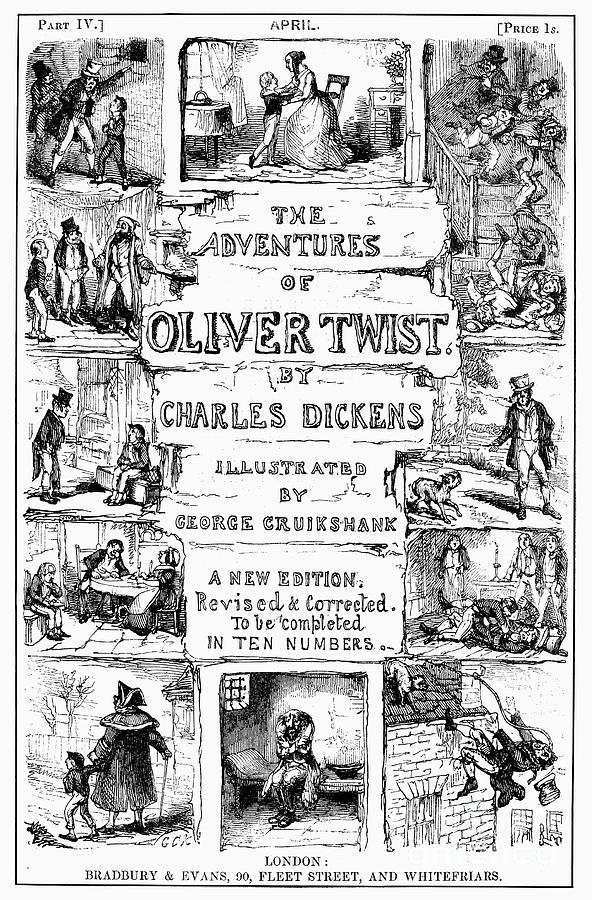

"It is true that Dickens did not set out to write crime fiction."
Most of us don't think of Charles Dickens (1812-70) as a crime fiction writer (perhaps due
to fond childhood memories of A Christmas Carol), but good old Boz can justifiably be considered as a pioneer in the field:

   "Crime and its detection; criminals and their motives behind it; victims and their predicament; investigation and its outcome: such elements produce the sensation
that has always mesmerized the imagination of the readers. The enthusiastic audience
was never turned down [but] rather catered with caution by specialized writers since
the dawn of this genre in the 18th century. The popular psyche that sometimes gets
tired of other literary forms never really finds it too much to digest suspense, thriller,
mystery and crime that usually involve the dark secrets of human hearts.

   "This may be the reason why we still enjoy Dickens’ writings for we often come
across such elements in his writings. As we read Dickens more and more in the
perspective of the Victorian age and its special obsession towards crime, jail,
prison and policing, it is observed that he was drawn towards the secret that
excites curiosity. Perhaps it is this element of secrecy that renders his work as
universal in nature and still provides the same pleasure experienced by his
contemporary audience.

   "A close analysis of Dickens’ great body of work including both fiction and
non-fiction marks the evolution of crime fiction from the initial success of the
detective story to the height of Holmes' popularity in the early twentieth century.
This is also perhaps the reason why even after two centuries, his works are so
much in demand that they are reproduced in various media. In spite of this
insight, Dickens’ crime writing is perhaps an undervalued aspect. In this paper,
therefore, we propose to read Dickens, as a crime writer with reference to his
revolutionary crime novels and try to find a reason for undervaluing his aspect
of crime writing, which in a way would attempt to prove either his success or
weakening of his ability as a crime writer."

When it came to sensing which way the winds of the literary market were blowing, Dickens was never one to let himself get becalmed:

   "In fact Dickens was always with the trends of the market. Thus with the
publication of Newgate Calender, as Newgate novels became popular, Dickens
gave his readers Oliver Twist [online HERE]. Though published initially as a
series from 1837-39, Oliver Twist is an extremely successful and highly
controversial novel where perhaps for the first time Dickens profoundly
focused on the master criminal Fagin, who seduces young homeless boys
and turns them into criminals, and introduced to his readers his inclination
towards writing crime fiction."
Even in other novels in which criminality wasn't Dickens's primary concern, it still obtrudes:

   "Crime during the Victorian age was an inescapable social problem. So as a social
novelist, Dickens tended to view crime in his novels more liberally. Not only Oliver
Twist, but even in Great Expectations [online HERE] Dickens’ dissatisfaction with
the prison system as well as a sympathetic portrayal of criminals is suggested."
However:

   ". . . as a journalist, Dickens’ non-fiction took a more conservative stance towards
crime where he suggested that it was more important to focus on the punishment of
criminals rather than giving them a second chance to redeem themselves. This
becomes even more clear on a close scrutiny of the description of Inspector Charles
Field and his detection in his short article 'On Duty of [sic] Inspector Field' (1851)
[online HERE] and Mr. Bucket from Bleak House (1853) [online HERE]."
Dickens understood that curiosity is endemic to humanity and that the solution of a conundrum can prove satisfying to readers:

   "Just as Fagin in Oliver Twist became a popular character through the sympathetic portrayal, Dickens’ contribution is worth mentioning in creating the prototype of the
literary detective as well. Though he did not set to write crime fiction, there is always
at least one puzzle to be solved in a Dickens novel and the crime and justice system
often comes in for castigation."

. . . which takes us to his only full-blown mystery novel:

   "Dickens' fascination with the practice of detection continued in more articles
for Household Words on the detective force, and in his later novels. The unfinished
The Mystery of Edwin Drood (1870), of which there had been numerous assumed
solutions, in particular represent[s] a move towards the detective fiction of the late
nineteenth century. Dickens was not only drawn towards the secret that excites
curiosity, he loved to introduce the game of hide and seek with the reader who
tried to anticipate the solution of the secret. It is perhaps the demand of his readers
as well as his keen interest and obsession with crime and policing that he intended
to write a mystery story that would reveal the secret to his readers at the end.
Unfortunately, Dickens died half way before solving the mystery."
For Dickens, crime and how it was punished served as bellwethers for social progress—or the lack of it:

  ". . . when we focus on the literary skill of his pioneering crime novels, we find that

he displayed a shrewd insight into the criminal character, meanwhile demanding
harsh penalty for those who broke the law.  . . . In these novels specifically we find
the treatment of crime for Dickens was far more than an authorial device: it was a
focal point for his deep concern with social problems and played a vital role in his
attempt to understand these ills."

Endnotes and References (2 pages)

Typos: [Very uncertain punctuation and capitalization]; "or on [should be an] adult"
======================================================================
Resources:
- There's more about Inspector Field on Wikipedia (HERE), the Jack the Ripper Tour

webpage (HERE), and in Grace Moore's Strand article (HERE), from which we quote:

   "Dickens eventually became friends with the detective Charles Frederick Field
(1805-74), immortalized in his article 'On Duty With Inspector Field' and widely
regarded as the model for Inspector Bucket. Bucket is credited as being the first
detective to appear in an English novel. He stands out as the one figure in the
world of confusion that is Bleak House who never loses control."

- Our last entanglement with Edwin Drood was probably (HERE).

Sunday, June 11, 2017

"Sometimes There Ain't No Justice"

"Account Settled."
By Robert Zacks (1915-95).
First appearance: Bestseller Mystery Magazine, March 1959.
Short story (8 pages).
Online at UNZ (HERE).


"Alice Robbins was a sweet young thing with everything to live for—but she killed herself when her boss left town with a $10,000 necklace that wasn't his . . . Big Bill Johnson figured he'd just have to find the guy and pin it on him—which proved surprisingly difficult."
Same old story: Like the moth to the flame, a small-town kid gets an overload of bright lights, big city, starts hanging with the wrong people, and ends up paying an extended visit to the morgue. Once she's found out just how rotten the man she's working for is, he does a bunk with some valuable jewelry which the Acme Collection Agency has an intense interest in, and she winds up dead. For Big Bill Johnson, Acme's best bill (no pun intended) collector, track-ing this individual down will take him from New York, to smalltown America, and finally to the Chicago office of an extremely nervous, uncertain man with a gun in his desk drawer and a strong motive to use it . . .

The characters:
~ Big Bill Johnson:

  "Boss, this is a tough one. I'm getting nowhere."
~ Doc Watson:
  "If we can catch up with this guy and squeeze the ten thousand out of him, we make ninety-five hundred dollars profit."
~ McGillicudy:
  "We're in a funny position. As far as we're concerned it's suicide without question. He's got a right to disappear if he wants to. It's a free country."
~ The landlady:
  "It's a lie. I didn't find any money."
~ Carruthers:
  "When his eyes adjusted to the semi-gloom and indirect lighting he saw Carruthers of the Gazette at the bar. Carruthers, small and egotistical, was a good friend of Bill's."
~ Reverend Smith:
  "The Reverend was a kindly, loquacious man with graying hair. He'd heard about Alice Robbins' death, it turned out."
~ Dr. Lord:
  "He looked at Big Bill with pain-filled eyes, and in them was a flicker of hope, a moment of indecision."
~ Randall Craig:
  "This guy is deadly. His advertising agency is a front—his business is blackmail."
~ Alice Robbins:
  "Alice Robbins was an orphan and poor. Alice helped Sybil spend her money. Probably the first good time Alice ever had in her life. Made her yearn for the big city."

Resources:
- To judge from FictionMags, Robert Zacks specialized in crime fiction and SFF, getting published in the pulps and the slicks from 1945 to 1959; "Account Settled" was apparently his last story.
- Zacks's comparatively small SFF output is listed on the ISFDb (HERE); he also has five screen credits on the IMDb (HERE).

Saturday, June 10, 2017

"Every Time I Get a Murder All Sewed Up, You Go Digging Up the Pavement and Upsetting the Apple Cart"

"These Shoes Are Killing Me."
By Leroy Yerxa (1915-46).
First appearance: Mammoth Detective, May 1943.
Short story (11 pages).
Online at Roy Glashan's Library (HERE).
"Footprints all around the corpse; but they were all prints of the left foot!"
What looks like an ordinary case (for the police anyway) of a young woman's strangulation rapidly turns strange when all of the crime scene evidence starts pointing to "a one-legged murderer hopping around, fighting with the girl and finally killing her"—forcing Inspector Hall to admit to his best detective that, "by the saints, Case, it's impossible." Eventually it'll all boil down to shoes. Shoes, shoes, shoes—that charming prince never came close to having this much aggravation with Cinderella's footgear.

The characters:
~ Inspector James Hall:
  "Hall didn’t like puzzles and he didn’t like details. Puzzles troubled his solid head, and right now, as he slammed down the phone, the toughest problem he’d faced in months sent three thick fingers scratching over his bald head."
~ Homicide Detective Robert Case:
  According to Inspector Hall, "the little wonder boy of the detective squad."
~ Helen Kane:
  The victim, "age twenty-six, came from a decent family, worked in a down town office and lived for nights like last night when she could put on the only nice things she owned and go stepping out among the bright lights."
~ Glenn Halliday:
  The prime suspect, age thirty-two and in good health—until, that is, according to the coroner he "died from a gunshot in the head. He held the gun close to his temple and fired it after stretching out on the bed and removing his shoes."
~ Percy Wallace:
  A shoe salesman at the Regent Shoe House who confesses to . . . a mistake: "I insisted on leaving the other right shoe and taking the muddy one back to the store."

Resources:
- Leroy Yerxa is remembered primarily for his SFF, hence these listings in the SFE (HERE), the ISFDb (HERE), and also (HERE); FictionMags shows that he was active exclusively in the '40s until his death in 1946, during which time he produced roughly a handful of crime fiction stories for Mammoth Detective, his main series character, Paddy O'Sheen, appearing in a half dozen of them.
- Footwear also figured heavily in the story which we highlighted in a previous posting (HERE).
- There's always somebody out there who'll catch an author's error, no matter how trivial:

  "In 'That Affair Next Door,' by Anna Katharine Green, an important piece of evidence is the pair of shoes worn by the murdered woman, for of course, the book being by Mrs. Rohlfs, there is a murdered woman to be considered. It is expressly stated, possibly by way of free advertisement, that these shoes were purchased from B. Altman & Co., a somewhat well known dry goods firm on Sixth Avenue. The crime was committed in September, 1895. We wonder if it has occurred to Mrs. Rohlfs that Altman did not sell shoes until the opening of the present season. These are small matters, but it is well to be accurate, especially in the case of circumstantial evidence." — "Literary Chat," Munsey's, April 1897

Tuesday, June 6, 2017

"He Felt a Warm Sense of Coming Adventure"

"Mousetrapped."
By Neill C. Wilson (1889-ca. 1960).
First appearance: Bestseller Mystery Magazine, September 1959.
Short short short story (4 pages).
Online at UNZ (HERE).
   "The fat man was a clever manipulator with a foolproof racket. He depended on the dishonesty of his victims and his own ability to recognize their potential. The young woman with the smudge on her cheek was, he decided, a gold mine . . ."

Some people are always, as the saying has it, ahead of the curve; consider the dysfunctional couple of "Oodles" and "Toodles" . . .

The characters:
~ The fat man:
  "He hung up, feeling a tingle. This could be a real break."
~ Tony:
  "Sure mister, I losa heem."
~ A shifty-eyed man:
  "Shifty-eyes took out a wallet, paid and scuttled away with his envelope."
~ The young woman:
  "A woman scorned, you know."
~ Mr. Talbott:
  "Where are those letters? If I ever get my hands on that vixen—"
Resource:
 - The FictionMags listing for Neill Compton Wilson indicates that he saw his greatest productive period in the early '40s to the early '60s, entirely in the high-paying slicks, nearly all of his work outside the crime fiction field.

Monday, June 5, 2017

"He Spun Round, Caught by the Age-Old and Never-Failing Trick, and in That Moment a Revolver Crashed"

"Duello."
By Henry Wade (Henry L. Aubrey-Fletcher, 1887-1969).
First appearance: Unknown.
Reprinted in The Second Omnibus of Crime (1932) 
and Policeman's Lot (1933) (review HERE).
Short story (15 pages).
"Tears, sobs, heaving shoulders—all the reactions familiar to the devotee of the cinema."
It is indeed an extraordinary sight that greets Superintendent Cox, a local policeman, and Detective-Inspector Poole of Scotland Yard in a sodden clearing in the woods—two men . . .

   ". . . both in evening clothes—short coat, black tie, one wearing a white waistcoat, one a black—and both dead. In the right hand of each was clasped a small automatic pistol and each white shirt-front was saturated with a dark smear of blood. 
   ". . . it seemed as if the two men must have fired simultaneously, at very close range, though not so close as to leave powder marking on the linen shirt-fronts. It was an intriguing affair; such a thing as a duel was almost unheard of in these days and in this case it seemed as if the men had been bent upon killing each other, without thought of one surviving."

When Superintendent Cox opines, "Like the good old times, isn't it?—All for the love of a lady," D. I. Poole responds, "Lady or money, Superintendent. Hardly politics in these days, I'm afraid"—neither of them realizing how close to the truth they both are. There actually is a lady involved, and she's a woman that Poole, for one, will never, ever forget . . .

The characters:
~ Superintendent Cox:
  ". . . a uniformed police-superintendent, ponderous in build and patriarchal in manner."
~ Detective-Inspector Poole, C.I.D.:
  ". . . a considerably younger man in plain clothes, whose firm mouth and steady grey eyes were becoming only too well known to the underworld . . ."
~ Sergeant Robins:
  ". . . Robins jumped on a bike and came along, found the car, did a bit of exploring into the wood and came across these chaps. Like a sensible fellow he got straight back to his station and telephoned for me . . ."
~ George Horne:
  ". . . a married man, with no children, living in a small house called Five Oaks . . ."
~ Julian de Lange:
  ". . . a London 'gigolo' was mentioned."
~ Rev. James Partacle, the Vicar:
  "He was genuinely distressed by the news brought by the detective and at once bustled off on his painful errand . . ."
~ Mrs. Partacle, the Vicar's wife:
  ". . . perhaps more worldly than her husband; she was deeply intriuged by the detective's news and was able and willing to throw considerable illumination upon it."
~ Quirril Horne, wife of one of the victims:
  "Mrs. Horne, dressed in a fawn skirt and striped jumper, was lying on a sofa, an embroidered shawl over her legs. She did not attempt to rise when Poole entered, 
but greeted him with the shadow of a smile and a gesture towards a chair."
~ Ethel, the house-parlourmaid:
  "The girl stared at him, looked at the shoes again, turned them over—and straightened herself abruptly. She seized the other pair and, turning them both over, displayed the difference to Poole."

Typo: "extraoardinary"
Resources:
- Wikipedia talks about Henry Wade (HERE), as does Mike Grost on his Guide to Classic Mystery and Detection megasite (HERE).

The bottom line: "And how can that be true love which is falsely attempted? Love is a familiar; Love is a devil. There is no evil angel but Love. Yet was Samson so tempted, and he had an excellent strength; yet was Solomon so seduced, and he had a very good wit. Cupid's butt-shaft is too hard for Hercules' club, and therefore too much odds for a Spaniard's rapier. The first and second cause will not serve my turn; the passado he respects not, the duello he regards not."

Saturday, June 3, 2017

"Go Mate with a Venusian Hedgehog"

"The Trouble with Vegans."
By Roger Deeley (?-?).
First appearance: Worlds of IF, August 1967.
Short short story (7 pages).
Online at Archive.org (HERE).
"Vegans? All the galaxy knows they're lovable rogues — very lovable, and indubitable rogues!"
Smuggling contraband is a serious offense, but what do you do when the smugglers 
aren't really serious?

The characters:
~ The chief Customs Officer of the Newyorkport Spacecenter, the unnamed narrator:
  "What cost me my pride as well as my job was the way he did it. And the results."
~ Llant'Gornu Gra-Oud, captain of the Vegan merchantman "Takka'Aq Dorg":
  ". . . a man whose sheer animal cunning would have made Machiavelli creep off 
in shame to go check up on his textbooks."
~ Lt. Malo Allallu:
  ". . . a young Martian who had just passed out of college and was starting on a 
career in Customs and Excise. One day he might even make a Chief Officer — 
providing he doesn't act like me, that is."
~ ~ ~ ~ ~
"The Time Trollers."
By Roger Deeley (?-?).
First appearance: Worlds of IF, December 1967.
Short short story (5 pages).
Online at Archive.org (HERE).
"He had been expecting a better reaction than this. He'd always had it before."
Already what happened last week is, for most of us, a hazy memory at best, so what would history look like three hundred and twenty centuries from now?

The characters:
~ The Time Troller:
  "Time travel as such is an impossibility, of course."
~ The small man:
  "Are you calling me a liar?"
Resources:
- Apart from this meager data on the ISFDb (HERE), we can find nothing else about 
Roger Deeley.
- A famous personage and an almost as famous island are mentioned in the story; 
see (HERE) for more.
- A few posts ago another checkpoint agent also experienced problems with aliens 
(HERE).

Friday, June 2, 2017

"He Decided That If He Were Committing Suicide, He Would Try To Make Even a Gas-oven As Comfortable As Possible"

"Death in the Kitchen."
By Milward Kennedy (Milward Kennedy Burge, 1894-1968).
First appearance: The Manchester Guardian, 1930 (FictionMags).
Reprinted in The Second Omnibus of Crime (1932), Great Crime Stories (1936), Fifty Masterpieces of Mystery (1937), and Lilliput, July 1937.
Short short short story (4 pages).
Online at UNZ (HERE).
Sorry, Edgar, they misspelled your name—again.
"That gas-oven, sir, that looks like suicide, doesn't it, sir?"
Here's the thing about the perfect crime, see: It's got to be perfect, or it'll just turn into a sloppy mess . . .

The characters:
~ The police sergeant:
  "I can understand how it is he's forgotten every blamed thing about what happened 
last night, but—Hallo, sir, what's up?"
~ Rupert Morrison:
  "The important thing was to be thorough. He had no alibi, and knew that it would be 
folly to fake one."
~ George Manning:
  "George Manning on the other hand had grown foolish, for he had not troubled to 
discover whether his victim had changed."
Resources:
- For more about Milward Kennedy see Wikipedia (HERE) and the GAD Wiki (HERE).
- You can read Sammi Cox's review of our story (HERE), but watch out for SPOILERS.

The bottom line: “Mike wished Mr. Burden had chosen another time to be murdered. He was beginning to see that the hour of dressing for dinner might have been expressly designed for persons who need a quiet spell for the commission of crime.” 
― Eilís Dillon