Monday, June 21, 2021

"Your Yes-man Is Dead"

THE THEATRICAL WORLD has always been a serviceable background for detective stories, with Golden Age authors like G. K. Chesterton, Agatha Christie, Ngaio Marsh, and Ellery Queen exploiting it for all it's worth. In today's story, it will take two murders to get to the implications of a . . .

"Bottom Deal."
By Hugh Pentecost (Judson Philips, 1903-89).
Illustrations by Charles Chickering (1891-1970; HERE).
First appearance: Blue Book, May 1941.
Novella (28 pages; 9 illos).
Online at Archive.org (HERE).
     "I'm on the job about four hours, and a murder is committed right under my nose."

When a bodyguard utterly fails to guard his own body, another bodyguard reluctantly sets out to solve his death—but not, unfortunately, before another murder. The solution, when it comes, is embedded in a card gambit: "The pattern of this crime is like the pattern of the trick I just showed you." . . . .

Main characters in order of appearance:
~ Richard Gaunt:
  ". . . felt beads of sweat break out on his forehead."
~ Robert Royden:
  "There's no one like him."
~ Marcia Royden:
  "I think he's dead!"
~ Gary Lloyd:
  ". . . stood back of Marcia's chair, his jaw belligerent."
~ Danny Cayle:
  ". . . was known as the Lloyds of New York."
~ Donovan (a.k.a. Harvard):
  "I think that without doubt this is the damnedest proposition that's ever been brought in here."
~ Joe Strega:
  "He's a bodyguard. Royden insults people, and Strega does the punching."
~ Harold Caldredge:
  "It was a nice play until you cut all the other parts out of it but your own."
~ Carla Warlen:
  "Playing detective, Mr. Donovan?"
~ Ted Havilock:
  ". . . a pathetic, broken-down actor."
~ Lilli Paville:
  ". . . an actress, first and last."
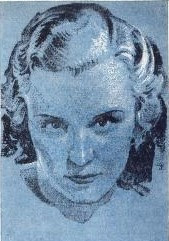
~ John Taylor:
  "I was in this room every second, Inspector, until—well, until just before it happened."
~ Inspector Moran:
  "You did say you'd been reading detective stories. Playing a hunch? They always play hunches in books."

"The moment" when it all becomes clear:
  "Donovan sat bolt upright in bed. His throat was suddenly dry. He felt beads of sweat standing on his forehead."

Comment: The story has faint echoes of a Nero Wolfe-Archie Goodwin type of character dynamic, with this "Wolfe," a big-time gambler, more ruthless than the Montenegrin.

References and resources:
- "Bottom Deal": Not recommended if you're playing for money, unless you're very good at it—or well-armed:
  "Bottom dealing or base dealing is a sleight of hand technique in which the bottom card from a deck of playing cards is dealt instead of the top card. It is used by magicians as a type of card illusion, and by card sharps and mechanics, and as a method of cheating in poker or other card games" (Wikipedia HERE).
- "Joe Louis": For several decades his name was a synonym for "boxing champ":
  "Joseph Louis Barrow (1914–1981) was an American professional boxer who competed from 1934 to 1951. Nicknamed the Brown Bomber, Louis is widely regarded as one of the greatest and most influential boxers of all time. He reigned as the world heavyweight champion from 1937 until his temporary retirement in 1949. He was victorious in 25 consecutive title defenses, a record for all weight classes. Louis had the longest single reign as champion of any boxer in history" (Wikipedia HERE).
- "baby was in need of a new pair of shoes": Beginning in 1914, an idiomatic expression that has enjoyed a long lifetime:
  "A phrase said aloud when one is hoping for good luck in a game of chance, especially before a dice roll" (The Free Dictionary HERE).
- "Fade me again?": If you're not doing well rolling the bones, it sure can help:
  "When you're playing in a open game of craps (not in a casino), you need someone to put up money against what you're betting. The person putting up that money is 'fading' you" (Urban Dictionary HERE). "Shoot craps, Mr. Donovan?" (Wikipedia HERE). "Honest dice" (Wikipedia HERE).
- "prussic acid": Less commonly called hydrogen cyanide:
  "Hydrogen cyanide, sometimes called prussic acid, is a chemical compound with the chemical formula HCN. It is a colorless, extremely poisonous, and flammable liquid that boils slightly above room temperature, at 25.6 °C (78.1 °F).
  . . . "Cyanide poisoning is poisoning that results from exposure to any of a number of forms of cyanide. Early symptoms include headache, dizziness, fast heart rate, shortness of breath, and vomiting. This phase may then be followed by seizures, slow heart rate, low blood pressure, loss of consciousness, and cardiac arrest. Onset of symptoms usually occurs within a few minutes. Some survivors have long-term neurological problems" (Wikipedia HERE and HERE).
- "Napoleon brandy": In our story it becomes a weapon:
  "Brandy thought to be of great age or merit" (Lexico.com HERE). "Courvoisier’s reputation as a Cognac for the elite dates back to their beginnings when a small wine and spirits shop owned by Emmanuel Courvoisier and Louis Gallois was visited by Napoleon Bonaparte himself. They soon became a supplier of Cognac for the Emperor, followed by royal families across Europe" (Cognac Expert HERE).
- "Phi Beta Kappa key": They say—and Carla seems to believe—that if you have one you probably possess a lot of smarts:
  "The Phi Beta Kappa Society (ΦΒΚ) is the oldest academic honor society in the United States, and is often described as its most prestigious one, due to its long history and academic selectivity. Phi Beta Kappa aims to promote and advocate excellence in the liberal arts and sciences, and to induct the most outstanding students of arts and sciences at American colleges and universities. It was founded at the College of William and Mary on December 5, 1776 as the first collegiate Greek-letter fraternity and was among the earliest collegiate fraternal societies.
  "Phi Beta Kappa (ΦΒΚ) stands for Φιλοσοφία Βίου Κυβερνήτης (Philosophia Biou Kybernētēs), which means 'Love of learning [lit. wisdom] is the guide [lit. helmsman] of life'" (Wikipedia HERE).
- "the inferiority complex": From all appearances Royden has one:
  "In psychology, an inferiority complex is an intense personal feeling of inadequacy, often resulting in the belief that one is in some way deficient, or inferior, to others.
  ". . . An inferiority complex may cause an individual to overcompensate in a number of ways. For example, a person who feels inferior because they are shorter than average (also known as a Napoleon complex) may become overly concerned with how they appear to others. They may wear special shoes to make themself [sic] appear taller or surround himself with individuals who are even shorter than they are. If this is taken to the extreme, it becomes a neurosis.
  "It may also cause an individual to be prone to flashy outward displays, with behaviors ranging from attention-seeking to excessive competitiveness and aggression, in an attempt to compensate for their either real or imagined deficiencies" (Wikipedia HERE).
- "went down in the crash": The stock market crash of 1929:
  "The Wall Street Crash of 1929, also known as the Great Crash, was a major American stock market crash that occurred in the autumn of 1929. It started in September and ended late in October, when share prices on the New York Stock Exchange collapsed. It was the most devastating stock market crash in the history of the United States, when taking into consideration the full extent and duration of its aftereffects" (Wikipedia HERE).
- "the odor of cordite": Fell out of favor after World War Two:
  "Cordite is a family of smokeless propellants developed and produced in the United Kingdom since 1889 to replace gunpowder as a military propellant. Like gunpowder, cordite is classified as a low explosive because of its slow burning rates and consequently low brisance. These produce a subsonic deflagration wave rather than the supersonic detonation wave produced by brisants, or high explosives. The hot gases produced by burning gunpowder or cordite generate sufficient pressure to propel a bullet or shell to its target, but not so quickly as to routinely destroy the barrel of the gun" (Wikipedia HERE).
- "making sure you weren't heeled": You've got to wonder how this idiom evolved:
  "Slang. armed, especially with a gun" (Dictionary.com HERE).
- "a single bright light burning in the middle of the stage": The scene of many triumphs and tragedies:
  "There are several types of stages that vary as to the usage and the relation of the audience to them. The most common form found in the West is the proscenium stage" (Wikipedia HERE). "just got into the wings": "Areas that are part of a stage deck but offstage (out of sight of the audience). The wings are typically masked with legs. The wing space is used for performers preparing to enter, storage of sets for scenery changes and as a stagehand work area. Wings also contain technical equipment, such as the fly system" (Wikipedia HERE).
- "impersonate The Shadow": At the time a very popular radio program:
  "The radio version of The Shadow is less ruthless than his pulp counterpart, preferring to capture his foes more often than gun them down. He sometimes openly shows compassion for his enemies, even at times criticizing society for creating circumstances that lead to certain crimes and cause some people to lose hope and support" (Wikipedia HERE).
- "a white scarf knotted Ascot fashion": Not as common as in days of yore:
   "An ascot tie, ascot or hanker-tie is a neckband with wide pointed wings, traditionally made of pale grey patterned silk. This wide tie is usually patterned, folded over, and fastened with a tie pin or tie clip. It is usually reserved for formal wear with morning dress for daytime weddings and worn with a cutaway morning coat and striped grey formal trousers" (Wikipedia HERE). "The ascot is a type of neckwear that looks like a cross between silken scarf and necktie" (Bows-N-Ties.com HERE).
- Our latest meeting with Hugh Pentecost was several years ago with his Collier's story "The Case of the Killer Dogs" (HERE).
- Murder mysteries presented as plays—unlike today's story, in which the murders are associated with a play—have a long history. Nearly a century ago George Jean Nathan, a perceptive drama critic, had his own ideas of what theatrical mysteries should be like; go (HERE) for those.
  Alexander Woollcott, another critic, had some ideas to offer as well; see his "Murder at 8:30 Sharp" highlighted (HERE).
  Augustus Thomas's melodrama "Nemesis" dealt with fingerprint evidence; see more (HERE).
~~~~~~~~~~~~~~~~~~~~~~~~~~~~~~~~~~~~~~~~~~~~~~~~~~~~~~~~~~~~~~~~~~~~~~~~~~~~

Friday, June 18, 2021

"It Was Just a Plain, Ordinary, Everyday Electric Push-button"

"The Doorbell."
By David H. Keller (1880-1966).
Original illustration by Lumen Winter (1908-82; HERE).
First appearance: Wonder Stories, June 1934.
Reprints page (HERE).
Short story (10 pages as a PDF).
Online at Faded Page (HERE).
     "Brother was dead and Mother was almost dead, but she managed to gasp out what had happened."

Even the most harmless technology can turn lethal when it becomes a means to exact revenge . . . .

Principal characters:
~ Jacob Hubler:
  "Why didn't you use the gun?"
~ Henry Cecil:
  "There would have been no originality in it."
~ Doctor Murdock:
  "He's a good physician and I have the greatest confidence in him. There's no occasion for him to worry."

References and resources:
- "a Rolls-Royce": For decades the world has regarded a Rolls as the very emblem of wealth:
  "Rolls-Royce was a British luxury car and later an aero-engine manufacturing business established in 1904 in Manchester, United Kingdom by the partnership of Charles Rolls and Henry Royce. Building on Royce's reputation established with his cranes they quickly developed a reputation for superior engineering by manu-facturing the 'best car in the world.' The First World War brought them into manufacturing aero-engines. Joint development of jet engines began in 1940 and they entered production. Rolls-Royce has built an enduring reputation for development and manufacture of engines for defence and civil aircraft" (Wikipedia HERE).
- "auditory hallucinosis": Often called "hearing voices":
  "An auditory hallucination, or paracusia, is a form of hallucination that involves perceiving sounds without auditory stimulus. A common form of auditory halluci-nation involves hearing one or more talking voices, and this is known as an auditory verbal hallucination. This may be associated with psychotic disorders, most notably schizophrenia, and holds special significance in diagnosing these conditions. How-ever, individuals without any psychiatric disease whatsoever may hear voices, including (but not limited to) those under the influence of mind-altering substances" (Wikipedia HERE).
- "should be good for cholera": Depending on where the patient lives, it could be fatal:
  "Cholera is an infection of the small intestine by some strains of the bacterium Vibrio cholerae. Symptoms may range from none, to mild, to severe. Cholera affects an estimated 3–5 million people worldwide and causes 28,800–130,000 deaths a year. Although it is classified as a pandemic as of 2010, it is rare in high income countries" (Wikipedia HERE).
- "an electromagnet": You probably haven't realized it, but there are many electromagnets influencing your life at this very moment:
  "An electromagnet is a type of magnet in which the magnetic field is produced by an electric current. Electromagnets usually consist of wire wound into a coil. A current through the wire creates a magnetic field which is concentrated in the hole, denoting the center of the coil. The magnetic field disappears when the current is turned off. The wire turns are often wound around a magnetic core made from a ferromagnetic or ferrimagnetic material such as iron; the magnetic core concentrates the magnetic flux and makes a more powerful magnet. The main advantage of an electromagnet over a permanent magnet is that the magnetic field can be quickly changed by controlling the amount of electric current in the winding. However, unlike a permanent magnet that needs no power, an electromagnet requires a continuous supply of current to maintain the magnetic field" (Wikipedia HERE).
- Writing in much the same vein as Poe but without his literary skills, David H. Keller had his fantasies often take a gruesome turn; see Wikipedia (HERE), the SFE (HERE), The Encyclo-pedia of Fantasy (HERE), and the ISFDb (HERE).
~~~~~~~~~~~~~~~~~~~~~~~~~~~~~~~~~~~~~~~~~~~~~~~~~~~~~~~~~~~~~~~~~~~~~~~~~~~~

Tuesday, June 15, 2021

"One Clutching Hand Seized the Revolver, the Other, with Clenched Fist, Pounded at His Face"

"Bank Night."
By Robert R. Mill (1895-1942).
Illustrations by Charles Chickering (1891-1970; HERE).
First appearance: Blue Book, February 1940.
Short story (11 pages; 6 illos).
Online at Archive.org (HERE).
     ". . . and they locked in a death struggle."

For a state trooper smitten with a speeder it's practically love at first sight, but for the object of his devotion it's something else entirely . . . .

Main characters:
The troopers:
~ Lt. Edward "Tiny" David:
  "Isn't it lucky, sir, that we came out the front way?"
~ Lt. James Crosby:
  ". . . taken completely by surprise, acted automatically."
~ Lt. Charles McMann:
  ". . . did not look forward to this with relish."
~ Captain Charles Field:
  "There's one thing in your favor: when you make a fool of yourself, you go whole hog."
~ Sgt. Max Payton:
  ". . . if the message is love and kisses, will the lieutenant care to have me deliver them to him?"
The civilians:
~ Vera Hamtrow:
  ". . . was smiling as she sat waiting for them. Her clothes and her make-up were vivid."
~ Mrs. Hamtrow:
  ". . . was carrying a large suitcase."
~ Pop:
  "Several nights here lately seems like I've been hearing funny noises down in the basement, but when I get there, there ain't nothin'."

References and resources:
- "Bank Night": It had relatively little to do directly with banks per se:
  "Bank Night was a lottery game franchise in the United States during the Great Depression. It was invented and marketed by Charles U. Yaeger, a former booking agent for 20th Century Fox. In 1936, Bank Night was played at 5,000 of America's 15,000 active theaters, and copies of it were played at countless more. The popularity of Bank Night and similar schemes contributed to the resiliency of the film industry during the Great Depression more than any other single business tactic" (Wikipedia HERE).
- "we haven't a jitterbug on the block": Not an insect but a style of dance:
  "White dancers picked up the energetic jitterbug from dancers at black venues. Venues in the Hill District of Pittsburgh were popular places for whites to learn the jitterbug. The Savoy Ballroom, a dance hall in Harlem, was a famous cross-cultural venue, frequented by both black locals and white tourists" (Wikipedia HERE).
- "the European dictators": They were very much in the news at the time:
  "Mussolini and Hitler used similar, modest titles referring to them as 'the Leader.' Mussolini used 'Il Duce' and Hitler was generally referred to as 'der Führer.' Franco used a similar title 'El Caudillo' ('the Head') and for Stalin his adopted name ['man of steel'] became synonyms with his role as the absolute leader. For Mussolini, Hitler, and Franco, the use of modest, non-traditional titles displayed their absolute power even stronger as they did not need any, not even a historic legitimacy either. Over time, dictators have been known to use tactics that violate human rights. For example, under the Soviet dictator Joseph Stalin, government policy was enforced by secret police and the Gulag system of prison labour camps. Most Gulag inmates were not political prisoners, although significant numbers of political prisoners could be found in the camps at any one time. Data collected from Soviet archives gives the death toll from Gulags at 1,053,829. Other human rights abuses by the Soviet state included human experimentation, the use of psychiatry as a political weapon and the denial of freedom of religion, assembly, speech and association" (Wikipedia HERE).
- "the P.W.A.": With FDR's New Deal in full effect, every reader would know what it was right away:
  "Public Works Administration (PWA), part of the New Deal of 1933, was a large-scale public works construction agency in the United States headed by Secretary of the Interior Harold L. Ickes. It was created by the National Industrial Recovery Act in June 1933 in response to the Great Depression. It built large-scale public works such as dams, bridges, hospitals, and schools. Its goals were to spend $3.3 billion in the first year, and $6 billion in all, to provide employment, stabilize purchasing power, and help revive the economy. Most of the spending came in two waves in 1933–35, and again in 1938. Originally called the Federal Emergency Administration of Public Works, it was renamed the Public Works Administration in 1935 and shut down in 1944" (Wikipedia HERE).
- "the gay nineties vintage": Seen through the haze of nostalgia almost any historical period would seem to be better than the present:
  "The Gay Nineties is an American nostalgic term and a periodization of the history of the United States referring to the decade of the 1890s. It is known in the United Kingdom as the Naughty Nineties, and refers there to the decade of supposedly decadent art of Aubrey Beardsley, the witty plays and trial of Oscar Wilde, society scandals and the beginning of the suffragette movement. Despite the term, the decade was marked by an economic crisis, which greatly worsened when the Panic of 1893 set off a widespread economic depression in the United States that lasted until 1896" (Wikipedia HERE).
- We had a recent encounter with Robert R. Mill's atypical tale, "Mrs. Murder" (HERE).
~~~~~~~~~~~~~~~~~~~~~~~~~~~~~~~~~~~~~~~~~~~~~~~~~~~~~~~~~~~~~~~~~~~~~~~~~~~~

Saturday, June 12, 2021

"I Don't Like Being Shot At"

 "Twelve Hours to Blow!"
By Robert Silverberg (born 1935).
Illustrator unknown.
First appearance: Imaginative Tales, May 1957.
Short story (15 pages).
Online at Comic Book Plus (HERE; using dropdown menu go to page 66) and Archive.org (HERE).
(Parental note: Mild profanity.)
     "My name isn't Caldwell."

What looks at first like a case of mistaken identity propels a cryonics expert into a criminal conspiracy that for one disagreeable moment has him seeing "pretty stars": "He got me up against one of the walls and began banging my head against it . . . "

Principal characters:
~ Martin:
  "I glanced at my watch. And realized, with a shock, that I had less time left than I imagined."
~ Caldwell:
  "Hey! You! Caldwell! Halt!"
~ Channing:
  "He could move fast; I'll give him credit for that."
~ Ledland:
  "A Z9M9Z tube, Mr. Martin? Well, we're rather short of them, but I suppose I could let you have one."
~ Parkhurst:
  "You're listed in the official files as a criminal wanted on three planets. Do you expect us to believe some cock-and-bull story like that in face of the identification evidence?"

Typos: "cooper bus bar" [copper]; "computor".

References and resources:
- "Phobos, the inner moon of Mars": "Measurements of the day and night sides of Phobos show such extreme temperature variations that the sunlit side of the moon rivals a pleasant winter day in Chicago, while only a few kilometers away, on the dark side of the moon, the climate is more harsh than a night in Antarctica" (NASA Solar System Exploration HERE). "A person who weighs 68 kilogram-force (150 pounds) on Earth would weigh about 40 gram-force (2 ounces) standing on the surface of Phobos" (Wikipedia HERE and HERE). "headed for Deimos, the outer moon of Mars": "Escape velocity from Deimos is 5.6 m/s. This velocity could theoretically be achieved by a human performing a vertical jump" (Wikipedia HERE and HERE).
- "Syrtis City, Mars": "Syrtis Major is centered near at 8.4°N 69.5°E, extends some 1,500 km (930 mi) north from the planet's equator, and spans 1,000 km (620 mi) from west to east" (Wikipedia HERE and HERE).
- "temperatures around absolute zero": "Scientists and technologists routinely achieve temperatures close to absolute zero, where matter exhibits quantum effects such as Bose–Einstein condensate, superconductivity and superfluidity" (Wikipedia HERE).
- "a superconductor": "Superconductivity is a set of physical properties observed in certain materials where electrical resistance vanishes and magnetic flux fields are expelled from the material. Any material exhibiting these properties is a super-conductor. Unlike an ordinary metallic conductor, whose resistance decreases gradually as its temperature is lowered even down to near absolute zero, a super-conductor has a characteristic critical temperature below which the resistance drops abruptly to zero. An electric current through a loop of superconducting wire can persist indefinitely with no power source" (Wikipedia HERE).
 - "a super ultra-high-frequency radio transmitter": "UHF radio waves propagate mainly by line of sight; they are blocked by hills and large buildings although the trans-mission through building walls is strong enough for indoor reception. They are used for television broadcasting, cell phones, satellite communication including GPS, personal radio services including Wi-Fi and Bluetooth, walkie-talkies, cordless phones, and numerous other applications" (Wikipedia HERE).
- "your retinal patterns": "The relative obscurity and 'high tech' nature of retinal scans means that they are a frequent device in fiction to suggest that an area has been particularly strongly secured against intrusion" (Wikipedia HERE, HERE, and HERE).
- "fifteen gravities of acceleration": "Human tolerances depend on the magnitude of the gravitational force, the length of time it is applied, the direction it acts, the location of application, and the posture of the body" (Wikipedia HERE).
- "a geodesic bee-line": "In geometry, a geodesic is commonly a curve representing in some sense the shortest path (arc) between two points in a surface" (Wikipedia HERE).
- "the fishbowl helmet": "Many space story writers merely mention a 'spacesuit' without considering or describing design details, in the same way as they mention a ray gun or a spaceship without considering how its mechanism would work" (Wikipedia HERE); also see Atomic Rockets (HERE).
- Beginning writing in the early '50s, the incredibly prolific Robert Silverberg has shown himself to be as adept at the novel as he is with the short form; see Wikipedia (HERE), the SFE (HERE), and the ISFDb (HERE).
~~~~~~~~~~~~~~~~~~~~~~~~~~~~~~~~~~~~~~~~~~~~~~~~~~~~~~~~~~~~~~~~~~~~~~~~~~~~

Tuesday, June 8, 2021

"Much Too Nice To Get Mixed Up with a Murder"

TODAY'S STORY showcases that venerable crime fiction trope of the protagonist, usually a man, who is wanted by both the cops and the baddies, desperately trying to exculpate himself before he comes to a bad end in what could be termed "the man on the run" motif (but see "References and resources" below). True to the trope, our hero finds himself framed for . . .

"The Fun Farm Murder."
By Thomas Duncan (1905-?).
Illustrations by Orson Lowell (1871-1956; HERE).
First appearance: Blue Book, January 1941.
Novelette (24 pages).
Online at Archive.org (HERE).
(Parental caution: Some violence.)

     "The rug pillowing his head gleamed wet and scarlet."

Crime is bad enough without politics fouling up everything: "Assault and battery, resisting arrest, murder . . . Oh, yes—larceny, too . . ."

Main characters:
~ Cliff Boyd:
  ". . . I've had enough headaches tonight without getting hydrophobia."
~ Sally Kerrigan:
  ". . . would be waiting at the park gate, instead of in the caretaker's bungalow where she lived with her uncle, Mike Kerrigan."
~ Mike Kerrigan:
  "She wouldn't be living with her Uncle Mike any more—for that doughty little Irishman lay sprawled on the living-room rug, dead."
~ Tubby Gunderson:
  ". . . was merely typical. Just a blockhead who owed his job to the votes he swung in a rural precinct."
~ Mrs. Rasmussen:
  "My heart was ticking about three times as fast as usual . . ."
~ Fritz Scanlon:
  "He's the slickest shyster in town. Or—was."
~ The desk clerk:
  ". . . kept backing painfully away, and suddenly he turned and scurried into some inner office."
~ Kenneth Richards:
  "You're not so dumb, Boyd. You might make a good sheriff."
~ August E. Schuckelutz:
  "That name sent a tingle to the ends of his hair."
~ Hubbard, Worrall, and Ott:
  ". . . were frozen motionless, like wax figures in a carnival chamber of murderers."
References and resources:
- "flivver in the garage": "a small cheap usually old automobile" (Merriam-Webster HERE; see etymology as well).
- "between the right ear and the medulla oblongata": "The medulla contains the cardiac, respiratory, vomiting and vasomotor centers, and therefore deals with the auto-nomic functions of breathing, heart rate and blood pressure as well as the sleep wake cycle" (Wikipedia HERE).
- "called itself a roadhouse": "A roadhouse (Australia and the United States) or stopping house (Canada) is a small mixed-use premises typically built on or near a major road in a sparsely populated area or an isolated desert region that services the passing travellers, providing food, drinks, accommodation, fuel and parking spaces to the guests and their vehicles. The premises generally consist of just a single dwelling, permanently occupied by a nuclear family, usually between two and five family members" (Wikipedia HERE).
- "our pin-ball machine": The story takes place on the eve of the Second World War, before certain design changes were made: "During World War II, all of the major manufac-turers of coin-operated games turned to the manufacture of equipment for the war effort. Some companies, like Williams, bought old games from operators and refurbished them, adding new artwork with a patriotic theme. At the end of the war, a generation of Americans looked for amusement in bars and malt shops, and pinball saw another golden age. Improvements such as the tilt mechanism and free games (known as replays) appeared" (Wikipedia HERE).
- "those five C's covered the drinks": There's a logical reason for that nickname: "$100 bill is occasionally 'C-note' (C being the Roman numeral for 100, from the Latin word centum) or 'century note'; it can also be referred to as a 'Benjamin' or 'Benny' (after Benjamin Franklin, who is pictured on the note), or a 'yard' (so $300 is '3 yards' and a $50 bill is a 'half a yard'). 'A rack' is $1,000 in the form of ten $100 bills, banded by a bank or otherwise" (Wikipedia HERE).
- "a six percent first mortgage bond": "A mortgage bond is a bond backed by a pool of mortgages on a real estate asset such as a house. More generally, bonds which are secured by the pledge of specific assets are called mortgage bonds. Mortgage bonds can pay interest in either monthly, quarterly or semiannual periods" (Wikipedia HERE). "hovering around par": "A bond selling at par is priced at 100% of face value. Par can also refer to a bond's original issue value or its value upon redemption at maturity" (Wikipedia HERE).
- "telegraph company": "Telegraph lines continued to be an important means of distributing news feeds from news agencies by teleprinter machine until the rise of the internet in the 1990s. For Western Union, one service remained highly profitable—the wire transfer of money. This service kept Western Union in business long after the telegraph had ceased to be important" (Wikipedia HERE).
- "the State cops": "Twenty-three U.S. states use the term 'State Police.' Forty-nine states have a State Police agency or its equivalent, with Hawaii being the only state with a Sheriff Division of the Hawaii Department of Public Safety with statewide jurisdiction" (Wikipedia HERE).
- "under the marquee": "A marquee is most commonly a structure placed over the entrance to a hotel, theatre, casino, train station, or similar building" (Wikipedia HERE).
- "tramped the starter": "Before Chrysler's 1949 innovation of the key-operated combination ignition-starter switch, the starter was often operated by the driver pressing a button mounted on the floor or dashboard. Some vehicles had a pedal in the floor that manually engaged the starter drive pinion with the flywheel ring gear, then completed the electrical circuit to the starter motor once the pedal reached the end of its travel" (Wikipedia HERE).
- "a gambling device": "Pinball was banned beginning in the early 1940s until 1976 in New York City. Like New York, Los Angeles banned pinball machines in 1939. The ban was overturned by the Supreme Court of California in 1974 . . . Although it was rarely enforced, Chicago's ban on pinball lasted three decades and ended in 1976. Philadelphia and Salt Lake City also had similar bans. Regardless of these events, some towns in America still have such bans on their books; the town of Kokomo, Indiana lifted its ordinance banning pinball in December 2016" (Wikipedia HERE).
- "Several rods ahead": "In modern U.S. customary units it is defined as 16 1⁄2 US survey feet, equal to exactly 1⁄320 of a surveyor's mile, or a quarter of a surveyor's chain, and is approximately 5.0292 meters. The rod is useful as a unit of length because whole number multiples of it can form one acre of square measure" (Wikipedia HERE).
- "go to the chair": "Execution by electrocution, performed using an electric chair, is a method of execution originating (and almost exclusively employed) in the United States in which the condemned person is strapped to a specially built wooden chair and electrocuted through electrodes fastened on the head and leg. This execution method, conceived in 1881 by a Buffalo, New York, dentist named Alfred P. South-wick, was developed throughout the 1880s as a supposed humane alternative to hanging, and first used in 1890" (Wikipedia HERE).
- TV Tropes (HERE) has its own term for the man on the run motif.
- FictionMags's (HERE) thumbnail about Thomas William Duncan: "Poet and writer. Born in Casey, Iowa; lived in California." He started out in the pulps in 1930 and found a home in the slicks as well, more or less alternating between the two; his last listed credit is in Collier's in 1947.
~~~~~~~~~~~~~~~~~~~~~~~~~~~~~~~~~~~~~~~~~~~~~~~~~~~~~~~~~~~~~~~~~~~~~~~~~~~~

Saturday, June 5, 2021

"They Are a Conquered People"

THE AGE-OLD problem conquerors always face is how to win the hearts and minds of those they've conquered. In today's story, a would-be conqueror doesn't realize that this hearts and minds thing can go both ways . . .

"Planetary Defences."
By S. R. Algernon (Sean Green).
First appearance: Nature/Futures, 5 December 2013.
Illustration by JACEY (Jason Cook).
Reprints page (HERE).
Short short short story (1 page).
Online at Nature/Futures (HERE; PDF).

     "How did they get access to galactic currency?"

Have you ever had one of those moments of introspection while you were in the middle of doing something where you couldn't be sure that what you were doing was your own idea or the result of somebody cleverly tricking you into it? Overseer Kleeg is about to have such a moment, but by the time he does, he really couldn't care less one way or the other . . . .

Principal characters:
~ Overseer Kleeg:
  "We've lost another mining platform."
~ Security Chief Vig’lah:
  "Alas, the natives have used their proceeds to buy access to the interstellar net from the Communications Guild."
~ The Esteemed Denzel Gatez Starbuck:
  "If you could provide us with 20,000 galactic credits for the equipment to recover the vault, we would gladly remit to you 50% of the riches within."

References and resources:
- "in exchange for one magnetic bottle of antimatter": Magnetic bottle: "A magnetic mirror, known as a magnetic trap (магнитный захват) in Russia and briefly as a pyrotron in the U.S., is a type of magnetic confinement device used in fusion power to trap high temperature plasma using magnetic fields. The mirror was one of the earliest major approaches to fusion power, along with the stellarator and z-pinch machines" (Wikipedia HERE). Antimatter: "In modern physics, antimatter is defined as matter that is composed of the antiparticles (or 'partners') of the corresponding particles of 'ordinary' matter. No macroscopic amount of antimatter has ever been assembled due to the extreme cost and difficulty of production and handling" (Wikipedia HERE).
- "the RF signature": "Radio frequency (RF) is the oscillation rate of an alternating electric current or voltage or of a magnetic, electric or electromagnetic field or mechanical system in the frequency range from around 20 kHz to around 300 GHz. This is roughly between the upper limit of audio frequencies and the lower limit of infrared frequencies; these are the frequencies at which energy from an oscillating current can radiate off a conductor into space as radio waves" (Wikipedia HERE).
- "power for their tractor beams": "A tractor beam is a device with the ability to attract one object to another from a distance. The concept originates in fiction: the term was coined by E. E. Smith (an update of his earlier 'attractor beam') in his novel Spacehounds of IPC (1931). Since the 1990s, technology and research has laboured to make it a reality, and have had some success on a microscopic level. Less commonly, a similar beam that repels is called a pressor beam or repulsor beam. Gravity impulse and gravity propulsion beams are traditionally areas of research from fringe physics that coincide with the concepts of tractor and repulsor beams" (Wikipedia HERE).
- About Nature/Futures: "In 1999 Nature began publishing science fiction short stories. The brief 'vignettes' are printed in a series called 'Futures.' The stories appeared in 1999 and 2000, again in 2005 and 2006, and have appeared weekly since July 2007. Sister publication Nature Physics also printed stories in 2007 and 2008. In 2005, Nature was awarded the European Science Fiction Society's Best Publisher award for the 'Futures' series. One hundred of the Nature stories between 1999 and 2006 were published as the collection Futures from Nature in 2008. Another collection, Futures from Nature 2, was published in 2014" (Wikipedia HERE). "Non-fiction magazine which publishes one short story each issue as part of the 'Futures' series, which was originally projected as temporary: The first series ran from November 1999 to December 2000. The second series ran from January/February 2005 to December 2006 (A ten-part serialization ran from January to March 2005, the parts of which were only occasionally labelled as 'Futures'). The third series ran from July 2007 to October 17, 2019 after which it switched to on-line only" (ISFDb HERE).
- Previous stories by S. R. Algernon that we've highlighted on ONTOS:
  . . . "VTE" (HERE)
  . . . "Trading in Futures" (HERE)
  . . . and "Murder at the Tesseract House" (HERE).
~~~~~~~~~~~~~~~~~~~~~~~~~~~~~~~~~~~~~~~~~~~~~~~~~~~~~~~~~~~~~~~~~~~~~~~~~~~~

Wednesday, June 2, 2021

"What He Might Have To Do Needed Careful Planning"

THE PERFECT CRIME is by definition one where the malefactor escapes, his or her identity never being revealed; in today's story a killer succeeds in getting away with a perfect murder—until, that is . . .

"The Clue Got Lost."
By Ray Cummings (1887-1957).
Illustrator unknown.
First appearance: Popular Detective, July 1948.
Short short story (6 pages).
Online at Archive.org (HERE).

     "Then he saw the level revolver."

In almost any endeavor careful planning usually results in success—but then plans can go south on—dare we say it?—the "spur" of the moment . . . .

Main characters:
~ Robert Tarn:
  ". . . was tense and grim as he drove his rattling car down the last declivity of the little mountain road."
~ Mrs. Greer:
  ". . . was downstairs screaming."
~ Parks:
  "Seems it jus' got lost, didn't it?"
~ Jake Conlin:
  ". . . had discovered that he had been tricked, of course."

Typo: "a snor of contempt" [snort is likely].

Reference and resources:
- "The ore of cinnabar": "It is the most common source ore for refining elemental mercury, and is the historic source for the brilliant red or scarlet pigment termed vermilion and associated red mercury pigments" (Wikipedia HERE and HERE).
- Our latest encounter with uberpulpster Ray Cummings was his "Crimes of the Year 2000" mini-series (HERE). You might also enjoy Cummings's nonSFFnal "The Scarlet Letter" (HERE).

Bottom line:
~~~~~~~~~~~~~~~~~~~~~~~~~~~~~~~~~~~~~~~~~~~~~~~~~~~~~~~~~~~~~~~~~~~~~~~~~~~~