Wednesday, January 19, 2022

Suicide Squeeze

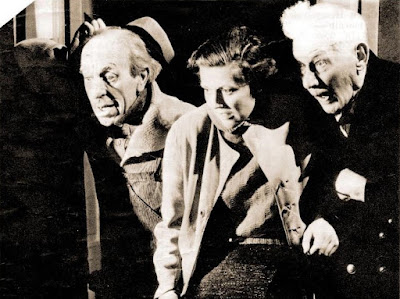
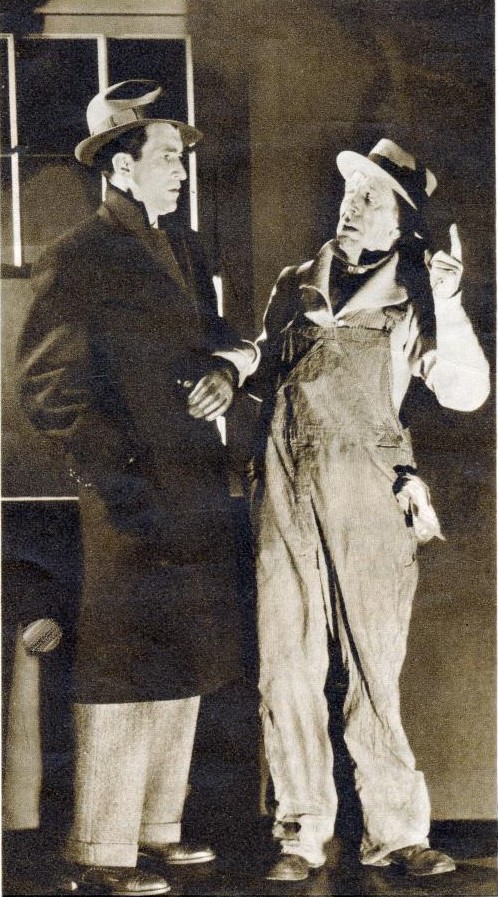
YOU COULD CALL it "The Damon Runyon Syndrome," in which writers become so enchant-ed with Runyon's stylistics that they attempt their own versions. Sometimes it works and sometimes it doesn't; we'll let you decide if today's author succeeds at it, as he has his sports maven sleuth investigating the case of . . .

"Baldy and the Dead Southpaw."
By Jack Kofoed (John Christian Kofoed, 1894-1979).
First appearance: Popular Detective, June 1946.
Short short story (8 pages).
Online at Archive.org starting (HERE) and finishing (HERE).

     ". . . it is reported that cemeteries are full of people he bumps off. This situation makes me very unhappy."

Lefty might be a great player, but rather shortsightedly he has also set himself up to take a great fall . . . .

Comment: Our story isn't fair play, since the decisive clue comes, you could say, out of left field.

Principal characters:
~ Lefty Waldron:
  ". . . baseball is my game, and I do not double-cross it under any circumstances."
~ Johnny O'Keefe:
  "Gimme the key, or you have no more nose left than an oyster."
~ Pop:
  "Well, he snatches her, and she snatches him, so maybe you use the proper term."
~ McElmurray:
  "After all, there is a back stairway, and I am not like Argus, who has eyes in practically every corner of his head."
~ Wippenberger:
  "Suicide beyond any shadow of a doubt. I find powder burns on the temple."
~ Whispering Jones:
  "I am not such a person as allows himself to be pushed around by a couple of hunkies just out of police school."
~ Pony McCoy:
  ". . . looks, and utters a scream so high-pitched it makes the walls shake."
~ The D.A.:
  "It seems to me, though, that in this instance you go slightly off the beam."
~ Baldy Simmons:
  "Dear, dear. I am very unhappy about this, and hate to open the bedroom door."

References and resources:
- The FictionMags thumbnail about Jack Kofoed: "Journalist, editor, and writer. Born in Philadelphia, Pennsylvania; died in Miami, Florida."
- Our story features Jack Kofoed's series character, "Baldy" Simmons; altogether, Baldy appeared in 34 stories, the majority of them in Thrilling Sports and three in Popular Detec-tive, the latter being listed below:
 (1) "Baldy Simmons and the T-Bone Murder," Popular Detective, April 1946
 (2) "Baldy and the Dead Southpaw," Popular Detective, June 1946 (above)
 (3) "Baldy and the Strip Tease Murder," Popular Detective, August 1946.
- "the star southpaw": It's no disgrace:
  "Southpaw is another name for a left-handed individual, particularly in sports" (Wikipedia HERE).
- "legs like Marlene Dietrich": They weren't bad but might have been overrated:
  "Marie Magdalene 'Marlene' Dietrich (1901-92) was a German-born American actress and singer. Her career spanned from the 1910s to the 1980s" (Wikipedia HERE).
- "a John Roscoe": For a while there everybody was calling it that:
  "A pistol is a handgun, more specifically one with the chamber integral to its gun barrel, though in common usage the two terms are often used interchangeably. The English word was introduced in ca. 1570 – when early handguns were produced in Europe and is derived from the Middle French pistolet (ca. 1550), meaning a small gun or knife" (Wikipedia HERE).
- "than Dillinger": To the world he was the gangster par excellence; he was also a publicity hound:
  "Dillinger courted publicity. The media ran exaggerated accounts of his bravado and colorful personality and cast him as a Robin Hood" (Wikipedia HERE).
- "schneider somebody": In Johnny's case the game is gin rummy:
  "Schneider is a term used in many card games for a low card point score that results in boosting an opponent's game score. The threshold is usually half the total points needed for a win; below the threshold, the player or team is Schneider; above it they are 'out of Schneider'" (Wikipedia HERE).
- "competing with Rita Hayworth or Paulette Goddard": Two wildly popular '40s screen stars:
  "Rita Hayworth (born Margarita Carmen Cansino, 1918–87) was an American actress, dancer, and producer. She achieved fame during the 1940s as one of the era's top stars, appearing in 61 films over 37 years. The press coined the term 'The Love Goddess' to describe Hayworth after she had become the most glamorous screen idol of the 1940s. She was the top pin-up girl for GIs during World War II" (Wikipedia HERE); "Paulette Goddard (born Marion Levy, 1910–90) was an American actress, child fashion model and a performer in several Broadway productions as a Ziegfeld Girl; she became a major star of Paramount Pictures in the 1940s. Her most notable films were her first major role, as Charlie Chaplin's leading lady in Modern Times, and Chaplin's subsequent film The Great Dictator" (Wikipedia HERE).
- "Argus": No place to hide from him:
  "Argus Panoptes (All-seeing; Ancient Greek: Ἄργος Πανόπτης) or Argos (Ancient Greek: Ἄργος) is a many-eyed giant in Greek mythology. The figure is known for having generated the saying 'the eyes of Argus', as in to be 'followed by the eyes of Argus', or 'trailed by' them, or 'watched by' them, etc. These terms are used to describe being subject to strict scrutiny in one's actions to an invasive, distressing degree" (Wikipedia HERE).
- "Primo Carnera's brothers": One tough guy:
  "Primo Carnera (1906–67), nicknamed the Ambling Alp, was an Italian professional boxer and wrestler who reigned as the boxing World Heavyweight Champion from 29 June 1933 to 14 June 1934. He won more fights by knockout than any other heavy-weight champion in boxing history" (Wikipedia HERE).
Photographed by Edward Steichen.
- "You ask more questions than Phil Baker, though I do not get sixty-four dollars for any answer": Baker was well known as a radio voice at the time:
  "Phil Baker (1896–1963) was an American comedian and emcee on radio. Baker was also a vaudeville actor, composer, songwriter, accordionist and author" (Wikipedia HERE); "Take It or Leave It was radio quiz show, which ran from April 21, 1940 to July 27, 1947 on CBS radio. It switched to NBC radio in 1947, and on September 10, 1950, the name of the program was changed to The $64 Question"; ". . . during the 1940s, 'That's the $64 question' became a common catchphrase for a particularly difficult question or problem" (Wikipedia HERE).
- "Boris Karloff": For forties audiences, the last word in scary:
  "William Henry Pratt (1887-1969), better known by his stage name Boris Karloff, was an English actor who starred as Frankenstein's monster in the horror film Franken-stein (1931), which established him as a horror icon. He reprised the role in Bride of Frankenstein (1935) and Son of Frankenstein (1939)" (Wikipedia HERE).
- Damon Runyon and his imitators have turned up several times on this weblog. Even science fiction writers have been prone to getting Runyon-fever:
  . . . Runyon's "The Lemon Drop Kid" (HERE)
  . . . James Alan Gardners' SFFnal "A Clean Sweep with All the Trimmings" (HERE)
  . . . and Spider Robinson's equally SFFnal "Chronic Offender" (HERE).
~~~~~~~~~~~~~~~~~~~~~~~~~~~~~~~~~~~~~~~~~~~~~~~~~~~~~~~~~~~~~~~~~~~~~~~~~~~~

Thursday, January 13, 2022

"He Let Go of the Dead Thing and Pulled His Hand Back Swiftly"

"Time Locker."
By Lewis Padgett (Henry Kuttner, 1914-58; HERE and HERE).
Illustrations by M. Isip (1904-87; HERE).
First appearance: Astounding Science Fiction, January 1943.
Reprints page (HERE and HERE).
Short story.
Online at Fadedpage (HERE; 15 pages as a PDF), The Luminist Archives (HERE; go down to text page 100; original text: 12 pages), and Archive.org (HERE; original text: 12 pages).
     "A useful little gadget. Stick anything in and it shrank, shrank to a point where it was invisible and totally concealed—but it would also shrink other things and permit curious sorts of crime—"

Is it really possible to be too smart for your own good? Vanning is about to find out . . . .

Main characters:
~ Galloway:
  "I put things in the locker and they get small. Take ’em out, and they get big again. I suppose I could sell it to a stage magician."
~ Horace Vanning:
  "You mean it’s bigger inside than it is outside?"
~ Counsel Hatton:
  "I don’t know where you’ve hid that suitcase, but we’ll find it."
~ The judge:
  "Indeed! If such a piece of evidence could be produced, the defendant would be jailed as fast as I could pronounce sentence."
~ MacIlson:
  "Oh, damn! I’m sitting on the edge of a volcano with termites under me. I can’t stay here and wait till they find the bonds. They can’t extradite me from South America—where I’m going, anyway."

References and resources:
- "Rheostats": They're commonplace but you never see them:
  "The most common way to vary the resistance in a circuit continuously is to use a rheostat" (Wikipedia HERE).
- "he could have told Dr. Crippen": In its day the Crippen case was an international sensation:
  "The American-British crime novelist Raymond Chandler thought it unbelievable that Crippen could be so stupid as to bury his wife's torso under the cellar floor of his home while successfully disposing of her head and limbs" (Wikipedia HERE).
- "with gamma rays": Don't go near them, whatever you do:
  "A gamma ray, also known as gamma radiation (symbol γ), is a penetrating form of electromagnetic radiation arising from the radioactive decay of atomic nuclei. It con-sists of the shortest wavelength electromagnetic waves, typically shorter than those of X-rays" (Wikipedia HERE).
- "sipped his zombie": Not one of the walking dead:
  "The Zombie is a Tiki cocktail made of fruit juices, liqueurs, and various rums. It first appeared in late 1934, invented by Donn Beach at his Hollywood Don the Beachcomber restaurant" (Wikipedia HERE).
- "this space-time continuum": One's enough, don't you think:
  "In physics, spacetime is any mathematical model which fuses the three dimensions of space and the one dimension of time into a single four-dimensional manifold. Spacetime diagrams can be used to visualize relativistic effects, such as why different observers perceive differently where and when events occur" (Wikipedia HERE).
- "scalene pyramid": They're probably not too common:
  "A scalene triangle (Greek: σκαληνὸν, romanized: skalinón, lit. 'unequal') has all its sides of different lengths. Equivalently, it has all angles of different measure" (Wikipedia HERE).
- "thinking about tesseracts": If you find one under the bed let us know:
  "In geometry, the tesseract is the four-dimensional analogue of the cube . . ." (Wikipedia HERE and especially HERE).
- "the Duke of Wellington": "The Iron Duke" they called him:
  "Arthur Wellesley, 1st Duke of Wellington, KG, GCB, GCH, PC, FRS (1769–1852) was an Anglo-Irish soldier and Tory statesman who was one of the leading military and political figures of 19th-century Britain, serving twice as prime minister. He is one of the commanders who won and ended the Napoleonic Wars when the coalition defeated Napoleon at the Battle of Waterloo in 1815" (Wikipedia HERE).
- "Because of Newton": Lucky for the future development of scientific inquiry he just couldn't dodge that falling apple in time:
  "Sir Isaac Newton PRS (1642–1726/27) was an English mathematician, physicist, astronomer, theologian, and author (described in his time as a 'natural philosopher') widely recognised as one of the greatest mathematicians and physicists of all time and among the most influential scientists" (Wikipedia HERE and especially HERE).
- "an empty demijohn": We're not sure how common they are these days:
  "A carboy, also known as a demijohn, is a rigid container with a typical capacity of 4 to 60 litres (1 to 16 US gal)" (Wikipedia HERE).
- "a zoot stoop": A reference to a then current (1943) fad:
  "A zoot suit (occasionally spelled zuit suit) is a men's suit with high-waisted, wide-legged, tight-cuffed, pegged trousers, and a long coat with wide lapels and wide padded shoulders" (Wikipedia HERE).
- "on the Winchell": A sly (and probably not flattering) reference to a well-known gossip columnist, Walter Winchell:
  "He uncovered both hard news and embarrassing stories about famous people by exploiting his exceptionally wide circle of contacts, first in the entertainment world and the Prohibition era underworld, then in law enforcement and politics. He was known for trading gossip, sometimes in return for his silence. His outspoken style made him both feared and admired. Novels and movies were based on his wisecracking gossip columnist persona" (Wikipedia HERE).
- "against scop": Scopolamine, in the mind's eye of the public, was a virtual synonym for "truth serum":
  "While there have been many clinical studies of the efficacy of narcoanalysis in interrogation or lie detection, there is dispute whether any of them qualify as a randomized, controlled study, that would meet scientific standards for determining effectiveness" (Wikipedia HERE).
- "the plat standard": We're guessing "plat" refers to platinum:
  "Platinum is a precious metal commodity; its bullion has the ISO currency code of XPT. Coins, bars, and ingots are traded or collected. Platinum finds use in jewellery, usually as a 90–95% alloy, due to its inertness. It is used for this purpose for its prestige and inherent bullion value. Jewellery trade publications advise jewellers to present minute surface scratches (which they term patina) as a desirable feature in attempt to enhance value of platinum products" (Wikipedia HERE).
- "life in the fourth dimension": It's an elegant notion:
  "Higher-dimensional spaces (i.e., greater than three) have since become one of the foundations for formally expressing modern mathematics and physics. Large parts of these topics could not exist in their current forms without the use of such spaces. Einstein's concept of spacetime uses such a 4D space, though it has a Minkowski structure that is slightly more complicated than Euclidean 4D space" (Wikipedia HERE).
- "fenagled [spelling] 'em out": "to get or achieve (something) by guile, trickery, or manipulation" (Dictionary.com HERE).
- "can't occupy the same place at the same time": That could be fatal:
  "Each object has a unique identity, independent of any other properties. Two objects may be identical, in all properties except position, but still remain distinguishable. In most cases the boundaries of two objects may not overlap at any point in time" (Wikipedia HERE).
- "I reasoned by induction": Sherlock did the same thing more often than he'd be willing to admit:
  "Inductive reasoning is a method of reasoning in which a body of observations is synthesized to come up with a general principle. Inductive reasoning is distinct from deductive reasoning. If the premises are correct, the conclusion of a deductive argument is certain; in contrast, the truth of the conclusion of an inductive argument is probable, based upon the evidence given" (Wikipedia HERE).
- "soak up the entropy": Ordinarily, the physicists tell us, everything's going downhill and they can prove it with measurements:
  "Entropy is a scientific concept as well as a measurable physical property that is most commonly associated with a state of disorder, randomness, or uncertainty" (Wikipedia HERE).
- Another story which briefly touches on tesseracts is S. R. Algernon's "Murder at the Tesseract House" (HERE), while A. J. Deutsch's "A Subway Named Möbius" (HERE) explores the implications of such geometries.
- "Time Locker" was the first story in the Gallegher series (HERE), with the main character undergoing a slight name change starting with the second story:
  (1) "Time Locker," Astounding Science Fiction, January 1943 (above)
  (2) "The World Is Mine," Astounding Science Fiction, June 1943 (online HERE; go to text page 9)
  (3) "The Proud Robot," Astounding Science Fiction, October 1943 (online HERE; go to text page 95).
  (4) "Gallegher Plus," Astounding Science Fiction, November 1943 (online HERE and HERE; go to text page 120)
  (5) "Ex Machina," Astounding Science Fiction, April 1948 (online HERE and HERE; go to text page 7).
These were collected in Robots Have No Tails (1952).
~~~~~~~~~~~~~~~~~~~~~~~~~~~~~~~~~~~~~~~~~~~~~~~~~~~~~~~~~~~~~~~~~~~~~~~~~~~~

Monday, January 10, 2022

A Quick Note

To our Readers:

Over the holidays we sustained a ribcage injury. It wasn't bad enough for hospitalization but more than enough to put a major crimp in one's style. This will explain why you have seen and might continue to see fewer than usual postings for now. But never fear, we're still here. Many thanks to you for hanging in there with us, and best wishes for a prosperous—and safe—new year.

Ye Editor

Tuesday, January 4, 2022

"Cries, Moans, Mutters, Whimpers, Slithery Noises, Patters, Scrapings"

WE'VE NOTED THAT we like to focus on first appearances when we can find them. The supersleuth in today's story is the legendary Ellery Queen, as he tries to unravel the dilemma of . . .

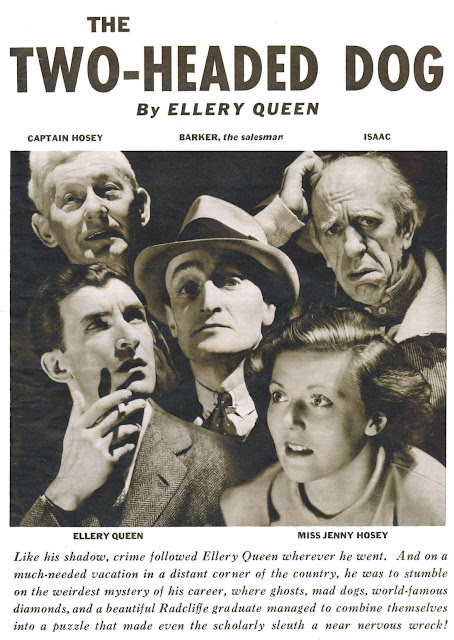
"The Two-Headed Dog."
By Ellery Queen (1905-82; 1905-71).
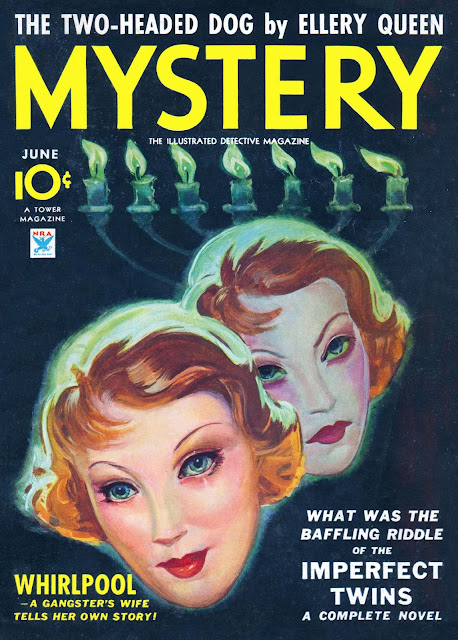
First appearance: Mystery, June 1934.
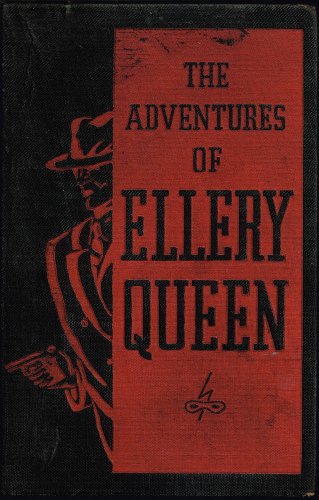
Collected in The Adventures of Ellery Queen (1934).
Short story (12 pages; 3 illos).
Online at Archive.org beginning (HERE) and finishing (HERE).
     "A black muzzle poked out of a hole in the curtain and I saw two savage eyes."

Ordinarily two heads are better than one, but in Captain Hosey's motel on this blustery night two heads can only signify death . . . .


Principal characters:
~ Captain Hosey:
  "Ellery Queen, hey? Well, well. I've heard tell of ye, young man."
~ Captain Rye:
  "So ye're the great d'tective. Can't say I ever heard o' ye."
~ Jenny:
  "Curiosity killed a cat, and it almost got me a very badly bitten hand."
~ Barker:
  "'Mechanics' and building tools, Mr. Queen, cement, quicklime, household wares, et cetera and so forth."
~ Heiman:
  "God, what a night that was! Makes my skin creep to think of it."
~ Isaac:
  "Wall, Cap'n Hosey's got an ol' shooter some'eres."
~ John Morse:
  "This man comes in shakin' off th' wet; he was rigged out in a cross 'tween a sou'wester an' a rubber tire . . ."
~ Benson:
  "You were dead right, Mr. Queen!"
~ Ellery Queen:
  "It all fitted nicely, once I had deduced the identity of the murderer. It had to be."

References and resources:
- "the Dusenberg"(spelling): Desirable but not cheap:
  "The Duesenberg is only used by Ellery whenever he was not residing in N.Y. It's a 1924 open two seater with a 'Dickey seat' in the back and a counter which shows 215000 km (Finishing Stroke). The Duesenberg was a symbol of wealth and the luxury dream car of Americans. It is only as second hand car Ellery could afford this vehicle" (Ellery Queen: A Website on Deduction HERE; also see Wikipedia HERE and Bing Images HERE).
- "a Chinese lazaret": Being a sailor man, Captain Hosey probably means this:
  "A storage space below deck or between decks on a ship or boat" (The Free Dictionary HERE).
- Ellery Queen Reader (HERE) says "The Two-Headed Dog" "stands up fairly well, one of the best Ellery Queen stories up to this point." Michael Grost (HERE) agrees: "This story is quite entertaining, with good New England atmosphere, and its solution is clever. EQ includes more than one mysterious surprise in the solution - like several of his best short works, it involves multiple mysteries."
- There's an audio podcast version of "The Two-Headed Dog" (HERE) and also (HERE) (1 hour and 1 minute).
- Another EQ first appearance was "The Hollow Dragon," which we featured (HERE).
~~~~~~~~~~~~~~~~~~~~~~~~~~~~~~~~~~~~~~~~~~~~~~~~~~~~~~~~~~~~~~~~~~~~~~~~~~~~

Wednesday, December 29, 2021

"New Year's Duty" (Update)

"New Year's Duty."
By Johnston McCulley (1883-1958).
First appearance: Detective Mystery Novel, Winter 1948.
Short story (11 pages).
Online at The Luminist Archives (HERE; it will be necessary to download the entire issue, 108 MB; go down to text page 89).

"Deputy Sheriff Retland is ready to retire—but not before walking into the gunfire of two killers in the line of duty!"
What starts out as a routine New Year's Eve for Lew Retland turns into anything but ordinary when a jealous gangster decides to eliminate the competitor for his girl's affections, and the girl, and anybody else who might get in the way—which just happens to be Lew . . .
~~~~~~~~~~~~~~~~~~~~~~~~~~~~~~~~~~~~~~~~~~~~~~~~~~~~~~~~~~~~~~~~~~~~~~~~~~~~

Thursday, December 23, 2021

"Santa Thumbs a Ride" (Repost)

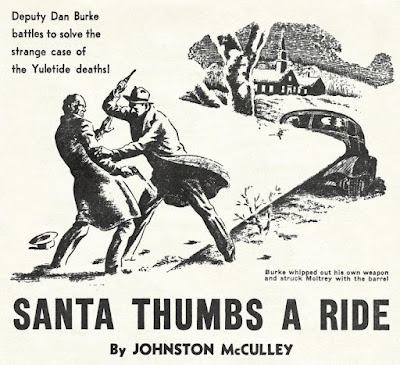
"Santa Thumbs a Ride."
By Johnston McCulley (1883-1958).
First appearance: Popular Detective, January 1948.
Short story (11 pages).
Online at Archive.org (HERE).

"Deputy Dan Burke battles to solve the strange case of the Yuletide deaths!"
If Dan has just given the man who is to play Santa Claus a ride to a Christmas celebration at a nearby church, then how come his body is found lying sprawled on his own living room floor with a knife in his chest—murdered, the coroner confirms, hours before Dan ever caught sight of him thumbing a ride on the side of the road?

A couple of Deputy Dan's observations:
  "Given enough provocation, or a situation to bring on temporary insanity through rage, and anybody is the killing type."
  "Knowing his own guilt, worrying about being found out, a man like that, not used to crime, will generally betray himself, if you give him enough to think about."


The bottom line:
~~~~~~~~~~~~~~~~~~~~~~~~~~~~~~~~~~~~~~~~~~~~~~~~~~~~~~~~~~~~~~~~~~~~~~~~~~~~

Wednesday, December 22, 2021

"Grifters' Asteroid" (Update)

THE ORIGINAL ONTOS posting about H. L. Gold's story appeared (HERE); we recommend going there first and then returning here.
You can also find a different reprinting of the story (HERE). Castalia House has a short review of "Grifters' Asteroid" (HERE).
~~~~~~~~~~~~~~~~~~~~~~~~~~~~~~~~~~~~~~~~~~~~~~~~~~~~~~~~~~~~~~~~~~~~~~~~~~~~