Friday, October 18, 2013

Why Aren't There More—and Better—Science Fiction Mysteries?

ROBOTS AND MURDER.
By Isaac Asimov.
Science Fiction Book Club.
1999. 745 pages.
Contains: THE CAVES OF STEEL, THE NAKED SUN, THE ROBOTS OF DAWN.
. . . and why are most of them pretty lousy as either detective fiction or SF?

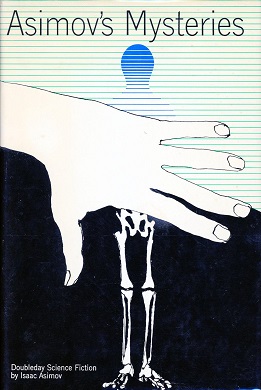
In his own Introduction to ASIMOV'S MYSTERIES (1968), Isaac Asimov (1920-92) tells us he also pondered this particular conundrum:
Oddly enough, it was the mystery form [and not others such as Westerns or romances] that seemed most difficult to amalgamate with science fiction. Surely this is unexpected. One would think that science fiction would blend easily with the mystery. Science itself is so nearly a mystery and the research scientist so nearly a Sherlock Holmes.
And if we want to reverse things, are there not mysteries that make use of the "scientific mind"? R. Austin Freeman's Dr. Thorndyke is an example of a well-known and successful (fictional) scientist-detective.
And yet science fiction writers seemed to be inhibited in the face of the science fiction mystery.
Back in the late 1940s, this was finally explained to me. I was told that "by its very nature" science fiction would not play fair with the reader. In a science fiction story, the detective could say, "But as you know, Watson, ever since 2175, when all Spaniards learned to speak French, Spanish has been a dead language. How came Juan Lopez, then, to speak those significant words in SPANISH?"
Or else, he could have his detective whip out an odd device and say, "As you know, Watson, my pocket-frannistan is perfectly capable of detecting the hidden jewel in a trice."
Such arguments did not impress me.
[Of course] you DON'T spring new devices on the reader and solve the mystery with them. You DON'T take advantage of future history to introduce ad hoc phenomena. In fact, you carefully explain all facets of the future background well in advance so the reader may have a decent chance to see the solution.
But talk is cheap, so I put my typewriter where my mouth was, and in 1953 wrote a science fiction mystery novel called THE CAVES OF STEEL (Doubleday, 1954). It was accepted by the critics as a good science fiction novel AND a good mystery and after it appeared I never heard anyone say that science fiction mysteries were impossible to write. I even wrote a sequel called THE NAKED SUN (Doubleday, 1957) just to show that the first book wasn't an accident. (From ASIMOV'S MYSTERIES, pages 13-15)
He later went on to write a third novel, THE ROBOTS OF DAWN (Doubleday, 1983), tying his sleuths into his Foundation series.

Asimov's complaint is still valid: Why aren't SF authors churning out quality science fictional whodunits on a regular basis?

Categories: Detective fiction, Science fiction

Thursday, October 17, 2013

The One and Only Philo Gubb

In "Philo Gubb's Greatest Case," The Great Intermittent Detective and Correspondence School Student is approached by a woman to wallpaper her bedroom—and coincidentally find her missing husband.

When asked what a clue is, he replies:
"A clue," said P. Gubb, "is almost anything connected with the late lamented, but generally something that nobody but a deteckative would think had anything to do with anything whatsoever. Not infrequently often it is a button."
For once, Gubb's assault on the English language is surpassed by Mr. Critz in "The Hard-boiled Egg." Gubb follows a learning curve as he acquires more knowledge of the "deteckative" business—and life in general.
As he says: 
"I don't aim to start in deteckating in earnest for a couple of months yet. I got a couple of jobs of paper-hanging and decorating to finish up, and I can't start in sleuthing until I get my star, anyway. And I don't get my star until I get one more lesson, and learn it, and send in the examination paper, and five dollars extra for the diploma. Then I'm goin' at it as a reg'lar business. It's a good business. Every day there's more crooks—excuse me, I didn't mean to say that."
The Correspondence School Detective encounters a knotty case in "The Pet." Kidnapping and murder most foul are suspected, and Gubb must investigate a travelling circus to reach a solution.
For several months the detective business of Philo Gubb had been at a low ebb. A period of detestable freedom from crime had fallen upon Riverbank, and the correspondence school detective had begun to fear that the triumph of virtue had been accomplished and that the millennium was at hand. So hungry was he for an opportunity to exercise his knowledge of detection that he would have taken a job to detect where any hen had hidden her 'stolen' nest, and would have accepted one tenth of the unhatched chicks as remuneration.
He must deploy his formidable, and quite negligible, powers of disguise, as he tells us:
"In the deteckative profession the assuming of disguises is often necessary to the completion of the clarification of a mystery plot."
And:
"A deteckative gent is obliged to keep up a set of disguises hitherto unsuspected by the mortal world. To deceive the malefactoring population he has to be quite constantly in disguise . . . ."
Resources:
- The first 17 Philo Gubb stories are available online here.
- Douglas G. Greene has compiled all 37 of Philo's adventures under the title THE COMPLETE DETECKATIVE MEMOIRS OF PHILO GUBB, ESQUIRE.

Category: Detective fiction

Clay-footed Gumshoes

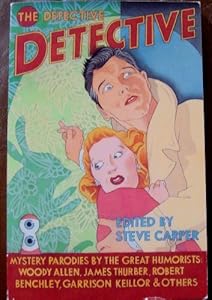
THE DEFECTIVE DETECTIVE: MYSTERY PARODIES BY THE GREAT HUMORISTS.
Edited by Steve Carper.
Citadel Press.
1992. 222 pages.
Some real classics here.

Contents [Note: ss = short story; nv = novelette; vi = vignette; ar = article]:
Introduction · Steve Carper
Match Wits with Inspector Ford · Woody Allen · ss Playboy, 1972
The Third Door from the Left [as by John Riddell] · Corey Ford · ss Vanity Fair, 1926
Farewell, My Lovely Appetizer · S. J. Perelman · ss New Yorker Dec 16 ’44
Doctor No Will See You Now · Alan Coren · ss, 1980
Don’t Guess, Let Me Tell You · Ogden Nash · pm New Yorker Apr 20 ’40
Me, the Judge · Ira Wallach · ss, 1952
Maddened by Mystery; or, The Defective Detective · Stephen Leacock · ss Nonsense Novels, London: Lane, 1911
The Last Recall · Henry Beard · nv The National Lampoon Feb ’72
The Pink Murder Case · Christopher Ward · ss Literary Review of the New York Evening Post, 1929
The White Rabbit Caper · James Thurber · ss New Yorker Nov 19 ’49
Jack Schmidt, Arts Administrator · Garrison Keillor · ss, 1979
The Stolen Cigar-Case · Bret Harte · ss Pearson’s Magazine Dec ’00
Monastic Mayhem: An Echo of Eco · John Harris · ss Atlantic Monthly Dec ’86
Breakneck · Jon L. Breen · vi EQMM Feb ’73
The Mystery of the Poisoned Kipper · Robert Benchley · ss, 1932
Babes and Bullets · Jim Davis & Ron Tuthill · ss, 1984
Mr. Treet, Chaser of Lost People · Bob Elliott & Ray Goulding · ss, 1975
The Purloined Butter · John Sladek · vi New Worlds Quarterly 3, ed. Michael Moorcock, London: Sphere, 1972
Greedy Night · E. C. Bentley · ss Parody Party, 1936
In Hot Pursuit · Fran Lebowitz · ss, 1974
About These Mystery Stories · P. G. Wodehouse · ar The Saturday Evening Post May 25 ’29

Category: Detective fiction

Long or Short?

THE MYSTERIES OF REVEREND DEAN.
By Hal White.
Lighthouse Publishing.
2008. 258 pages.
There can be no good detective fiction which is not bound by the rule of fair play with regard to presenting the evidence . . . . real life is bound by no rule of fair play with regard to anything. —John Dickson Carr, The Murder of Sir Edmund Godfrey (1936)
On the Criminal Brief weblog (July 1, 2008 and still online!), Hal White offers his reasons for preferring the short form as a conveyance for telling impossible crime tales:
I've always believed the best way to tell such a story was not in a novel, but in a short story. After the impossible elements of a story have been set up, the last thing I want to do is wade through 300 additional pages to find the solution. It's like sitting in a restaurant, eating an appetizer, then waiting three hours for the main course.

Category: Detective fiction

The EQ Thesis

For those of you just discovering "Ellery Queen" and the influence he/they had on American detective fiction, Cathy Akers-Jordan's 1998 master's thesis ("Ellery Queen: Forgotten Master Detective") should prove an invaluable resource. It's a 2-megabyte, 180-page PDF file.
As always, however, be on the lookout for the occasional SPOILER.

Contents:

Section I: The Stage is Set

1. Paving the Way to the Golden Age
2. The Golden Age Mystery

Section II: The Men Behind the Mask

3. Who Was That Masked Man?

Section III: Literary Themes and Techniques

4. Queen's World
5. Reality vs. Fiction
6. Father and Son
7. Ellery Queen: Working Author
8. The Queen Method
9. The Inconsistent Queen
10. Literary Motifs

Section IV: Recent Developments

11. Who Really Wrote Ellery Queen?
12. The Forgotten Master
13. Lest We Forget

Bibliography

Category: Detective fiction

"The First Genuine Locked-Room Mystery"

THE BIG BOW MYSTERY.
By Israel Zangwill.
Henry Publishers. 1892.
"To dash a half-truth in the world's eyes is the surest way of blinding it altogether."
The Rap Sheet Blog (August 8, 2008) features a review of Israel Zangwill's book by an author who has used Zangwill as a character in some of his own novels: 
It wraps us in fog and sets us down in the mean streets of Jack the Ripper's London, complete with a freshly cut throat. It offers humor and pathos, a whiff of Dickens, and a skillful locked-room mystery.
Several other reviews can be found on the GAD Wiki.
BIG BOW is readily available on Project Gutenberg.
THE VERDICT, a fascinating movie version featuring the great Sydney Greenstreet and Peter Lorre, was released in 1946.

Category: Detective fiction

Saturday, October 5, 2013

An Advance on Vance

John at PRETTY SINISTER BOOKS (October 4, 2013) points us to a tolerable alternative to the unspeakable Philo:
Spike Tracy was one of the better Vance impersonators but a lot more likable.
More short reviews of H. Ashbrook's mysteries are here:
~ THE MURDER OF SIGURD SHARON (1933): "Spike gets another chance at crime detecting . . ." — THE BOOKMAN, February 1933.
~ A MOST IMMORAL MURDER (1935): "20 cents worth." — THE SATURDAY REVIEW, "The Criminal Record," August 31, 1935. Available online.
~ MURDER MAKES MURDER (1937): "Commendable." — THE SATURDAY REVIEW, "The Criminal Record," April 17, 1937.
~ MURDER COMES BACK (1940): ". . . decidedly not for seasoned solvers." — THE SATURDAY REVIEW, "The Criminal Record," November 2, 1940.
~ THE PURPLE ONION MYSTERY (1941): "Spike, tho' still unpredictable, shows real talent for painstaking deduction." — THE SATURDAY REVIEW, "The Criminal Record," June 14, 1941.
See also the GAD Wiki article.

Category: Detective fiction