Saturday, December 11, 2021

"Three Wilted Red Roses and a Gun"

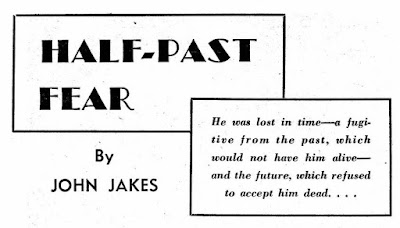
"Half-Past Fear."
By John Jakes (born 1932).
Illustration by Paul Callé (1928-2010; HERE).
First appearance: Super Science Stories, August 1951.
Short short story (8 pages).
Reprinted in Super Science Stories (Canada), August 1951 and the Argosy Special: Science Fiction, 1977.
Online at Archive.org (HERE) and The Luminist Archives (HERE; go down to text page 50).
     "He pointed the gun at her. She noticed his eyes, intense now, the peaceful quality gone. She wanted to scream."

Much like the Bard centuries ago, a man with no future will come to realize how inexorably "Time's fell hand" moves across life, that eventually—and against everything he does—it 
"will come and take my love away" . . . .

Main characters:
~ Vincent Deem:
  "She was a lovely woman, the only one who has ever loved me."
~ David:
  "Where do you come from?"
~ Sari:
  ". . . laughed at first, and then she grew frightened, and ran to her mother . . ."
~ Julia:
  "He is very strange. Very strange indeed."
~ The young man:
  "I've been here since yesterday, hunting you."
~ Mrs. Childs:
  "Twice dead, and the roses."

Resources:
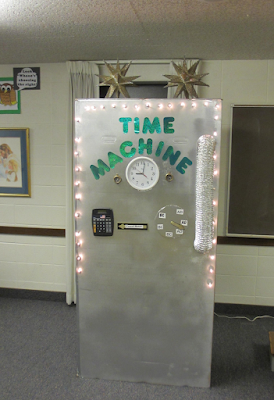
- Is history immutable, incapable of being changed even if there's a time machine handy? There have been a lot of furrowed brows over that vexatious question. Peruse the following chart and decide into which one, if any, of the following theories our story would seem to fit:
- Our latest encounter with John Jakes was with his story "With Intent to Kill" (HERE).
~~~~~~~~~~~~~~~~~~~~~~~~~~~~~~~~~~~~~~~~~~~~~~~~~~~~~~~~~~~~~~~~~~~~~~~~~~~~
Thursday, December 9, 2021

"Are You Guilty?"

A HOT ITEM IN the early 1900s after his miraculous return from the dead, Sherlock Holmes not only sold tobacco (HERE) but also returned to what he'd been doing when he first debut-ed, selling magazines:
From Pearson's Magazine, January 1904.
~~~~~~~~~~~~~~~~~~~~~~~~~~~~~~~~~~~~~~~~~~~~~~~~~~~~~~~~~~~~~~~~~~~~~~~~~~~~

Monday, December 6, 2021

"Lucky for You, I'm Resourceful"

"Cons of Time Travel."
By A. Rector.
First appearance: Daily Science Fiction, December 2, 2021.
Short short short story (1 page).
Online at Daily Science Fiction (HERE).

     "Time-traveling's cheap and easy. It's space-traveling that ain't."

Almost anything that clever humans devise can be used for more than one purpose, some-times surprising even the inventors (Play-Doh, for example, was originally intended as a wallpaper cleaner). Now consider that machine over there in the corner, the one your smooth-talking acquaintance promises can solve your problem in no time at all . . . .

Reference:
- The only other story that the ISFDb credits to A. Rector is "Loyal Companion," which we featured last May (HERE).
~~~~~~~~~~~~~~~~~~~~~~~~~~~~~~~~~~~~~~~~~~~~~~~~~~~~~~~~~~~~~~~~~~~~~~~~~~~~

Friday, December 3, 2021

"Scotland Yard Goes Up in My Estimation Accordingly"

 CULTURAL ATTITUDES about things change over time. Take, for instance, smoking:

From T. P.'s Weekly, January 29, 1904.
~~~~~~~~~~~~~~~~~~~~~~~~~~~~~~~~~~~~~~~~~~~~~~~~~~~~~~~~~~~~~~~~~~~~~~~~~~~

Tuesday, November 30, 2021

"Where He Was Going, No Man Had Ever Gone Before"

"The Cosmic Snare."
By Stephen Marlowe (Milton Lesser, 1928-2008).
Illustration uncredited.
First appearance: Imagination Science Fiction, February 1956.
Short story.
Online at Project Gutenberg (HERE; 13 text pages) and The Lumin-ist Archives (HERE; original text: 14 pages; go down to text page 108).

     "Sub-space was a vast nothingness used for instantaneous travel between stellar worlds. It was uncharted, and—Liddell knew—a death trap!"

In our everyday world the shortest distance between two points is a straight line, but in Liddell's universe the shortest distance is between love and death . . . .

Main characters:
~ Liddell:
  "He blinked. And opened his eyes. And stared out on a featureless gray infinity."
~ Linda:
  "I trust you, Lidd. I trust you with my life."
~ John Smith:
  "Why don't we talk about where you're going to send me?"

Typos: "They must be a catch"; "the blank whiteness his head".

References and resources:
- "a hundred parsecs": A long, long walk:
  "The parsec (symbol: pc) is a unit of length used to measure the large distances to astronomical objects outside the Solar System, approximately equal to 3.26 light-years or 206,000 astronomical units (au), i.e. 30.9 trillion kilometres (19.2 trillion miles)" (Wikipedia HERE).
- "Sub-space" (often called hyperspace) has been a very useful trope for SFF writers for decades; for the Star Trek versions of sub-space see Memory Alpha (HERE). Wikipedia has an article about "hyperspace" (HERE) and TV Tropes has a more expansive entry about it (HERE), but the idea of using it to get around is lampshaded at Atomic Rockets (HERE).
- "Deneb Twelve": We still don't know for certain how far away it is:
  "[Deneb] is the brightest star in Cygnus and the 19th brightest star in the night sky, with an average apparent magnitude of +1.25. A blue-white supergiant, Deneb rivals Rigel as the most luminous first-magnitude star. However, its distance, and hence luminosity, is poorly known; its luminosity is somewhere between 55,000 and 196,000 times that of the Sun" (Wikipedia HERE and HERE; also see Memory Alpha HERE).
- "the normal space-time continuum": We're not so sure about that "normal":
  "In physics, spacetime is any mathematical model which fuses the three dimensions of space and the one dimension of time into a single four-dimensional manifold. Spacetime diagrams can be used to visualize relativistic effects, such as why different observers perceive differently where and when events occur" (Wikipedia HERE).
- "Snafu here": For politicians and bureaucrats it's a way of life:
  "It means that the situation is bad, but that this is a normal state of affairs. The acronym is believed to have originated in the United States Marine Corps during World War II" (Wikipedia HERE).
- "Zeus wielding a thunderbolt": When that happened superstitious people would look anxiously skyward:
  "Zeus is frequently depicted by Greek artists in one of three poses: standing, striding forward with a thunderbolt leveled in his raised right hand, or seated in majesty" (Wikipedia HERE).
- Two other stories making use of the teleportation plot device have been featured on ONTOS: Larry Niven's "The Alibi Machine" (HERE) and Wendy Nikel's "Glitch" (HERE).
- We've bumped into Milton Lesser using several aliases, including his own name ("Wild Talents, Inc." HERE) and the less common Darius John Granger ("Stop, You're Killing Me!" HERE).
~~~~~~~~~~~~~~~~~~~~~~~~~~~~~~~~~~~~~~~~~~~~~~~~~~~~~~~~~~~~~~~~~~~~~~~~~~~

Sunday, November 28, 2021

Two by Worth

EVEN THOUGH WE FIRST encountered our author just about three years ago, we haven't been able to find out anything about him since.

"The Hammerless Heater."
By Rodney Worth (?-?).
First appearance: Ten Detective Aces, January 1948.
Short short short story (3 pages).
Online at Archive.org (HERE) and The Luminist Archives (HERE; go down to text page 74).
   "He knew he had forgotten something, but he just couldn't put his finger on it."

It would be more accurate to say that he couldn't put his thumb on it . . . .

Main characters:
~ Knuckles:
  "He dug his hand into his coat pocket and brought out two identical automatics."
~ Joe:
  "A shadowy figure appeared, outlined against the sky. And then another. He raised his gun."
~ The desk sergeant:
  "Yeh, those German Sauers are nice little rods."

Resources:
- Read more about hammerless handguns (HERE) and Sauer automatics (HERE).

~ ~ ~

"Homemade Murder."
By Rodney Worth (?-?).
First appearance: 10-Story Detective, October 1947.
Online at the Pulpgen Archive (HERE).
Short short story (7 pages).

     "This rod may look small, but I can put five bullets just a little smaller than .22’s in your face before you could move two feet."

A police detective is certain he knows whodunit, but there's a snag. He already has motive and opportunity, natch, but it's the means that's proving hard to nail down, since the murder weapon is not only unique but also, as our detective suspects, it's likely that the cunning killer has already destroyed it . . .

Comment: With its humorous buddycop dynamic working for it, this efficient little police procedural wouldn't have been out of place as a Dragnet episode, either radio or TV.

Characters:
~ Jack Arnold, a.k.a. "Jack Fort":
  ". . . looked thoughtful for a moment. 'No, I can’t say that I did. The garbage truck goes by about that time. It’s hard to hear anything,' he replied. 'I didn’t even know this Marlowe had been shot until you told me.'"
~ Charles Marlowe, a.k.a. "Lefty":
  "Yes, that had been a good many years ago. But he had still recognized Lefty when he suddenly showed up two months ago. Lefty hadn’t known him, but that was just as well. This way he would get Lefty for old time’s sake, and not even Lefty would know he had done it."
~ Tommy, a.k.a. "Tommy":
  "Some guy moved in about a month ago. Last night he was shot while he was sitting in front of his window, but they didn’t find him until this morning."
~ Logan, homicide detective:
  "How many times do I have to tell you not to talk when you’re eating?"
~ Monk, Logan's partner:
  ". . . opened his mouth to say something, remembered the apple, and shut it again."
~ Haley, police ballistician:
  "I’m kind of sorry you brought that damned thing in. I won’t sleep for a week wondering about it. If somebody told me about it, I’d say they were nuts. I’ve seen just about every piece of lead a gun can throw, but that thing has got me stumped. I’ll tell you one thing, produce the gun that shot this bullet and I’ll prove to any jury it’s the murder weapon."
~ The landlady:
  "'Oh, Lieutenant, I wish you would find the murderer and take the'—she didn’t say what, but pointed at the corpse on the floor without looking at it—'out of my house.'"

Resources:
- So far not much has turned up about our author, Rodney Worth; FictionMags lists only two stories by him, this one and "The Hammerless Heater," Ten Detective Aces, January 1948 (above).
- The killer's motive stems from what happened during Prohibition; see the Wikipedia article (HERE). If you'd like to brush up on firearms ballistics, see Wikipedia (HERE), (HERE), (HERE), and (HERE).

The bottom line:
   “How simple death without weapons was. How safe for the killer."
     ― Cornell Woolrich
~~~~~~~~~~~~~~~~~~~~~~~~~~~~~~~~~~~~~~~~~~~~~~~~~~~~~~~~~~~~~~~~~~~~~~~~~~~~

Saturday, November 27, 2021

"Alibi in Reverse" (Repost)

"Alibi in Reverse."
By Robert Leslie Bellem (1902-68).
First appearance: Mammoth Detective, March 1943.
Short short story (6 pages).
Online at The Luminist Archives (HERE; go down to text page 178).

     "Nosey Logan had a peach of an alibi; so perfect it was foolproof. But if he’d been without one, he’d have been safer!"

When hardcore criminals disagree, they tend to do more than just sniff and walk away . . .

Characters:
~ Tim Jarnegan:
  "'If you’ve got a gun in there, better let it alone. Mine’s already out.' He displayed the snub-nosed .32 special in his fist."
~ Pop Conway:
  "'Sure I remember,' Pop said. 'We sent him up for three years on a bunko rap. It was Ace Cullane, the guy he worked for, whose testimony nailed the lid on him. We figured it was another case of thieves falling out—a big one feeding a little one to the wolves.'"
~ Ace Cullane:
  "Okay. Now get this. I’m gunnin’ for Ace Cullane, see? He ratted on me three years ago, an’ tonight I’m gonna get even."
~ Nosey Logan:
  ". . . swaggered in, a sallow little rat with a certain rodent bravado."

~ Dice Vallardo:
  "'Have it your way, copper,' Vallardo said smoothly. His voice matched his hair, sleek and oily. Sun lamps gave him a healthy tan the year around. He cast a flickering glance at Nosey Logan. 'Hello, skunk.'"


Resources:
- Sound recording and wiretapping become plot points in the story; for background, consult the following Wikipedia articles: "LP record" (HERE), "Phonograph record" (HERE), "History of sound recording" (HERE), and especially "History of sound recording: The Electrical Era (1925 to 1945) (including sound on film)" (HERE), as well as "Telephone tapping" (HERE).
- A one-man pulp machine, Robert Leslie Bellem wrote literally thousands of stories under at least 45 pseudonyms in addition to his own (FictionMags); since his forte was crime fiction, he was able to enjoy a latter-day career in television script writing (which one may consider as pulp fiction in another medium; see HERE). As Kevin Burton Smith at The Thrilling Detec-tive Website says:

   "In his prime, it was said that Bellem was pumping out a million words annually, and selling almost every single one of them to the pulps. But he was more than merely prolific—he was a riot. The question, though, is did he know it? Was he was trying to parody the hard-boiled detective genre, barely ten years after its birth, with his stories of [Dan] Turner [the Hollywood detective], or (and this is even scarier) was he simply, completely unaware of how funny and original his style was?"
   — "Robert Leslie Bellem," The Thrilling Detective Website


- Also see Wikipedia (HERE) for a brief article about our author and (HERE) for one of Bellem's rare forays into SFF ("Robots Can't Lie").
~~~~~~~~~~~~~~~~~~~~~~~~~~~~~~~~~~~~~~~~~~~~~~~~~~~~~~~~~~~~~~~~~~~~~~~~~~~