Wednesday, July 4, 2018

"Each Time He Went Step by Step Over the Mechanics of the Robbery, It Seemed More Gemlike and More Work-able"

"The Dusty Drawer."
By Harry Muheim (1920-2003).
First appearance: Collier's, May 3, 1952.

Reprinted in Ellery Queen's Mystery Magazine, March 1956; 
EQMM (U.K.), March 1956; and EQMM (Australia), May 1956.
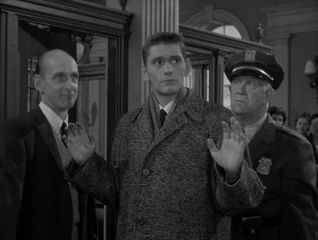
Filmed for the Alfred Hitchcock Presents TV series (1959; see HERE: SPOILERS).
Short short story (5 pages).
Online at UNZ starting (HERE) and concluding (HERE; scroll down to page 70).


   "There was no flaw in Logan's plan for revenge. He had calculated cleverly, rehearsed every move. Tritt was vulnerable—weak, vain, 
and smug—and Logan would turn his self-righteousness against him."

Weak, vain, smug, and self-righteous he may be, but is William Tritt really the thief that Norman Logan thinks he is? Don't be too quick with your answer . . .

Resource:
- What biographical data we could locate about Harry Miles Muheim comes from the Internet Movie Database (HERE).
~~~~~~~~~~~~~~~~~~~~~~~~~~~~~~~~~~~~~~~~~~~~~~~~~~~~~~~~~~~~~~~~~~~~~~~~~~~~

Monday, July 2, 2018

"You See, I Had To Get It at Any Cost"

"The Bowstring Murder."
By Maurice Procter (1906-73).
First appearance: Collier's, November 1, 1952.
Reprinted as "The Million Dollar Mystery" in Ellery Queen’s Mystery Magazine, January 1960; EQMM (Australia), March 1960; EQMM (U.K.), March 1960; and Ellery Queen’s Anthology #15 (1968).
Short short story (7 pages).
Online at UNZ starting (HERE) and finishing (HERE; scroll down to page 60).


   "What linked the atomic scientist to this bold jewel theft? Scotland Yard had to find the answer itself. Dr. Tempest could not give it to them. He was dead."

U.S. Treasury agent John Norton is in England searching for a stolen million dollars, unaware that the problem is bigger than that, as Chief Inspector Warwick of the Special Branch informs him: "Know what you've done? Walked smack into the middle of the biggest murder job in years. It's only two hours old, but it's started a Security flap from one end of Whitehall to the other." As if that weren't enough, by the end of the day Norton will have more than missing money and somebody else's murder to deal with; there'll be the very real dilemma of being cremated alive or blown to tiny bits . . .

Comment: One of the few short stories that would have worked better as a novel.

Resources:
- FictionMags describes Maurice Procter thusly: "Novelist. Born in Nelson, Lancashire, England. The name was sometimes spelled Proctor"; also see the GAD Wiki entry (HERE).
- An informative Wikipedia article about Procter is (HERE):
   "Procter is best known for his series of police procedural novels featuring Detective Chief Inspector Harry Martineau of the Granchester City Police. In his novels Granchester was an industrial city in the north of England. Procter based the city on Manchester. When his novel Hell Is a City (which was published in the United States with the title Somewhere in This City) was filmed in 1960 with Stanley Baker as Martineau, it was shot on-location in Manchester."
- Here are links to very brief reviews of a few of his novels:
  ~ Hurry the Darkness (HERE): "Well-handled irony."
  ~ The Ripper (HERE): "Top flight."
  ~ Killer at Large (HERE): "Good show."
  ~ The Devil Was Handsome (HERE): "Superb detection number."
  ~ A Body to Spare (HERE): "Fast motion all the way . . ."
  ~ The Graveyard Rolls (HERE): "Good straight-out police job . . ."
  ~ Two Men in Twenty (HERE): "An absolute knockout!"
  ~ Homicide Blonde (HERE): "Professional as usual . . ."
  ~ His Weight in Gold (HERE): ". . . excellent chase sequence."
See the Fantastic Fiction page (HERE) for more.
~~~~~~~~~~~~~~~~~~~~~~~~~~~~~~~~~~~~~~~~~~~~~~~~~~~~~~~~~~~~~~~~~~~~~~~~~~~~

Friday, June 29, 2018

"The Charges Are Planetary Slavery and Mass Murder"

"Kill Me If You Can!"
By S. M. Tenneshaw (Randall Garrett, 1927-87).
First appearance: Imagination, June 1957.
Short story (13 pages).
Online at Archive.org (HERE).


   "Every five years the Autarch in power was murdered. Bartol knew this was why he had been picked as a stand-in for the reigning tyrant!"

You'd better pay attention to that man behind the curtain—because he plans to send his androids to burn you down . . .

Comment: This one moves so fast, especially through the resolution, that you might experience reader's whiplash.

Resources:
- Other stories that feature societies which approve of murder include Robert Sheckley's classic "Seventh Victim" (HERE) and Jeffrey Goddin's "Who Murders, Who Dreams" (HERE).
- Being as prolific as he was it's not surprising that we would bump into Gordon Randall Phillip David Garrett fairly often in our never-ending quest to find stories that combine crime fiction with other genres. Garrett seemed to delight in mashing science fiction together with tecfic, tales of espionage, and political intrigue; see (HERE) for ONTOS's latest encounter with him.
~~~~~~~~~~~~~~~~~~~~~~~~~~~~~~~~~~~~~~~~~~~~~~~~~~~~~~~~~~~~~~~~~~~~~~~~~~~~

Wednesday, June 27, 2018

"I Hope I Am Not Conceited, but I Have Always Considered Myself a Bit of a Detective"

JAMES BARR wasn't nearly as prolific or well known as his older brother, but he could tell an interesting story, such as these two.

   "In the office we acted a scene that would have gladdened the heart of a Paris criminal judge."

"Setting the Detective a Puzzle."
By James Barr (1862-1923).
First appearance: The Strand Magazine, September 1921.
Short short story (7 pages, 2 illos).
Online at Archive.org (HERE).


   "What is a detective for but to clear up mysteries? I have set you one all your own to unravel. Good day."

It doesn't happen very often, but in order to save a young man from himself a little safe robbing just might be necessary . . .

~ ~ ~
   "You give the burglar a square deal."

"The Eccentric Burglar."
By James Barr (1862-1923).
Illustrations by S. Abbey.
First appearance: The Strand Magazine, July 1922.
Short short story (7 pages, 3 illos).
Online at Archive.org (HERE).
(Note: Some of the text is faded.)


   "You seem to have been fairly successful in doing the wrong thing at the right time."

A Dutch uncle doesn't have to be either Dutch or an uncle; instead, he could be someone who will unhesitatingly help himself to the silverware . . .

Resources:
- James Barr was the younger brother of Robert Barr, whom we've encountered several times already (see HERE and HERE); the SFE and the ISFDb have more about James (HERE and HERE).
~~~~~~~~~~~~~~~~~~~~~~~~~~~~~~~~~~~~~~~~~~~~~~~~~~~~~~~~~~~~~~~~~~~~~~~~~~~~

Monday, June 25, 2018

"Can You Also Conceive of How Helpless an Army Is That's Blind?"

"See No Evil."
By Charles E. Fritch (1927-2012).
First appearance: Cosmos Science Fiction and Fantasy, July 1954.
Short short story (5 pages, 1 illo).
Online at SFFAudio (HERE).

   "You tripped yourself up a dozen different times."

Dr. Schoener's invention is really amazing, with a zowie factor that has the government very interested; it's too bad for Jason, though, that he can be so easily blinded by science . . .

Resources:
- As a short story writer Charles Edward Fritch wasn't very prolific, but he was persistent, with his first piece of fiction being published in 1951 and his last in 1999 (see the SFE HERE and the ISFDb HERE), meanwhile finding the time to edit a short-lived SFF magazine. The SFE characterizes his fiction as "written for a variety of markets but sharing a certain glibness and snappiness of effect."
- Last week we highlighted a story (HERE) in which the power of invisibility was misused to commit murder; in "See No Evil" the malefactors are considerably more ambitious.
~~~~~~~~~~~~~~~~~~~~~~~~~~~~~~~~~~~~~~~~~~~~~~~~~~~~~~~~~~~~~~~~~~~~~~~~~~~~

Friday, June 22, 2018

"He Knew Now—Finally He Knew That She Was Dead and It Was Over"

"It Could Happen to Anyone."
By Charles Mergendahl (1919-59).
First appearance: Collier's, August 20, 1954.

Reprinted in Ellery Queen's Mystery Magazine, January 1957; 
Ellery Queen’s Mystery Magazine (U.K.), January 1957; and 
Ellery Queen’s Mystery Magazine (Australia), April 1957.
Short short short story (2 pages).
Online at UNZ (HERE).

   "There had been silence, long and awkward, and he'd known then that he should never have been angry."

Ice is slippery, but it's nothing compared to love . . .

Resources:
- FictionMags's thumbnail about Charles Henry Mergendahl: "Novelist, actor, traveller. Born in Lynn, Massachusetts; died in Glen Cove, Long Island, New York."
- "It Could Happen to Anyone" appears to be Mergendahl's only EQMM reprint; he did have several other original stories placed with AHMM before his untimely death [FictionMags data]:
  ~ "Premonition," Alfred Hitchcock’s Mystery Magazine, July 1957
  ~ "Secret Recipe," Alfred Hitchcock’s Mystery Magazine, January 1958
  ~ "Points Unknown," Alfred Hitchcock’s Mystery Magazine, March 1958
  ~ "Do-It-Yourself," Alfred Hitchcock’s Mystery Magazine, August 1958.

~~~~~~~~~~~~~~~~~~~~~~~~~~~~~~~~~~~~~~~~~~~~~~~~~~~~~~~~~~~~~~~~~~~~~~~~~~~~

Wednesday, June 20, 2018

"His Head Was Missing, Neatly Severed from His Body"

"The Invisible Man Murder Case."
By Henry Slesar (1927-2002).
First appearance: Fantastic, May 1958.
Reprinted in Invisible Men (1960) and The Seven Deadly Sins of Science Fiction (1980).
Reprints page (HERE).
Novelette (35 pages in book edition).
Online at The Luminist League (HERE; scroll down to page 6).
(Note: Beware of slow load.)


   "But Rufe Armlock wasn't interested; he raised the automatic in his hand and tenderly squeezed the trigger. The bullet ripped into her soft white . . ."

Life's full of coincidences, isn't it? Just when a has-been locked room mystery author's career hits the skids, people start dying in impossible situations, thereby generating 
enough publicity for him to start preparing for a comeback; but another writer, one specializing in Spillane-style hardboiled private eye novels, doesn't think coincidence 
has anything to do with the murders. Unless he's very careful, though, he just might 
end up taking that skeptical attitude of his with him—to the morgue . . .

Characters, visible and otherwise:
~ Jeff Oswald:
  "For a moment, I was frightened. To tell you the truth, I scare easily. Even the stories 
I write sort of scare me sometimes, and the realization that my visitor was a man who 
hated me intensely was disturbing."
~ Kirk Evander:
  "I've heard quite enough about private detectives, Mr. Oswald. The occupation has 

been an excuse for the worst offenses against good taste that I have ever known."
~ Eileen:
  ". . . thrust me out the door like a cat."

~ Aaron Snow:
  "I think you're nuts."

~ Captain Bill Spencer:
  "Stick to the facts. I'm not fond of fiction; particularly your kind. All I'm interested 

in is murder. Real murder."
~ Borg Evander:
  ". . . why would anybody want to be invisible?"
~ Douglas Wharton:
  "I was being tickled. So help me God, I was being tickled. It was horrible . . ."
~ Greta:

  "It smelled like rotten eggs to me."

Typo: "People wold be talking"

Resources:
- The nicely thorough article on Wikipedia (HERE) tells us that Henry Slesar, whose legendary association with Alfred Hitchcock proved lucrative for them both, "wrote hundreds of scripts for television series and soap operas, leading TV Guide to call him 'the writer with the largest audience in America.'"
- Slesar was as equally adroit at turning out SFF as he was thrillers; see (HERE) and (HERE).
- Considering how prolific he was, it's surprising that we've encountered Slesar only once before (HERE).

The bottom line: "To make Harry Potter invisible, one would have to liquefy him, boil him to create steam, crystallize him, heat him again, and then cool him, all of which would be quite difficult to accomplish, even for a wizard."
   ― Michio Kaku

~~~~~~~~~~~~~~~~~~~~~~~~~~~~~~~~~~~~~~~~~~~~~~~~~~~~~~~~~~~~~~~~~~~~~~~~~~~~