T. S. ELIOT didn't know it at the time, but in his poem "The Love Song of J. Alfred Prufrock" (1915) he anticipated the underlying theme of today's story by well over a century, in which what is meant to be a well-intentioned murder unexpectedly leads to an opportunity to create . . . what?
There will be time to murder and create,
And time for all the works and days of hands
That lift and drop a question on your plate;
Time for you and time for me,
And time yet for a hundred indecisions,
And for a hundred visions and revisions,
Before the taking of a toast and tea.
There could also be "time for you and me" if only someone could tame . . .
"The Oh My God Particle."
By Ian Stewart (born 1945).
Illustration by Jacey (Jason Cook; HERE).
First appearance: Nature/Futures, 17 June 2020.
Short short short story (2 pages).
Online (HERE; PDF).
"'You murdered him!' the Medical Man cried, aghast."
They don't call them "mad scientists" for nothing: "There is only one universe. But it
is . . . mutable."
Resources:
- "I call it a chronon.": "A chronon is a proposed quantum of time, that is, a discrete
and indivisible 'unit' of time as part of a hypothesis that proposes that time is not continuous." (Wikipedia HERE).
- A somewhat different take on the theme of today's story is Sylvia Jacobs's "Time Payment" (HERE).
- Our author Ian Nicholas Stewart is an emeritus professor of mathematics and Fellow of the Royal Society, putting him in the same ranks as Isaac Newton and giving him a splendid background for "The Oh My God Particle"; he's been generating SFF since the late '70s; see Wikipedia (HERE), the SFE (HERE), and the ISFDb (HERE).
~~~~~~~~~~~~~~~~~~~~~~~~~~~~~~~~~~~~~~~~~~~~~~~~~~~~~~~~~~~~~~~~~~~~~~~~~
Saturday, July 18, 2020
Wednesday, July 15, 2020
"If Anybody's Going To Get That Ice Back, and Incidentally Get the Murderer, I Guess It's Up to Us"
STORIES FEATURING investigators who work for insurance agencies have been a popular staple of crime fiction writers for a long time; the format allows authors to combine the (often hard-boiled) private eye trope with the real world of business activity—and, once in a while, actual mystery plots. An example from television would be Banacek (HERE and HERE), although he was a freelance investigator not exclusively employed by any particular agency. In today's story, our sleuth, who does work for one, while investigating a case of theft and murder discovers that there is much significance in . . .
"The Murderer's Left Hand."
By Donald Barr Chidsey (1902-81).
First appearance: Short Stories, November 25, 1935.
Reprinted in Short Stories (U.K.), April 1936 and Short
Stories, May 1952.
Short short story (8 pages).
Online at The Luminist Archives (HERE; go down to text page 59).
"He thlapped me with hith open hand."
Superstitious people believe our fate is in the stars; but in this instance, for a cowardly criminal it lies in (or should we say on) a crystal ball—a phony crystal ball—that and two bullets . . .
Principal characters:
~ Harris:
"He was lying on the walk there right next to a brand new flower bed, and his lower jaw had been socked so hard that it had splintered off and part of it had been driven up through his brain."
~ "The boss":
"He had a $70,000 policy with us for his wife's jewelry, which is more to the point, and that was the stuff the murderer got away with."
~ Charles Francis Xavier Morrissey:
"I studied it until I could close my eyes and see every single delta and island and end in its relation to every other end and island and delta."
~ Monkhouse:
"He was a big guy, and nasty-tempered. He stood there with his fists on his hips, glaring at me."
~ "a little rat of a guy in a brown suit":
". . . I knew that, for all his hard-boiled mannerisms, he was superstitious as hell."
~ "this female mountain":
"I ought to have you arrested!"
What would a tough guy shamus adventure be without a moment like this:
". . . I went spinning around while funny lights, most of them red, did funny dances for me. The lights broke up into streamers, which whirled in tight little circles very fast, and then exploded all at once. I hit a wall and went flat."
References and resources:
- Our sleuth mentions persons who were involved with palmistry: Whipple and Wilder (HERE), Kidd, Desbarolles (HERE), and Heron-Allen (HERE).
- "palmistry was a new one on me": Sometimes called chiromancy (Wikipedia HERE); for scientific forensic palm identification see Wikipedia (HERE).
- "the whole crystal ball": An important element in our story (Wikipedia HERE).
- "Or rummy.": At one time a very popular card game. (Wikipedia HERE).
- "right in the breadbasket": Slang for the region around the stomach. "No one is quite sure of the exact origins of the use, but it’s likely that there’s some connection between the basket used to hold bread and the basket where the bread ends up after a person eats it." (Merriam-Webster Dictionary HERE).
- "pivot teeth": A pivot tooth is "an artificial crown attached to the root of a tooth by a usually metallic pin." (Merriam-Webster Dictionary HERE).
- "handing out a haymaker": See Wikipedia's article about types of punches (HERE).
- While our author Donald Barr Chidsey was quite prolific in the pulps (1930-58), he also generated quite a lot of historical fiction; see the Wikipedia entry for him (HERE). Chidsey's series characters included McGarvey, always paired with Wainwright T. Morton, and, on one occasion, Nick Fisher in Detective Fiction Weekly (1934-41); Fisher appeared in one issue of DFW (1932) and then migrated to Argosy for thirteen more adventures (1933-34, 1936-39). A fourth series character was short-lived Sergeant Fletcher Steel with three tales in Double Detective (1938-39). (All data from the FictionMags Index)
- Stories involving insurance investigations that we've previously featured: Ronald A. Knox's Miles Bredon novel THE THREE TAPS (HERE), Henry Kuttner's "Murder's Handyman" (HERE), Sam Merwin's "Disturb the Dead" (HERE), Donald E. Westlake's "The Risk Profession" (HERE), Ray Cummings's "Poor Economy" (HERE), A.E.W. Mason's "The Ginger King" (HERE), E. Hoffman Price's "A Burning Clue" (HERE), Lawrence G. Blochman's "Calendar Girl" (HERE), Henry Slesar's "Policeman's Lot" (HERE), and Robert Sheckley's "Double Indemnity" (HERE).
~~~~~~~~~~~~~~~~~~~~~~~~~~~~~~~~~~~~~~~~~~~~~~~~~~~~~~~~~~~~~~~~~~~~~~~~~
"The Murderer's Left Hand."
By Donald Barr Chidsey (1902-81).
First appearance: Short Stories, November 25, 1935.
Reprinted in Short Stories (U.K.), April 1936 and Short
Stories, May 1952.
Short short story (8 pages).
Online at The Luminist Archives (HERE; go down to text page 59).
"He thlapped me with hith open hand."
Superstitious people believe our fate is in the stars; but in this instance, for a cowardly criminal it lies in (or should we say on) a crystal ball—a phony crystal ball—that and two bullets . . .
Principal characters:
~ Harris:
"He was lying on the walk there right next to a brand new flower bed, and his lower jaw had been socked so hard that it had splintered off and part of it had been driven up through his brain."
~ "The boss":
"He had a $70,000 policy with us for his wife's jewelry, which is more to the point, and that was the stuff the murderer got away with."
~ Charles Francis Xavier Morrissey:
"I studied it until I could close my eyes and see every single delta and island and end in its relation to every other end and island and delta."
~ Monkhouse:
"He was a big guy, and nasty-tempered. He stood there with his fists on his hips, glaring at me."
~ "a little rat of a guy in a brown suit":
". . . I knew that, for all his hard-boiled mannerisms, he was superstitious as hell."
~ "this female mountain":
"I ought to have you arrested!"
What would a tough guy shamus adventure be without a moment like this:
". . . I went spinning around while funny lights, most of them red, did funny dances for me. The lights broke up into streamers, which whirled in tight little circles very fast, and then exploded all at once. I hit a wall and went flat."
References and resources:
- Our sleuth mentions persons who were involved with palmistry: Whipple and Wilder (HERE), Kidd, Desbarolles (HERE), and Heron-Allen (HERE).
- "palmistry was a new one on me": Sometimes called chiromancy (Wikipedia HERE); for scientific forensic palm identification see Wikipedia (HERE).
- "the whole crystal ball": An important element in our story (Wikipedia HERE).
- "Or rummy.": At one time a very popular card game. (Wikipedia HERE).
- "right in the breadbasket": Slang for the region around the stomach. "No one is quite sure of the exact origins of the use, but it’s likely that there’s some connection between the basket used to hold bread and the basket where the bread ends up after a person eats it." (Merriam-Webster Dictionary HERE).
- "pivot teeth": A pivot tooth is "an artificial crown attached to the root of a tooth by a usually metallic pin." (Merriam-Webster Dictionary HERE).
- "handing out a haymaker": See Wikipedia's article about types of punches (HERE).
- While our author Donald Barr Chidsey was quite prolific in the pulps (1930-58), he also generated quite a lot of historical fiction; see the Wikipedia entry for him (HERE). Chidsey's series characters included McGarvey, always paired with Wainwright T. Morton, and, on one occasion, Nick Fisher in Detective Fiction Weekly (1934-41); Fisher appeared in one issue of DFW (1932) and then migrated to Argosy for thirteen more adventures (1933-34, 1936-39). A fourth series character was short-lived Sergeant Fletcher Steel with three tales in Double Detective (1938-39). (All data from the FictionMags Index)
- Stories involving insurance investigations that we've previously featured: Ronald A. Knox's Miles Bredon novel THE THREE TAPS (HERE), Henry Kuttner's "Murder's Handyman" (HERE), Sam Merwin's "Disturb the Dead" (HERE), Donald E. Westlake's "The Risk Profession" (HERE), Ray Cummings's "Poor Economy" (HERE), A.E.W. Mason's "The Ginger King" (HERE), E. Hoffman Price's "A Burning Clue" (HERE), Lawrence G. Blochman's "Calendar Girl" (HERE), Henry Slesar's "Policeman's Lot" (HERE), and Robert Sheckley's "Double Indemnity" (HERE).
~~~~~~~~~~~~~~~~~~~~~~~~~~~~~~~~~~~~~~~~~~~~~~~~~~~~~~~~~~~~~~~~~~~~~~~~~
Saturday, July 11, 2020
"The Lights Went Out in a Burst of Crashing Pain"
THE FICTIONAL TROPE of the endangered protagonist suffering from memory loss has been used and reused in written fiction, movies, and TV for many years (Mirage with Gregory Peck, for instance); in today's story we have a relatively early example of it being employed in science fiction, said narrative being called . . .
"Conspiracy on Callisto."
By James MacCreigh (Frederik Pohl, 1919-2013).
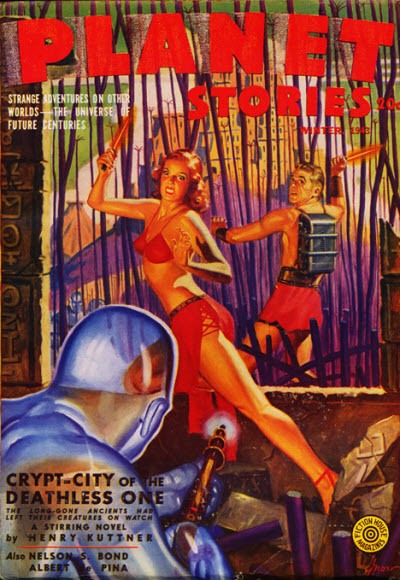
First appearance: Planet Stories, Winter 1943.
Reprints page (HERE).
Novelette (20 pages).
Online at Project Gutenberg (HERE).
(Parental caution: Mild profanity.)
"Revolt was flaring on Callisto, and Peter Duane held the secret that would make the uprising a success or failure. Yet he could make no move, could favor no side—his memory was gone—he didn't know for whom he fought."
It's no surprise that revolutions need guns, in this case four thousand electron rifles; all Peter has to do is sign them away and he's told he'll be allowed to live and even profit—but along with an unexpected case of amnesia Peter has this stubborn streak that will almost certainly get him killed . . .
Main characters:
~ Peter Duane:
". . . looked at the man's eyes. Death was behind them, peeping out."
~ Stevens:
"I've done all the work on this—I've supplied the goods. My price is set, a hundred thousand Earth dollars. What Andrias promised you is no concern of mine. The fact
is that, after I've taken my share, there's only ten thousand left. That's all you get!"
~ Andrias:
"If you had to kill him, it's no skin off my nose."
~ Dakin and Reed:
"Two large, ugly men in field-gray uniforms, emblazoned with the shooting-star insignia of Callisto's League police, came in, looking to Andrias for instructions."
~ The captain of the Cameroon:
". . . it strikes me that you may have lost more than your memory. Which side are
you on."
~ The nurse:
"How's your head . . .?"
Comment: Palace intrigue transferred to the High Frontier; nevertheless, a lot of fun.
References:
- "Muslini, or some such name": A reference to Benito Mussolini ("Il Duce"), the ambitious national socialist dictator of Italy who ended up shot to death and hanged from the rafters; see Wikipedia (HERE).
- "They'd made a prison planet of Callisto; had filled it with the worst scum of Earth.": As a venue for pulp SFF, Callisto, one of Jupiter's 79 known satellites, has long been a favorite. Here are stories that we've already featured which involve Callisto in some way: "Grandma Perkins and the Space Pirates" (HERE), "Daymare" (HERE), "Vanishing Act" (HERE), and "Stellar Showboat" (HERE).
- If you've never seen Mirage (1965), a film that also has a subtext of weapons of mass destruction, Wikipedia has a write-up (WARNING! SPOILERS! HERE).
- FictionMags's list of Frederik George Pohl, Jr.'s other aliases used in his prolific seven-decade career includes Elton V. Andrews, Paul Flehr, Warren F. Howard, Paul Dennis Lavond, James MacCreigh, Scott Mariner, Ernst Mason, Edson McCann, and Charles Satterfield. Plenty of information about this titan of SFF can be found in Wikipedia (HERE), the SFE (HERE), the splendidly comprehensive ISFDb entry (HERE), and the IMDb (HERE), the sparse listing in the last showing how much Hollywood has ignored Pohl.
~~~~~~~~~~~~~~~~~~~~~~~~~~~~~~~~~~~~~~~~~~~~~~~~~~~~~~~~~~~~~~~~~~~~~~~~~
"Conspiracy on Callisto."
By James MacCreigh (Frederik Pohl, 1919-2013).
First appearance: Planet Stories, Winter 1943.
Reprints page (HERE).
Novelette (20 pages).
Online at Project Gutenberg (HERE).
(Parental caution: Mild profanity.)
"Revolt was flaring on Callisto, and Peter Duane held the secret that would make the uprising a success or failure. Yet he could make no move, could favor no side—his memory was gone—he didn't know for whom he fought."
It's no surprise that revolutions need guns, in this case four thousand electron rifles; all Peter has to do is sign them away and he's told he'll be allowed to live and even profit—but along with an unexpected case of amnesia Peter has this stubborn streak that will almost certainly get him killed . . .
Main characters:
~ Peter Duane:
". . . looked at the man's eyes. Death was behind them, peeping out."
~ Stevens:
"I've done all the work on this—I've supplied the goods. My price is set, a hundred thousand Earth dollars. What Andrias promised you is no concern of mine. The fact
is that, after I've taken my share, there's only ten thousand left. That's all you get!"
~ Andrias:
"If you had to kill him, it's no skin off my nose."
~ Dakin and Reed:
"Two large, ugly men in field-gray uniforms, emblazoned with the shooting-star insignia of Callisto's League police, came in, looking to Andrias for instructions."
~ The captain of the Cameroon:
". . . it strikes me that you may have lost more than your memory. Which side are
you on."
~ The nurse:
"How's your head . . .?"
Comment: Palace intrigue transferred to the High Frontier; nevertheless, a lot of fun.
References:
- "Muslini, or some such name": A reference to Benito Mussolini ("Il Duce"), the ambitious national socialist dictator of Italy who ended up shot to death and hanged from the rafters; see Wikipedia (HERE).
- "They'd made a prison planet of Callisto; had filled it with the worst scum of Earth.": As a venue for pulp SFF, Callisto, one of Jupiter's 79 known satellites, has long been a favorite. Here are stories that we've already featured which involve Callisto in some way: "Grandma Perkins and the Space Pirates" (HERE), "Daymare" (HERE), "Vanishing Act" (HERE), and "Stellar Showboat" (HERE).
- If you've never seen Mirage (1965), a film that also has a subtext of weapons of mass destruction, Wikipedia has a write-up (WARNING! SPOILERS! HERE).
- FictionMags's list of Frederik George Pohl, Jr.'s other aliases used in his prolific seven-decade career includes Elton V. Andrews, Paul Flehr, Warren F. Howard, Paul Dennis Lavond, James MacCreigh, Scott Mariner, Ernst Mason, Edson McCann, and Charles Satterfield. Plenty of information about this titan of SFF can be found in Wikipedia (HERE), the SFE (HERE), the splendidly comprehensive ISFDb entry (HERE), and the IMDb (HERE), the sparse listing in the last showing how much Hollywood has ignored Pohl.
~~~~~~~~~~~~~~~~~~~~~~~~~~~~~~~~~~~~~~~~~~~~~~~~~~~~~~~~~~~~~~~~~~~~~~~~~
Wednesday, July 8, 2020
"18, and 9, and 27"
"The Three Numbers."
By "Sapper" (H. C. McNeile, 1888-1937).
First appearance: The Legion Book (1929).
Short story (23 pages as a PDF).
Online at Roy Glashan's Library (HERE).
"And though no such recondite information was necessary in the affair I am about to put down, yet it illustrated very fully his favourite dictum: 'A fact pointing in a certain direction is just a fact: two pointing in the same direction become a coincidence: three—and you begin to get into the regions of certain-ty. But you must be very sure of your facts'."
What begins as a seemingly trivial, even negligible problem in gaslighting escalates into a case of murder, catching Ronald Standish off guard . . .
Principal characters:
~ Sir Richard Burton:
". . . the eminent South American explorer, was brutally murdered last night at Knowle Manor, his house near Pangbourne."
~ Sir John Burton:
"Great Scott! Jobson, it's yet another bit of proof, if more were needed."
~ Inspector Jobson:
"Strange, isn't it, how quite ordinary actions may prove links in the chain that brings a man to the gallows?"
~ Mark Fuller:
"A morose, queer-tempered fellow living by himself, who makes a bare livelihood by market gardening. Officially, that is: unofficially he adds to it by poaching."
~ Ronald Standish:
"'I can't help feeling,' he said two or three times, 'that we're not being very clever about it, Tom. There's something behind it'."
~ Tom Manvers, the narrator:
"It is easy to be wise after the event, and to replay the hand when all the cards are on the table."
Resources:
- "I wanted to play that gramophone or, rather, hear it": See the Wikipedia entry "Phonograph" (HERE).
- "Sapper" was, as many of you know, the nom de plume of Herman Cyril McNeile, creator of Bulldog Drummond, archfoe of any and all enemies of the British Empire; see more about him on Wikipedia (HERE) and Roy Glashan's collection of Ronald Standish stories (HERE).
- We've already featured a couple of Standish adventures: "The Mystery of the Slip-Coach" (HERE) and "The Music-Room" (HERE).
~~~~~~~~~~~~~~~~~~~~~~~~~~~~~~~~~~~~~~~~~~~~~~~~~~~~~~~~~~~~~~~~~~~~~~~~~
By "Sapper" (H. C. McNeile, 1888-1937).
First appearance: The Legion Book (1929).
Short story (23 pages as a PDF).
Online at Roy Glashan's Library (HERE).
"And though no such recondite information was necessary in the affair I am about to put down, yet it illustrated very fully his favourite dictum: 'A fact pointing in a certain direction is just a fact: two pointing in the same direction become a coincidence: three—and you begin to get into the regions of certain-ty. But you must be very sure of your facts'."
What begins as a seemingly trivial, even negligible problem in gaslighting escalates into a case of murder, catching Ronald Standish off guard . . .
Principal characters:
~ Sir Richard Burton:
". . . the eminent South American explorer, was brutally murdered last night at Knowle Manor, his house near Pangbourne."
~ Sir John Burton:
"Great Scott! Jobson, it's yet another bit of proof, if more were needed."
~ Inspector Jobson:
"Strange, isn't it, how quite ordinary actions may prove links in the chain that brings a man to the gallows?"
~ Mark Fuller:
"A morose, queer-tempered fellow living by himself, who makes a bare livelihood by market gardening. Officially, that is: unofficially he adds to it by poaching."
~ Ronald Standish:
"'I can't help feeling,' he said two or three times, 'that we're not being very clever about it, Tom. There's something behind it'."
~ Tom Manvers, the narrator:
"It is easy to be wise after the event, and to replay the hand when all the cards are on the table."
Resources:
- "I wanted to play that gramophone or, rather, hear it": See the Wikipedia entry "Phonograph" (HERE).
- "Sapper" was, as many of you know, the nom de plume of Herman Cyril McNeile, creator of Bulldog Drummond, archfoe of any and all enemies of the British Empire; see more about him on Wikipedia (HERE) and Roy Glashan's collection of Ronald Standish stories (HERE).
- We've already featured a couple of Standish adventures: "The Mystery of the Slip-Coach" (HERE) and "The Music-Room" (HERE).
~~~~~~~~~~~~~~~~~~~~~~~~~~~~~~~~~~~~~~~~~~~~~~~~~~~~~~~~~~~~~~~~~~~~~~~~~
Saturday, July 4, 2020
"Eliminate Distractions (and Humans)"
"The Seven Billion Habits of Highly Effective Robots."
By Aidan Doyle (born 1974).
First appearance: Daily Science Fiction, June 20, 2020.
Short short short story (4 pages).
Online at Daily Science Fiction (HERE).
Even murderous automatons can benefit from suggestions once in while . . .
Resources:
- The title parodies that of one of the most successful self-help books of recent times,
The 7 Habits of Highly Effective People by Stephen R. Covey (Wikipedia HERE).
- Also see Danielle Ryan's article at Fandom.com (HERE).
- Aidan Doyle's weblog is (HERE) and his ISFDb page is (HERE).
~~~~~~~~~~~~~~~~~~~~~~~~~~~~~~~~~~~~~~~~~~~~~~~~~~~~~~~~~~~~~~~~~~~~~~~~~
By Aidan Doyle (born 1974).
First appearance: Daily Science Fiction, June 20, 2020.
Short short short story (4 pages).
Online at Daily Science Fiction (HERE).
Even murderous automatons can benefit from suggestions once in while . . .
Resources:
- The title parodies that of one of the most successful self-help books of recent times,
The 7 Habits of Highly Effective People by Stephen R. Covey (Wikipedia HERE).
- Also see Danielle Ryan's article at Fandom.com (HERE).
- Aidan Doyle's weblog is (HERE) and his ISFDb page is (HERE).
~~~~~~~~~~~~~~~~~~~~~~~~~~~~~~~~~~~~~~~~~~~~~~~~~~~~~~~~~~~~~~~~~~~~~~~~~
Wednesday, July 1, 2020
"It Meant That There Was Murder in the Air"
"Mind Over Matter."
By Ellery Queen (1905-82; 1905-71).
Illustrations by Charles Chickering (1891-1970).
First appearance: The Blue Book Magazine, October 1939.
Reprinted in The 20-Story Magazine, April 1940; Ellery Queen’s Mystery Magazine (EQMM), September 1962; EQMM (U.K.), January 1963; and EQMM (Australia), March 1963.
Other reprints: The New Adventures of Ellery Queen (1940) and Masterpieces of Mystery, The Golden Age, Volume 2 (1977).
Adapted for radio as "The Fallen Gladiator" (CBS, July 7, 1940; repeated September 16 or 18, 1943; HERE: Scroll down to number 56).
Short story (13 pages).
Online at Archive.org (HERE).
(Note: Pages faded but readable.)
(Parental note: Mild profanity.)
"Specifically, his six-foot body was taut as a violin-string. It was a familiar but always menacing phenomenon."
You'd expect some mayhem in a boxing match, but not when the fight's over—the bloody and highly perforated corpse of the heavyweight champ curled up in a car being eloquent evidence of murder most foul. While clues are sparse, to Ellery Queen, master detective, it's the theft of his own camel's-hair coat that "has everything to do with it" . . .
Cast (in order of appearance):
~ Paula Paris:
"Aren't you disappointed too, that you can't buy a ticket to the fight?"
~ Inspector Richard Queen:
"He's afraid somebody will knock somebody off."
~ Ellery Queen (a.k.a. "Master Mind"):
"Well, doesn't somebody always?"
~ Phil Maguire:
". . . picked them up that evening in his cranky little sports roadster and they all drove uptown to the Stadium together to see the brawl."
~ Happy Day:
". . . was visible a few rows off, an expensive Panama resting on a fold of neck-fat. He
had a puffed face the color of cold rice pudding, and his eyes were like raisins."
~ Ivy Brown:
". . . was a full-blown female with a face like a Florentine cameo."
~ Ollie Storn:
". . . pays a lot of attention in public to the champ's wife."
~ Jim Koyle:
"He was met by a roar, like the roar of a river at flood-tide bursting its dam."
~ Barney Hawks:
"His manager, Barney Hawks, followed him into the ring. Hawks too was big,
but beside his fighter he appeared puny."
~ Mike Brown:
"They hate his insides because he's an ornery, brutal, crooked slob with
the kick of a mule and the soul of a pretzel."
~ Storn's chauffeur:
". . . a tough-looking customer . . ."
~ Hymie Oetjens:
"I don't want no trouble, no trouble."
Resources:
- For a detailed rundown on the "sport" of boxing, see Wikipedia (HERE).
- "the way Firpo was": "Luis Ángel Firpo (October 11, 1894 – August 7, 1960) was an Argentine boxer. Born in Junín, Argentina, he was nicknamed The Wild Bull of the Pampas." (Wikipedia HERE).
- "full of more curves and detours than the Storm King highway": See Wikipedia (HERE).
- Reading Ellery Queen briefly highlights our story (HERE).
- Our last encounter with Ellery Queen the fiction writer rather than Ellery Queen the fiction editor was over a year ago, with a text version of one of their radio plays also featuring a boxing background, "The Adventure of the Mouse's Blood" (HERE).
~~~~~~~~~~~~~~~~~~~~~~~~~~~~~~~~~~~~~~~~~~~~~~~~~~~~~~~~~~~~~~~~~~~~~~~~~
By Ellery Queen (1905-82; 1905-71).
Illustrations by Charles Chickering (1891-1970).
First appearance: The Blue Book Magazine, October 1939.
Reprinted in The 20-Story Magazine, April 1940; Ellery Queen’s Mystery Magazine (EQMM), September 1962; EQMM (U.K.), January 1963; and EQMM (Australia), March 1963.
Other reprints: The New Adventures of Ellery Queen (1940) and Masterpieces of Mystery, The Golden Age, Volume 2 (1977).
Short story (13 pages).
Online at Archive.org (HERE).
(Note: Pages faded but readable.)
(Parental note: Mild profanity.)
"Specifically, his six-foot body was taut as a violin-string. It was a familiar but always menacing phenomenon."
You'd expect some mayhem in a boxing match, but not when the fight's over—the bloody and highly perforated corpse of the heavyweight champ curled up in a car being eloquent evidence of murder most foul. While clues are sparse, to Ellery Queen, master detective, it's the theft of his own camel's-hair coat that "has everything to do with it" . . .
Cast (in order of appearance):
~ Paula Paris:
"Aren't you disappointed too, that you can't buy a ticket to the fight?"
~ Inspector Richard Queen:
"He's afraid somebody will knock somebody off."
~ Ellery Queen (a.k.a. "Master Mind"):
"Well, doesn't somebody always?"
~ Phil Maguire:
". . . picked them up that evening in his cranky little sports roadster and they all drove uptown to the Stadium together to see the brawl."
~ Happy Day:
". . . was visible a few rows off, an expensive Panama resting on a fold of neck-fat. He
had a puffed face the color of cold rice pudding, and his eyes were like raisins."
~ Ivy Brown:
". . . was a full-blown female with a face like a Florentine cameo."
~ Ollie Storn:
". . . pays a lot of attention in public to the champ's wife."
~ Jim Koyle:
"He was met by a roar, like the roar of a river at flood-tide bursting its dam."
~ Barney Hawks:
"His manager, Barney Hawks, followed him into the ring. Hawks too was big,
but beside his fighter he appeared puny."
~ Mike Brown:
"They hate his insides because he's an ornery, brutal, crooked slob with
the kick of a mule and the soul of a pretzel."
~ Storn's chauffeur:
". . . a tough-looking customer . . ."
~ Hymie Oetjens:
"I don't want no trouble, no trouble."
- For a detailed rundown on the "sport" of boxing, see Wikipedia (HERE).
- "the way Firpo was": "Luis Ángel Firpo (October 11, 1894 – August 7, 1960) was an Argentine boxer. Born in Junín, Argentina, he was nicknamed The Wild Bull of the Pampas." (Wikipedia HERE).
![]() |
| "Dempsey and Firpo" (1923) by George Bellows. |
- Reading Ellery Queen briefly highlights our story (HERE).
- Our last encounter with Ellery Queen the fiction writer rather than Ellery Queen the fiction editor was over a year ago, with a text version of one of their radio plays also featuring a boxing background, "The Adventure of the Mouse's Blood" (HERE).
~~~~~~~~~~~~~~~~~~~~~~~~~~~~~~~~~~~~~~~~~~~~~~~~~~~~~~~~~~~~~~~~~~~~~~~~~
Saturday, June 27, 2020
"I'm Going To Blow a Hole Through Your Back Some Night"
"Destination—Death."
By Wilbur S. Peacock (1911/15-1979).
First appearance: Planet Stories, Winter 1943.
Short story (11 pages).
Online at Project Gutenberg (HERE).
(Parental note: Mild profanity.)
By Wilbur S. Peacock (1911/15-1979).
First appearance: Planet Stories, Winter 1943.
Short story (11 pages).
Online at Project Gutenberg (HERE).
(Parental note: Mild profanity.)
"One man had to die on Uranus' frozen crust, so that the other might live."
The perfect place for murder: millions of miles from the heavily traveled space lanes. The perfect plan: murdering your partner, claiming it was an accident, and cashing in on a fortune in kronalium. The only problem: the unforseen; the unanticipated elements that, in this instance, leave "plans in an awful mocking silence" . . .
Major characters:
~ Tom Headley:
". . . worked with the quiet sureness of a man whose life had been self-sufficient."
~ Bart Caxton:
". . . worked with the grim doggedness of a man who knows that his life hinges
upon his speed in working."
Typo: "three graves" [probably gravs was meant].
Resources:
- While the planet Uranus hasn't been showcased in SFF as often as Venus, Mars, and so forth, it has appeared surprisingly often; see Wikipedia (HERE) for scientific fact about Uranus and (HERE) for science fiction about same. Does it rain diamonds on Uranus?
See Wikipedia (HERE) for that speculation.
- The FictionMags thumbnail about Wilbur Scott Peacock: "Editor, writer of short stories and television scripts. Born in Kansas; died in Los Angeles, California." Peacock cruised through the usual pulp venues, ambidextrously producing Westerns, crime fiction, and SFF with equal ease. Also see the ISFDb (HERE) and the IMDb (HERE).
- Another pulpy Planet Stories concoction by Peacock is "Spider Men of Gharr," online at Comic Book Plus (HERE; select page 56 from the dropdown menu).
- Several Hollywood films with somewhat similar situational and character set-ups but entirely different settings and resolutions are discussed (SPOILERS: HERE, HERE, and HERE).
~~~~~~~~~~~~~~~~~~~~~~~~~~~~~~~~~~~~~~~~~~~~~~~~~~~~~~~~~~~~~~~~~~~~~~~~~
The perfect place for murder: millions of miles from the heavily traveled space lanes. The perfect plan: murdering your partner, claiming it was an accident, and cashing in on a fortune in kronalium. The only problem: the unforseen; the unanticipated elements that, in this instance, leave "plans in an awful mocking silence" . . .
Major characters:
~ Tom Headley:
". . . worked with the quiet sureness of a man whose life had been self-sufficient."
~ Bart Caxton:
". . . worked with the grim doggedness of a man who knows that his life hinges
upon his speed in working."
Typo: "three graves" [probably gravs was meant].
Resources:
- While the planet Uranus hasn't been showcased in SFF as often as Venus, Mars, and so forth, it has appeared surprisingly often; see Wikipedia (HERE) for scientific fact about Uranus and (HERE) for science fiction about same. Does it rain diamonds on Uranus?
See Wikipedia (HERE) for that speculation.
- The FictionMags thumbnail about Wilbur Scott Peacock: "Editor, writer of short stories and television scripts. Born in Kansas; died in Los Angeles, California." Peacock cruised through the usual pulp venues, ambidextrously producing Westerns, crime fiction, and SFF with equal ease. Also see the ISFDb (HERE) and the IMDb (HERE).
- Another pulpy Planet Stories concoction by Peacock is "Spider Men of Gharr," online at Comic Book Plus (HERE; select page 56 from the dropdown menu).
- Several Hollywood films with somewhat similar situational and character set-ups but entirely different settings and resolutions are discussed (SPOILERS: HERE, HERE, and HERE).
~~~~~~~~~~~~~~~~~~~~~~~~~~~~~~~~~~~~~~~~~~~~~~~~~~~~~~~~~~~~~~~~~~~~~~~~~
Subscribe to:
Posts (Atom)